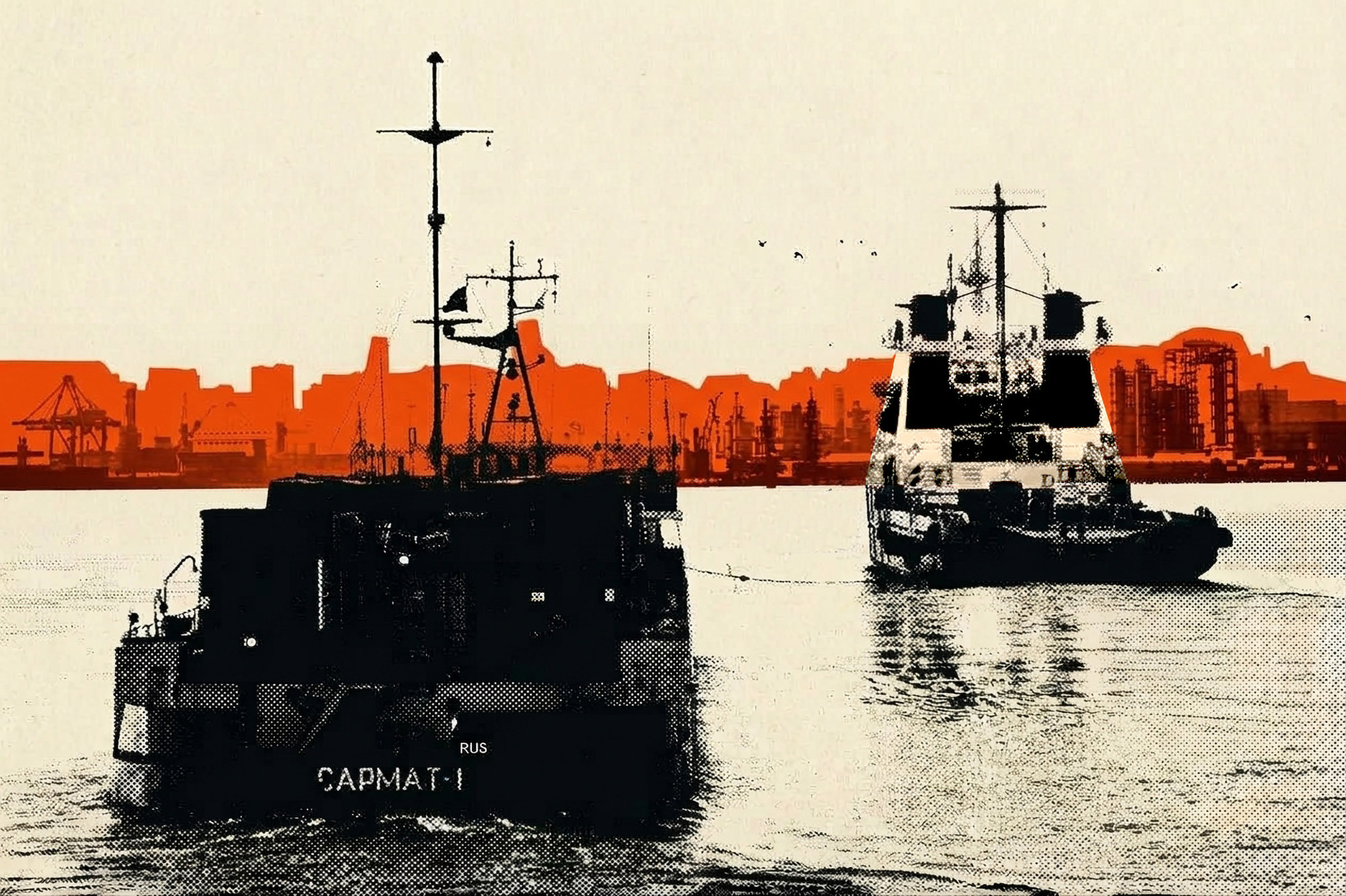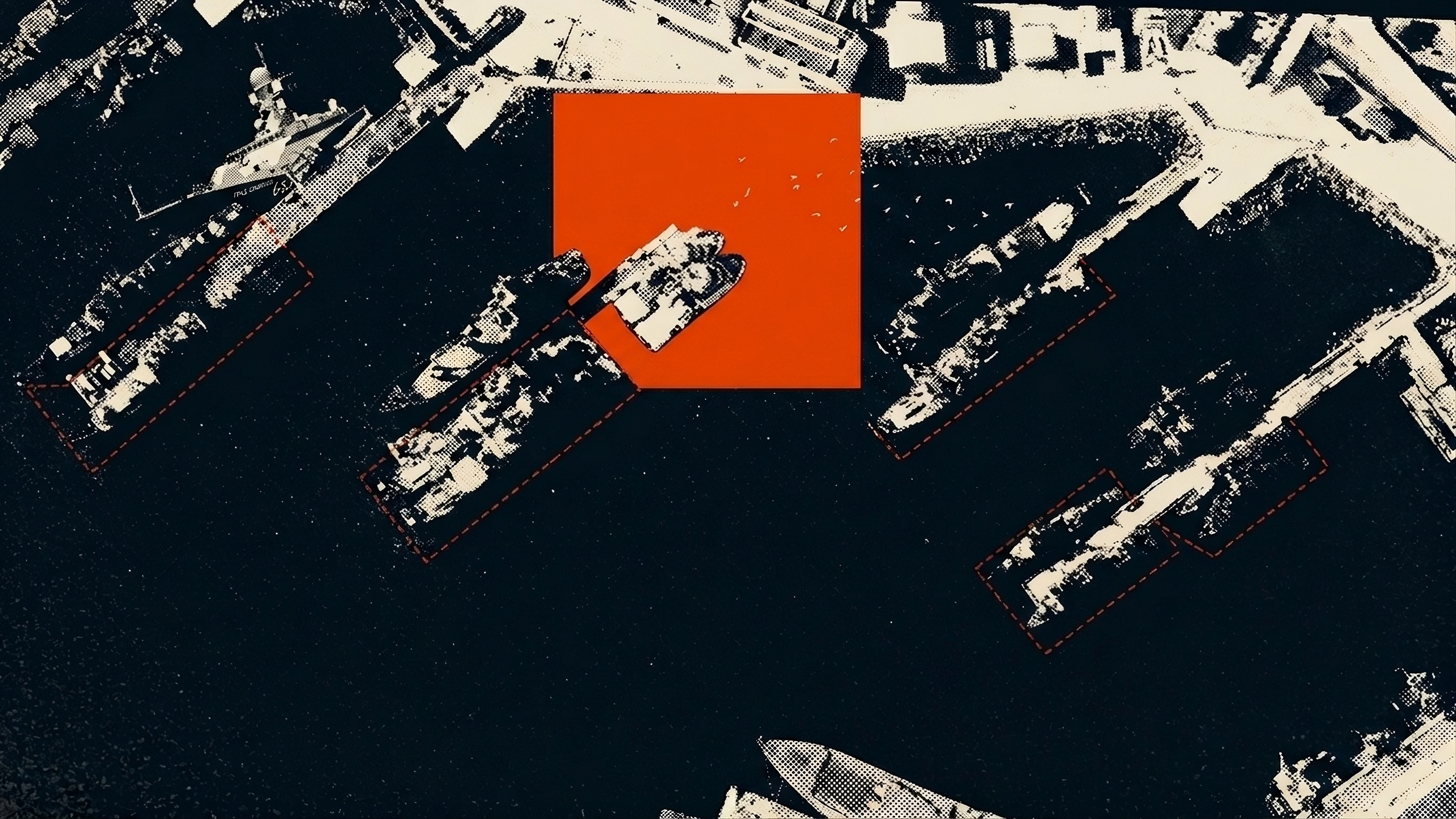
§ 01 · ContextThree Fleets Within Range
Since the start of the full-scale invasion, Russia has deployed the full spectrum of available strike capabilities against Ukraine. Alongside tactical ballistic missiles, aircraft, and long-range artillery — the naval component has been used systematically: ship-based carriers of long-range cruise missiles.
Three operational-strategic formations of the Russian Navy are within reach of Ukraine — the Black Sea Fleet, the Caspian Flotilla, and the Baltic Fleet. All are armed with Caliber cruise missile carriers — the primary means of long-range sea-based strikes against land targets.
Ukrainian intelligence has nonetheless operated in the Baltic as well — in 2024, the HUR MO conducted a special operation against one of the small missile ships that was preparing for transfer to the Black Sea Fleet. Details on this episode will be covered separately in a later installment of this series.
§ 02 · InfrastructureThe Montreux Convention and Inland Waterways
It is worth explaining why three Russian fleets can cooperate and transfer ships between theatres at all — and why the closure of the Turkish straits did not isolate the Black Sea from the rest of the Russian Navy as it might have appeared at first glance.
The Montreux Convention is a 1936 international treaty governing navigation through the Turkish Straits of Bosphorus and Dardanelles. It gives Turkey the right to control the transit of warships, and in wartime — under Article 19 — Ankara is obliged not to permit passage to warships of belligerents unless Turkey itself is a party to the conflict. On 27 February 2022, Turkey formally classified the Russian invasion as a war and invoked Article 19 — closing the Straits to Russian and Ukrainian warships alike.
No new Russian Navy warship can enter the Black Sea from outside. However, Russia could not fully exploit even the exception the Convention provides — the right for ships to return to their home base: the frigate Admiral Grigorovich and two Project 636.3 submarines (Novorossiysk and Stary Oskol), which were in the Mediterranean and Baltic at the time, never made it back to the Black Sea Fleet.
Yet the closure of the Straits did not isolate the Black Sea from the rest of the Russian Navy — and here is why. Dating back to Soviet times, Russia has a sprawling inland waterway network connecting all four of its naval theatres — Baltic, White Sea, Caspian, and Black Sea — into a single continuous water corridor. The key links in this network are the Volga-Don Canal, connecting the Caspian with the Sea of Azov and Black Sea, and the Volga-Baltic Waterway, linking the Baltic to the Caspian and onwards to the Black Sea.
Volga-Don
Volga-Balt
The lock dimensions of both systems allow the transfer of ships up to 145 metres long, 17 metres wide, and with a draught of 3.5–4 metres. This fits the small missile ships of Projects 21631 Buyan-M and 22800 Karakurt — the main Caliber carriers of the new generation. The Buyan-M was specifically designed as a river-sea vessel precisely to allow rapid redeployment via inland waterways — and Russia has made active use of this capability.
In 2024, from the Kerch shipyard Zaliv — where two Karakurts were being built for the BSF — the ship Tucha was transferred to the Caspian (entered service with the Caspian Flotilla on 24 December 2024), while Amur took an even longer route: first to the Caspian (entered service 26 August 2024), then in November 2025 to the Baltic, to Kronstadt. Another Buyan-M, Naro-Fominsk, was transferred in 2024 via inland waterways from Zelenodolsk (Tatarstan) to Baltiysk. These are only selected examples — a detailed review of ship movements will follow in later installments.
§ 03 · ArmamentWhy Caliber?
Russian Navy ships are armed with various missile types — Moskit, Uran, Termit, Oniks, Zircon. Yet virtually all documented strikes against land targets in Ukraine from ships have used the Caliber cruise missile, index 3M14, NATO designation SS-N-30A Sagaris. To understand why, it is worth briefly examining the full spectrum of Russian naval missile weapons and Caliber's place within it.
What Caliber is and why it leads
Caliber is a subsonic long-range cruise missile for strikes against land targets. It is launched from the universal shipborne firing complex (UKSK) 3S14. The manufacturer's stated maximum range is up to 2,600 km, but actual strikes against Ukraine from the Black Sea and Caspian indicate an effective range of around 1,500–1,700 km — consistent with expert assessments by the OBOZ / Informational Resistance project.[1]
Stated range: 2,600 km, but actual strikes against Ukraine do not exceed 1,700.
High-explosive. Flight altitude: 50–150 m over land, ~20 m over water.
HUR and RBC-Ukraine estimate. Estimated stockpile as of 06.2025: ~150 units.
Guidance: inertial-satellite. Low-altitude flight profile complicates air defences.
Caliber production is constrained: according to HUR and RBC-Ukraine estimates, Russian industry produces 25–30 missiles per month.[2] Total stockpile as of June 2025 was estimated at 150 units. This explains why massed Caliber launches have long alternated with strikes by air-launched Kh-101 and ballistic Iskander missiles — the naval component is a scarce resource that Russia deploys in measured doses.
The other missiles: why they do not strike Ukraine from ships
Other missile types aboard Russian Navy ships serve fundamentally different roles — and that is precisely why they are not used against land targets in Ukraine. In brief: Moskit, Uran, and Termit are anti-ship missiles with ranges of 80 to 260 kilometres. They are designed to destroy enemy surface vessels, not land targets. No confirmed launches of these missiles from ships against Ukrainian territory have been recorded. Oniks (P-800) has been used by Russia against Ukraine from the shore-based Bastion complex in Crimea — but that is a different, land-based system.
Also worth mentioning is Vulkan (P-1000) — a powerful long-range anti-ship missile with a range of up to 700 km. Its only carrier, the cruiser Moskva, was destroyed on 14 April 2022 by Ukrainian Neptune anti-ship missiles. Along with the cruiser, Russia lost the only ship carrying this system in the region.
Finally, Zircon (3M22) — a next-generation hypersonic missile with a range of up to 1,000 km and speed of Mach 8–9. Potentially the most dangerous system in the Russian Navy's arsenal. However, its combat launches have so far only been recorded in test mode from the Northern Fleet frigate Admiral Gorshkov. No confirmed Zircon strikes against Ukraine from Russian Navy ships have been recorded.
| Missile | Role | Range | Speed | Strikes vs UA from sea |
|---|---|---|---|---|
| Caliber3M14 / SS-N-30A | land targets | up to 2,600 kmeffective ~1,500–1,700 | 0.8 M | Yes — primary |
| Caliber3M54 (ASuW) | anti-ship | up to 660 km | up to 2.9 M | Not confirmed |
| OniksP-800 | land / sea | up to 600 km | 2.5 M | Not from shipsshore-based Bastion |
| Zircon3M22 | hypersonic, land | up to 1,000 km | 8–9 M | Not confirmed |
| Moskit3M80 | anti-ship | up to 120 km | 2.5 M | Not confirmedshort range |
| UranKh-35, Harpoon analogue | ASuW | up to 260 km | 0.8 M | Not from shipsshore-based Bal |
| TermitP-15M | legacy ASuW | up to 80 km | 0.9 M | Not confirmed |
| VulkanP-1000 | long-range ASuW | up to 700 km | 2.5 M | Carrier destroyedMoskva · 14.04.2022 |
Caliber remains the only Russian naval weapon that is systematically and confirmed used against land targets in Ukraine. This is why the analysis of the naval missile threat is first and foremost an analysis of Caliber carriers.
The information trail: how the Russian MoD's public rhetoric has shifted
It is worth noting the dynamics of information management. In 2022, the Russian Ministry of Defence actively published video footage of Caliber launches from all available carriers — frigates, small missile ships, submarines. Launch footage from decks and from underwater became a standard feature of weekly briefings and appeared in state media as proof of the fleet's "technological superiority." From 2023, official publications of ship-launched Caliber footage virtually ceased — despite the launches themselves continuing. The most likely explanation: Russia's reluctance to reveal the current positions of carriers given the risk of Ukrainian strikes before they complete their mission. Archive of 2022 launches below.
Пуски «Калібрів» — публікації МО РФ
Launches filmed from the shore by chance witnesses
§ 04 · CarriersSeven Projects, Three Categories
The Russian Navy fields seven ship and submarine designs claimed by manufacturers as Caliber cruise missile carriers. But the real picture differs significantly from the official one. Six of the seven designs are genuine carriers with the system installed and confirmed operational. The seventh — the Project 22160 patrol ships of the Vasily Bykov class — has for years been cited in public discourse as a missile carrier, despite no Caliber launch from these ships having ever occurred in combat, and none likely in the near future.
| Project | Type | Salvo | Built / ordered | Distribution | Strikes vs UA |
|---|---|---|---|---|---|
Proj. 11356R Admiral Grigorovich frigate · Krivak V | frigate | 8 | 3 / 6 | BSF — 3 | Yes |
Proj. 11661K Gepard patrol ship | patrol | 8 | 1 / 1 | Caspian — 1 | Yes |
Proj. 21631 Buyan-M MRK · river-sea | MRK | 8 | 11 / 12 | BSF — 4, Caspian — 3, BF — 4 | Yes |
Proj. 22800 Karakurt MRK next generation | MRK | 8 | 9 / 16 | BSF — 5 planned (2 destroyed, 3 transferred), BF — 4 | Yes |
Proj. 636.3 Varshavyanka diesel submarine · Improved Kilo | SSK | 4 | 6 / 6 | BSF — 6 (nominal) | Yes |
Proj. 877V Paltus diesel submarine · Alrosa | SSK | 4 | 1 / 1 | BSF — 1 | Not confirmed |
Proj. 22160 Vasily Bykov patrol — claimed carrier | patrol | — | 4 / 6 | BSF — 4 | Not confirmed |
Expand any project below to see a detailed dossier with specifications, fleet roster, and timeline of key events. The six genuine carriers are split into three categories — surface ships, MRKs, and submarines.
proj.11356RSurface carrier · Black Sea FleetAdmiral Grigorovich-class frigates3 units in service · Krivak V (NATO) · 8 Calibers per ship
The most capable surface Caliber carriers in the Black Sea Fleet. Multi-role second-rank frigates developed by the Northern Design Bureau on the basis of the export Talwar project, previously built for the Indian Navy.
The programme originally envisaged six units for the BSF: the first three were to enter service by 2017, the next three by 2020. The programme was cut short after Ukraine's Revolution of Dignity — when Ukraine refused to supply gas turbine units. The Mykolaiv enterprise Zorya-Mashproekt had time to deliver only three GTU sets — for Admiral Grigorovich, Admiral Essen, and Admiral Makarov. The remaining three — Butakov, Istomin, Kornilov — were left without engines.
The Russian replacement — GTU M90FR by NPO Saturn — took over eight years to develop. In 2019 Russia announced the resumption of construction, but as of 2026 none of the three incomplete frigates have entered service with the BSF. Instead, Russia agreed to complete two of them for the Indian Navy — under a $1.2 billion contract.
Frigate silhouette
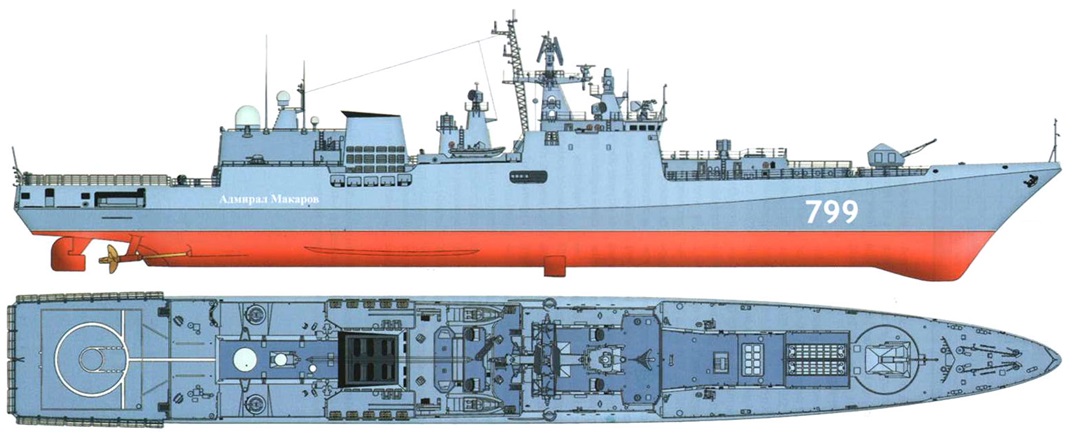
Specs · Project 11356R
In service · 30th BSF Division
- Admiral Grigorovich
hull 49411.03.2016 - Admiral Essen
hull 49007.06.2016 - Admiral Makarov
hull 49927.12.2017
Incomplete (no GTU)
- Admiral Butakovfor Indian Navy
- Admiral Istominfor Indian Navy
- Admiral Kornilovstatus unknown
Key wartime events
- 24.02.2022Admiral Grigorovich — blocked in the Mediterranean, never returned to BSF (Montreux)
- 2022–2025All three frigates in service — confirmed Caliber launches against Ukraine
- 2023Redeployment from Sevastopol to Novorossiysk
Detailed chronicle of all three hulls — in «Russian Navy Frigates. Four Years of War at Sea» →
proj.11661KSurface carrier · Caspian FlotillaGepard patrol ships2 units · radically different armament · Dagestan — pioneer of Caliber
A series of third-rank patrol ships designed by the Zelenodolsk Design Bureau in the late 1980s as a replacement for ageing Soviet Project 1135 patrol vessels. Eight units were originally planned, but after the USSR's collapse the programme was sharply cut: only two were built for the Russian Navy — Tatarstan and Dagestan, both serving in the Caspian Flotilla.
A defining feature of this class: the two ships have radically different armament, despite their similar appearance. Tatarstan retained its original armament — Uran (Kh-35) anti-ship missiles with a range of up to 130 km. It cannot strike Ukraine. Dagestan was completed to a revised design and received the UKSK 3S14 for Caliber-NK — becoming the first-ever Caliber carrier in the Russian Navy, ahead of all other designs including the Buyan-Ms and Karakurts.
On 7 October 2015, Dagestan together with three Buyan-Ms carried out the first-ever combat Caliber launches from the Caspian against ISIS positions in Syria — the world premiere of the system.[3]
On 6 November 2024, both Gepards sustained what appear to be damage at Kaspiysk from a Ukrainian A-22 Flying Fox kamikaze drone strike covering approximately 1,500 kilometres — the first-ever Ukrainian strike against the Caspian Flotilla.[4]
Silhouette
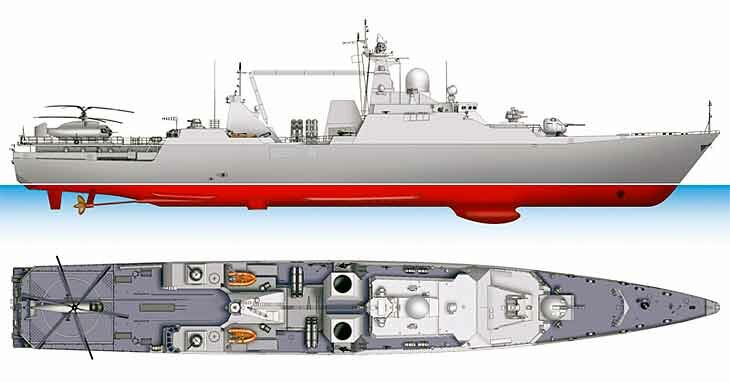
Specs · Project 11661K
2 ships · Caspian Flotilla
Without Caliber — Uran ASuW
- Tatarstan
hull 691 · CF flagship 2003–201731.08.2003
Caliber carrier — UKSK 3S14
- Dagestan
hull 693 · CF flagship from 201728.11.2012
Key events
- 07.10.2015Dagestan — first ever combat Caliber launch in history (against ISIS, Syria)
- 02–05.2022Caliber launches against Ukraine from the Caspian
- 06.11.2024Both ships — likely damage from A-22 drones (1,500 km to target)
proj.21631MRK · all three fleetsBuyan-M small missile ships11 units in service · river-sea class · Russia's most numerous Caliber carrier
The most numerous and best-known Caliber carrier in the Russian Navy. A third-rank small missile ship displacing less than a thousand tonnes, designed by the Zelenodolsk Design Bureau as the cheapest possible river-sea Caliber carrier.
It was from Buyan-Ms alongside Dagestan that the first-ever combat Caliber launches against Syria took place in October 2015 — and that was when the world first saw this weapon in action.
The key design feature is a shallow draught of around 2.6 m, allowing the ships to transit inland waterways between the Caspian, Black Sea, and Baltic. The Buyan-M was designed precisely for this — as a platform that can be rapidly redeployed between theatres without the restrictions of the Montreux Convention.
MRK silhouette
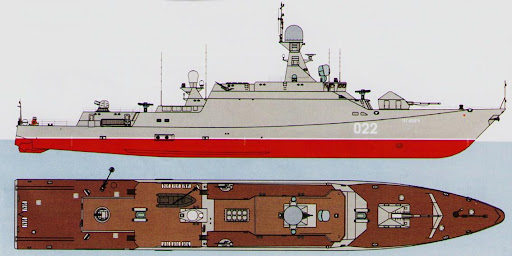
Specs · Project 21631
11 ships · 3 fleets
Black Sea Fleet · 4
- Vyshniy Volochek
hull 60901.06.2018 - Orekhovo-Zuyevo
hull 62610.12.2018 - Ingushetiya
hull 60028.12.2019 - Grayvoron
hull 62230.01.2021
Caspian Flotilla · 3
- Grad Sviyazhsk
hull 02127.07.2014 - Uglich
hull 02227.07.2014 - Veliky Ustyug
hull 02319.12.2014
Baltic Fleet · 4 (+1 in trials)
- Zeleny Dol
hull 562 · built for BSF12.12.2015 - Serpukhov
hull 567 · HUR special op. 04.202412.12.2015 - Grad
hull 57529.12.2022 - Naro-Fominsk
hull 577 · transferred from Zelenodolsk25.12.2023 - Stavropol
12th unit · in trials— 2026
proj.22800MRK · BSF series destroyed / transferredKarakurt small missile shipsBuyan-M successor with Pantsir-M · of 5 BSF ships — not one reached combat as part of BSF
The Karakurt was conceived as the next generation of small missile ships — a Buyan-M successor with better seakeeping, a more capable air defence system, and improved electronics. Armament is the same UKSK 3S14 with 8 Calibers or Oniksas, but instead of the weak Gibka SAM, from the third ship of the series onwards a naval variant of the Pantsir-M CIWS is fitted — significantly more serious protection against aerial targets.
Russia's Ministry of Defence originally ordered 18 units from five shipyards. In 2020, the contract with Vostochnaya Verf was cancelled — effectively 16 ships are being built. The programme ran into the same sanctions constraints as the Buyan-M: Ukrainian GTUs were replaced with Russian diesels, pushing delivery dates back 4–6 years.
The BSF series: five ships, none reached their goal
Tsiklon — the only one of the five to officially enter BSF service, on 12 July 2023. But on 4 September 2023 it was struck by a Ukrainian missile attack in Sevastopol and put out of action. The ship effectively completed zero combat launches as part of the fleet.[5]
Askold was destroyed before formally entering fleet service — by a strike on the Zaliv shipyard in Kerch. The ship was lost on the slipway.[6]
Amur, Tucha, and Tayfun — Russia decided not to risk these and transferred them via inland waterways away from the strike zone (see the transfer table in the Montreux section).
None of the five Karakurts ordered for the Black Sea Fleet ever joined its combat strength in any meaningful sense — two were destroyed, three were transferred to other theatres.
Silhouette
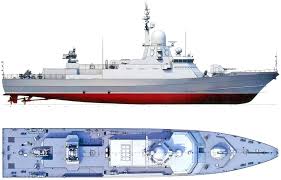
Specs · Project 22800
BSF-designated · 5 (none in BSF)
- Tsiklon
Kerch · entered 12.07.2023, struck 04.09.2023LOST - Askold
Kerch · destroyed on slipwayLOST - Amur
Kerch → Caspian → Baltic (Kronstadt)11.2025 - Tucha
Zelenodolsk → Caspian24.12.2024 - Tayfun
Zelenodolsk → Caspian28.08.2025
Baltic Fleet · 5
- Mytishchi
lead ship17.12.2018 - Sovetsk
—12.10.2020 - Odintsovo
first with Pantsir-M21.11.2020 - Burya
Pantsir-M trials 03.202608.05.2026 - Kozelsk
final fitting-out— 2026
Pacific Fleet · 4 (outside UA theatre)
- Rzhev · Udomlya · Pavlovsk · Ussuriysk2025+
proj.636.3SSK · the hidden componentVarshavyanka submarines6 units · 4 Caliber-PL via torpedo tubes · NATO: Improved Kilo
A series of diesel-electric submarines of the third generation, developed by TsKB Rubin on the basis of the Soviet Project 877 Paltus. The 636.3 modification represents the first Russian Navy SSKs built specifically to carry the Caliber-PL submarine missile system, fired through torpedo tubes.
Six units were built for the Black Sea Fleet in 2014–2016 — the largest and most modern submarine force Russia has deployed in the region. Under NATO classification, these submarines were designated Improved Kilo and gained a reputation as some of the quietest diesel submarines in the world.
On 24 February 2022, two submarines of the class found themselves effectively blocked outside the Black Sea — Novorossiysk and Stary Oskol were undergoing repairs at Kronstadt, and after the closure of the Bosphorus and Dardanelles they could not return to the BSF. Both formally remain on the Black Sea Fleet roster, but are physically in the Gulf of Finland. They are unavailable for strikes against Ukraine.
Four submarines remained in the Black Sea. Here open sources have recorded unprecedented results.
On 13 September 2023, Rostov-on-Don was struck by Storm Shadow cruise missiles while in dry dock at the Sevastopol Maritime Plant. On 2 August 2024, a repeated Ukrainian strike definitively destroyed the vessel.[7]
On 15 December 2025, Ukraine's Security Service struck with Sub Sea Baby underwater drones at Novorossiysk — hitting another Varshavyanka. According to the Ukrainian Navy's assessment, after this strike only two combat-ready Caliber-capable submarines remained in the Black Sea.[8]
Silhouette
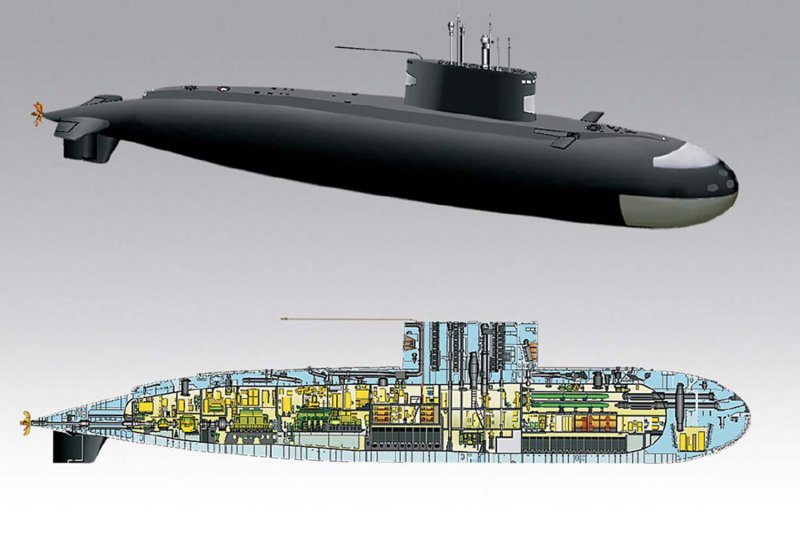
Specs · Project 636.3
6 submarines · BSF
In the Black Sea
- B-237 Rostov-on-Don
destroyed 02.08.2024 (second strike)LOST - B-265 Krasnodar
operationally active05.11.2015 - B-268 Veliky Novgorod
operationally active26.10.2016 - B-271 Kolpino
operationally active24.11.2016
"Locked" in the Baltic
- B-261 Novorossiysk
repair Kronstadt · inaccessible22.08.2014 - B-262 Stary Oskol
repair Kronstadt · inaccessible03.07.2015
15.12.2025 — one of the three active submarines struck at Novorossiysk (hull not officially named). Combat-ready: 2 units.
Loss timeline · 2022–2025
- 2022 – onwardsCaliber combat launches against Ukraine from submerged position
- 13.09.2023Rostov-on-Don — struck by Storm Shadow in dry dock at Sevastopol
- 02.08.2024Rostov-on-Don — definitively destroyed by second strike
- 15.12.2025SBU Sub Sea Baby underwater drone strike at Novorossiysk
proj.877VSSK · disputed statusAlrosa — the oldest submarine in the BSF1 unit · unique pump-jet propulsion · claimed as Caliber carrier, but unconfirmed
A separate and far less straightforward story — B-871 Alrosa, the only older Project 877V submarine in the Black Sea Fleet. Built at Krasnoe Sormovo in Nizhny Novgorod and commissioned on 1 December 1990, Alrosa is the oldest submarine in the BSF.
Its unique design feature: instead of a propeller it has a pump-jet propulsion system, making it the quietest vessel in its class.
In 2014, Alrosa was sent for repair and modernisation at the 13th BSF ship repair plant in Sevastopol. Russian state media — TASS and Lenta.ru — claim the modernisation gave the submarine the ability to use Caliber-PL cruise missiles through its torpedo tubes.[9] On 16 May 2022, Russia announced Alrosa returning to service specifically as a Caliber carrier.
The Russians have repeatedly claimed that Alrosa was modified to launch Calibers, but this information remains unconfirmed. — Dmytro Pletenchuk, spokesperson of the Ukrainian Navy, February 2024
According to OSINT analysts and leaks from Russian sources (VChK-OGPU, 2025), the submarine has not carried out any combat cruise missile launches, has not entered the exclusive maritime zone to use weapons, and has spent most of its time at Sevastopol's Kilen Bay undergoing repairs.[10]
Alrosa's real combat capability as a Caliber carrier remains doubtful. In this article it is listed as a claimed carrier — with a caveat on the level of verification.
Silhouette
Specs · Project 877V
1 submarine · BSF
- B-871 Alrosa
4th Separate SSK Brigade BSF · unit 8051501.12.1990
Key milestones
- 03.1992Attempt to transfer to Ukrainian flag
- 2004Named Alrosa
- 2014Withdrawn for repair and modernisation
- 05.2022Russia announces return to service with Calibers
- 02.2024Ukrainian Navy: Caliber modification unconfirmed
- 06.2025Leaks from Russian sources: submarine effectively non-operational
§ 05 · ClarificationWhy Project 22160 Vasily Bykov Is Not a Missile Carrier
In public discourse — both Ukrainian and Russian — the Project 22160 patrol ships of the Vasily Bykov class are often listed among Caliber carriers. This is an established misconception long perpetuated by Russian propaganda itself. In fact, no Project 22160 ship in the Russian Navy has ever launched a Caliber cruise missile in combat conditions — and none will be able to do so in the near future.
The design concept itself, developed by the Northern Design Bureau, envisaged a modular armament principle: the ship's stern section had provisions for standard maritime containers, which could theoretically house Club-K launchers for four Caliber missiles or Uran anti-ship missiles. This was the basis of the marketing promise: a cheap patrol corvette with a cruiser's strike potential.
In August 2020, the lead ship of the class — Vasily Bykov — was transferred via inland waterways from the Baltic to the White Sea for Caliber container-launch trials. The trials failed. As Russia's Nezavisimaya Gazeta acknowledged in May 2021, the ship's narrow stern hull could lead to an accident when firing cruise missiles. An alternative was then discussed — fitting a full UKSK 3S14 — but it was never implemented.[11]
In the end, the four completed Project 22160 ships (Vasily Bykov, Dmitry Rogachov, Pavel Derzhavin, Sergei Kotov) carry only a 76mm AK-176MA gun mount, machine guns, and a helicopter hangar. Instead of the promised Calibers, the Russians literally installed land-based Tor-M2 air defence systems on the helicopter decks of these corvettes — which speaks eloquently to the actual combat potential of the class.
This does not mean that Project 22160 poses no threat at all. The ships are actively used as patrol escorts and regularly come under Ukrainian fire.
Project 22160 losses · 2023–2024
- 13.09.2023Pavel Derzhavin and Sergei Kotov — struck by naval drones near Sevastopol
- 13.10.2023Pavel Derzhavin — struck again
- 05.03.2024Sergei Kotov — definitively destroyed by Magura V5 naval drones ("Group 13", HUR MO)[12]
But this is the story of patrol ships, not missile carriers. Including Project 22160 in any list of Caliber carriers means incorrectly assessing both Russian fleet capabilities and the true scale of the threat.
§ 06 · ConclusionOne Weapon, Six Platforms, Three Fleets
Russia's naval missile threat is real — but it is significantly more complex than it is usually presented. Caliber remains the only naval weapon that is systematically and confirmed used against land targets in Ukraine. Its carriers are six genuine platform types distributed across three fleets. Some have already been destroyed, some withdrawn from the theatre; the seventh type, which appeared in carrier lists for years, never was one.
But this article is only a starting point. Since February 2022, the composition and condition of the Caliber carrier group has changed many times: Ukrainian strikes, redeployments, sanctions constraints, technical failures — all have substantially altered the real picture of the naval threat. Assessing what has happened to the fleet over the years of war, and its current state, will be the subject of subsequent installments in this series.
25 min read · 12 sources