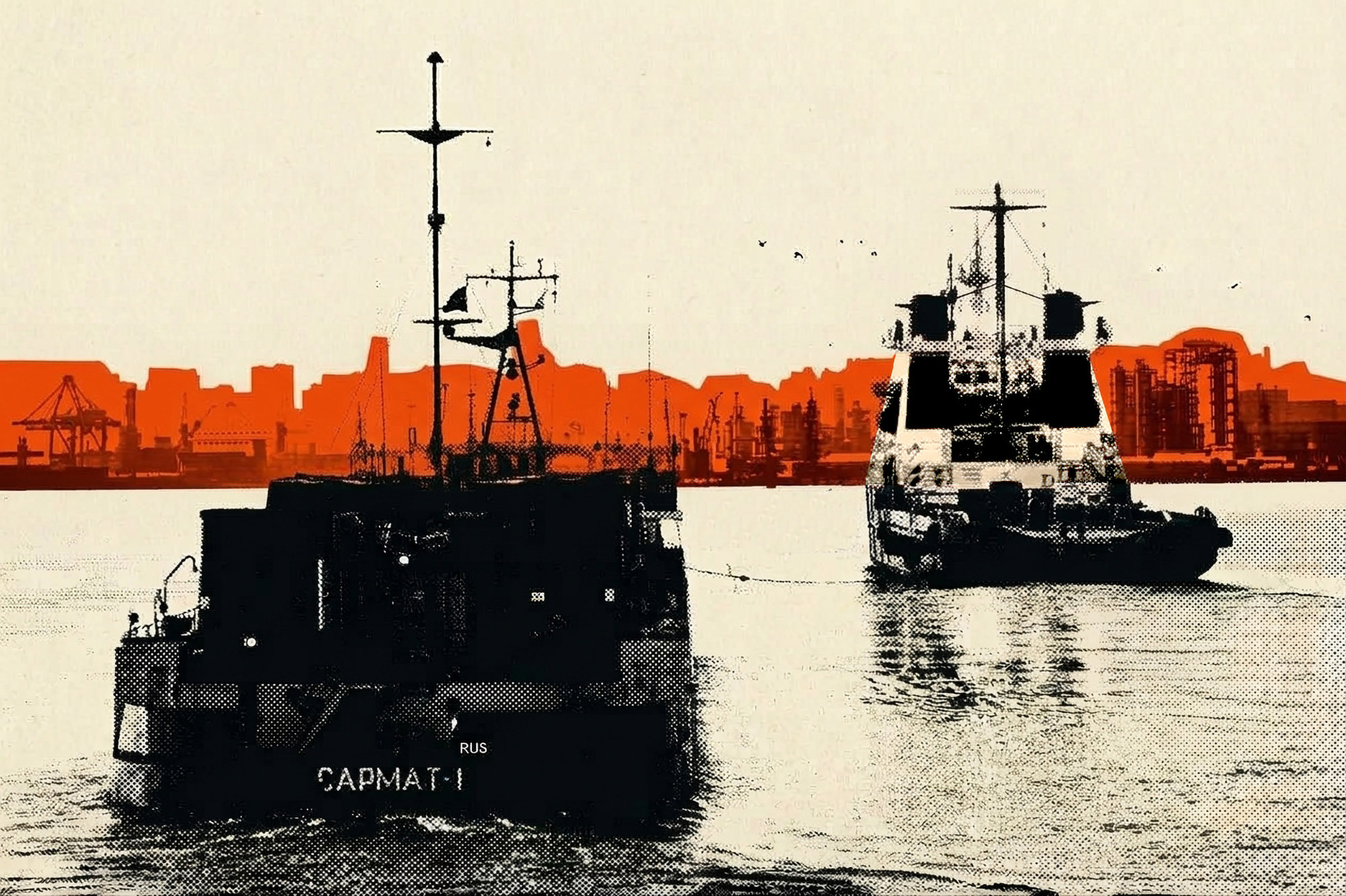
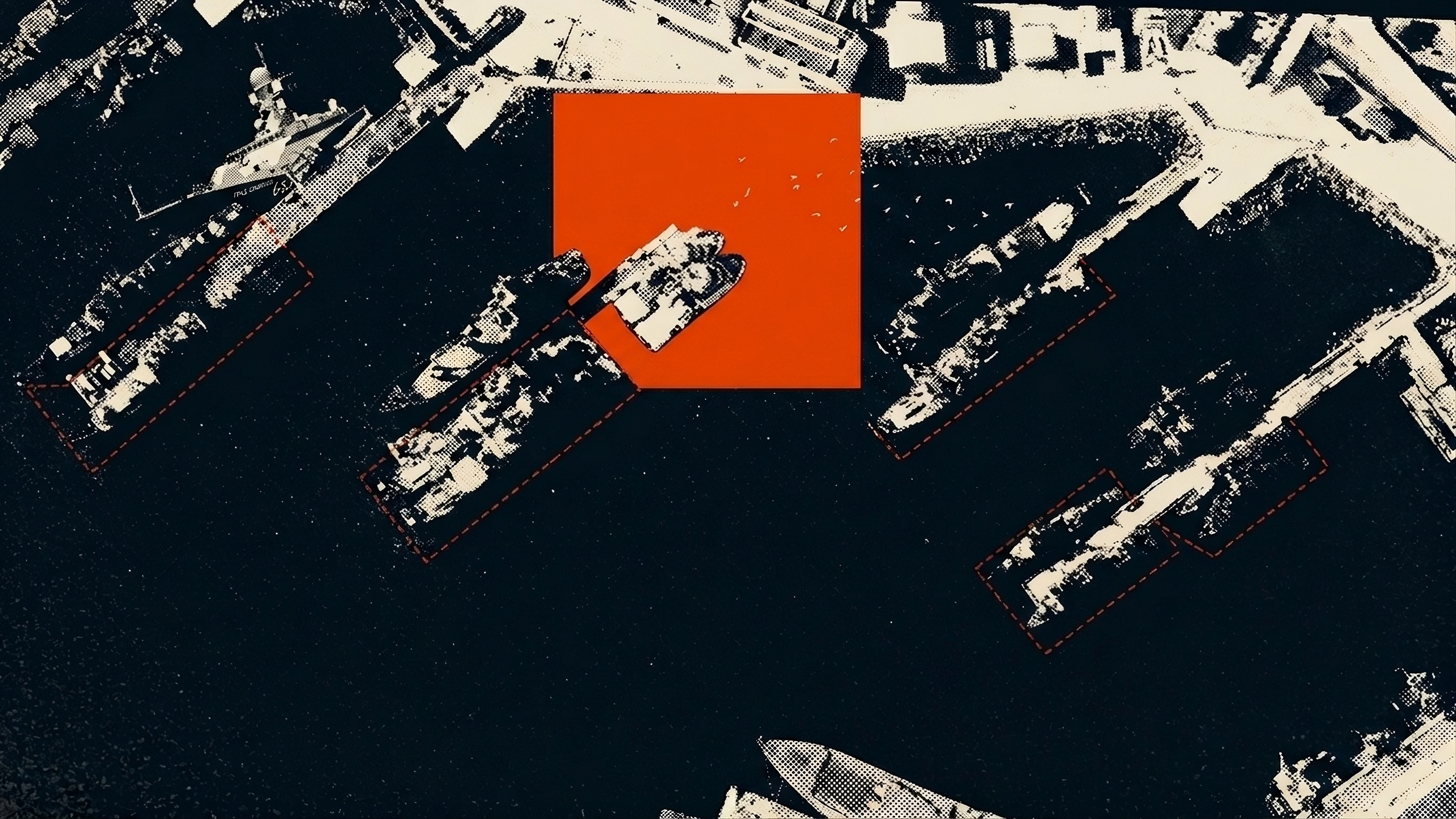
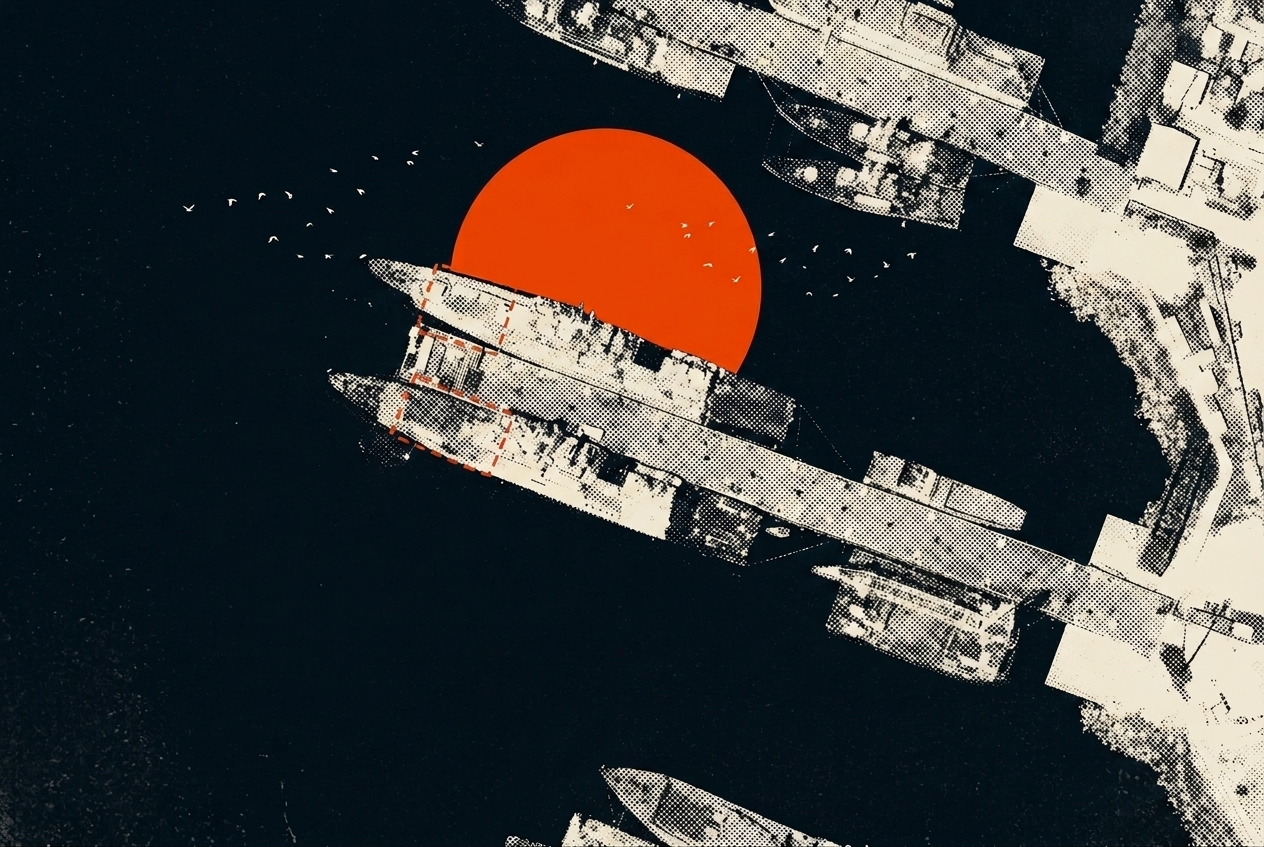
Over four years of full-scale war, the naval component of Russian missile strikes has undergone the most significant transformation in the post-Soviet history of the Russian Navy. Ships that in 2022 seemed unreachable from the shore fled their main base in 2023 and were burning in Novorossiysk by 2026. This is the first detailed chronicle in the series tracing the fate of Russian fleet missile carriers — focusing here on frigates and what they endured during the war.
§ 00 · IntroductionContext and Methodology
This piece is the second instalment in the series on the naval missile threat. Where the first instalment described what comprises the Caliber carrier group, this article reconstructs how each platform has fared over four years of combat operations. The first part of the reconstruction is limited to two classes of surface carriers — frigates of Project 11356R (Black Sea Fleet) and Project 11661K Gepard-3.9 (Caspian Flotilla). Five frigates, three fleets, four years of documented movements and strikes.
Methodology
This piece distinguishes between confirmed and unconfirmed episodes. Confirmed means verified by at least one source of the following type: Ukrainian Navy, HUR MO, SBU, SBI indictments, joint General Staff assessments, verified OSINT analyses with satellite imagery or drone strike footage. Episodes circulating in the public domain without such verification are explicitly marked “unconfirmed”.
§ 01 · Black Sea FleetProject 11356R Frigates: Three Ships, Four Years
Admiral Grigorovich, Admiral Essen, and Admiral Makarov — three of the six planned frigates of the series that Russia managed to complete by 2017. The remaining three — Butakov, Istomin, Kornilov — were frozen after 2014 following the Mykolaiv enterprise Zorya-Mashproektʼs refusal to supply gas turbine units. Technical details, incomplete hulls, and programme constraints are covered in the first instalment of the series.
Below — each ship in the series individually.
Admiral GrigorovichThe Ship That Never Came Back
The lead frigate of the 11356R series joined the Black Sea Fleet on 11 March 2016. Hull number 494, home port — Sevastopol, 30th Surface Ships Division. The first five years of service were a standard story for a new ship: rotations to the Mediterranean, exercises, flag-showing. In May–June 2020 Grigorovich completed the longest voyage in Black Sea Fleet history — over 24,000 nautical miles in 134 days across the Atlantic, through Suez, and into the Indian Ocean. In February 2021 it participated in the multinational exercise Aman-2021 at Karachi, after which it was the first Russian warship in modern history to call at Port Sudan.
In 2021 the ship transited the Bosphorus southbound — for another rotation to the permanent Russian Navy squadron in the Mediterranean. This proved to be Grigorovichʼs last passage through the Turkish straits. Eight months later, 27 February 2022, Turkey invoked Article 19 of the Montreux Convention, classifying the Russian invasion as a war and closing the Bosphorus and Dardanelles to warships of the belligerents. Grigorovich was left outside the Black Sea — with no way to return to its home base.
From this point, the shipʼs entire subsequent trajectory was determined by geography, not tactics. Its new anchor point was the Russian naval base at Tartus, Syria. From there Grigorovich performed the duties of the permanent squadron: patrols of the eastern Mediterranean, rotations, calls at Latakia. In April 2023 the ship went for repairs via Gibraltar, the Bay of Biscay, the English Channel, and the North Sea — to the Baltic shipyard Yantar in Kaliningrad. The Royal Navy deployed the Type-23 HMS Defender for shadowing escort. In November of the same year Grigorovich completed the same route in reverse — back to Tartus, this time escorted by HMS Richmond.
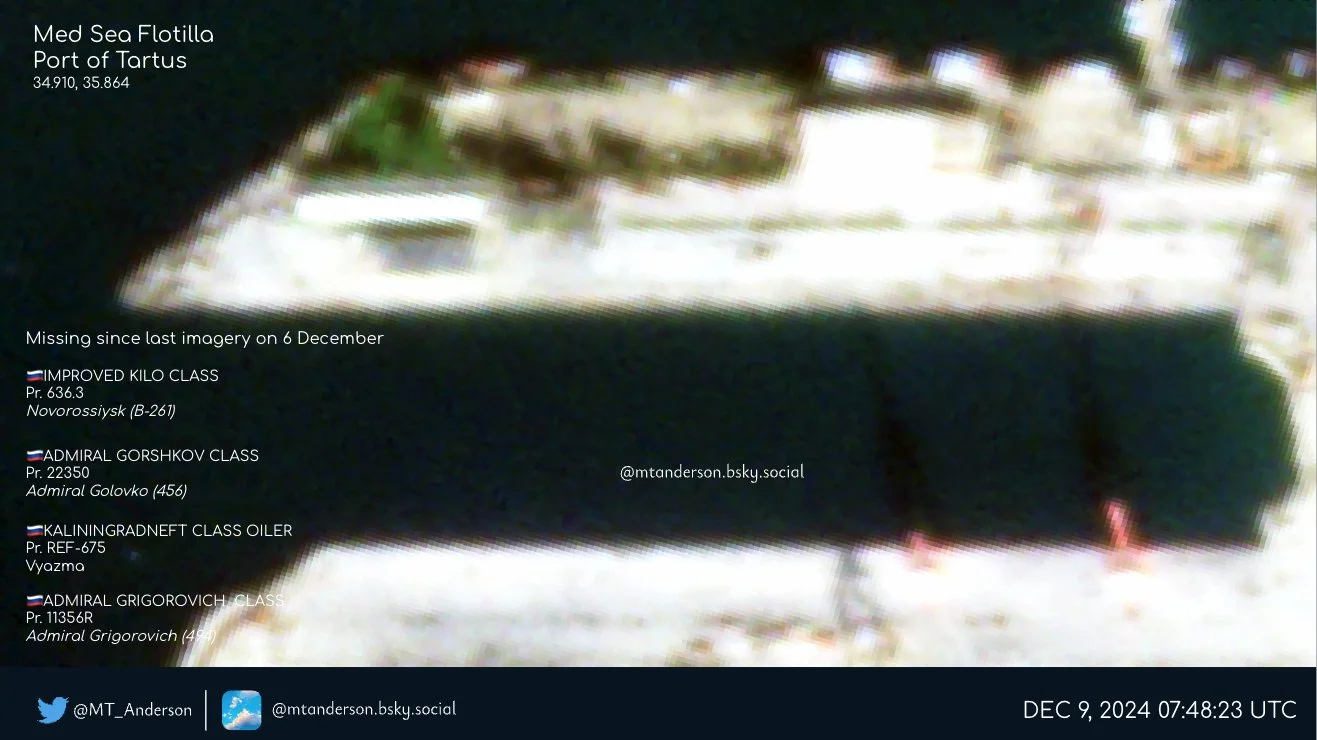
The Russian presence at Tartus had been sustained by the Assad regime. 27 November 2024, the Hayat Tahrir al-Sham coalition and allied factions launched an offensive from northern Syria; eleven days later — 8 December — Damascus fell, and Assad flew to Moscow. Tartus and Hmeimim air base came under threat of seizure. Satellite imagery from Planet Labs, published by OSINT analyst MT Anderson, captured the sequence: 30 November – 1 December, Russian ships still at their berths; 3 December — the harbour already empty, the squadron had moved to the outer roadstead. On 8 December HUR MO confirmed: Grigorovich had left Tartus escorted by the cargo vessel Inzhener Trubin.[1]
After leaving Tartus the ship transferred to the Baltic Sea. Turkey will not permit a return to the Black Sea, so the new operational area became the Atlantic, the North Sea, and the Baltic. Here Grigorovich remains the only surface Caliber carrier of the Black Sea Fleet operating outside the Black Sea — and it is this that gave rise to its most significant episode of 2026.
Navy Day
That morning Leningrad Oblast suffered the largest drone attack since the start of the war — Governor Alexander Drozdenko reported strikes on “industrial and military facilities,” and the Russian Ministry of Defence claimed the destruction of 51 UAVs over the region. Pulkovo airport halted operations. The main naval parade in St. Petersburg, held annually since 2017, was cancelled in advance — officially for security reasons. It was the first cancellation in eight years.
Admiral Grigorovich, which had transferred to the Baltic after leaving Tartus, was at Kronstadt following 20 months of operational deployment in the Mediterranean. According to Russian media, the frigate participated in repelling the attack alongside ground-based air defences and the forces of the Leningrad Naval Base. That evening Vladimir Putin arrived in Kronstadt and boarded the ship.
The President spoke with the crew over tea, thanking them for “successfully repelling the drone attack.” Aksionov reported that during the shipʼs operational deployment it had covered over 87,000 nautical miles. This was followed by a public promotion of the commander:
«Я смотрю, вы капитан третьего ранга, а положено вроде для кораблей такого ранга, чтобы командовал капитан второго ранга. Думаю, что пора это сделать, я вас поздравляю с получением очередного звания».
This was the episode Russian state media made the centrepiece of Navy Day 2025. Instead of the traditional parade — the President on a warshipʼs deck, a commander, a repelled attack, and a live promotion.
Between Two Shadow Fleet Tankers
The Telegraph published footage taken from the auxiliary vessel RFA Tideforce: Admiral Grigorovich was transiting the English Channel precisely between two sanctioned tankers. Universal, sailing under the Russian flag, had departed from Vysotsk; Enigma, flying the Cameroonian flag, had loaded at Ust-Luga. The British Type-23 frigate HMS Richmond was escorting the Russians in the North Sea. None of the vessels were stopped.[2]
A month earlier, Prime Minister Keir Starmer had publicly stated his intention to “push harder on the shadow fleet.” Grigorovichʼs passage between the two tankers in a combat escort configuration was the first recorded instance of Moscow deploying a warship in such an arrangement. The Kremlin officially characterised the operation as “protecting Russian shipping from piracy” in international waters.
Throughout spring 2026, the Russian military frigate Admiral Grigorovich continued to appear off the British coast and escort tankers of Russiaʼs so-called shadow fleet, despite Londonʼs promises to increase pressure on Russian shipping. According to British media, since April Admiral Grigorovich has escorted more than a dozen Russian tankers, auxiliary vessels, and one submarine through the waters around Great Britain.
Grigorovich remains in service — it is the only one of the three Project 11356R frigates that had not been struck in combat by May 2026. The paradox is that the price of this intact condition is the complete inability to fulfil its primary purpose — missile strikes against Ukrainian targets from the Black Sea.
- November 2014 – February 2016: Serhiy Bustrin — first commanding officer, took charge of the ship while it was still under construction.
- February 2016 – August 2018: Anatoliy Belytsko — under his command the frigate entered combat service and made its first combat deployments to the Syrian coast.
- August 2018 – March 2019: Roman Pashchenko — a brief tenure; his subsequent career is unknown.
- 31 March 2019 – late 2025: Konstantin Aksionov — commanded the ship during the full-scale invasion, detailed below.
- Since late 2025: Denys Kudashkin — transferred from Admiral Makarov, detailed below.
Has commanded Admiral Grigorovich since 31 March 2019 — the appointment was made on the 50th anniversary of the 30th Surface Ships Division. He was 38 at the time of appointment. A 2008 graduate of the navigation faculty of the Peter the Great Naval Corps, son of an ocean-going ship captain.
Before receiving his own command he followed a standard career path: junior officer on the LST Korolev of the Baltic Fleet, patrol ship Neustrashimy, executive officer on LST Kaliningrad, Naval Officersʼ Advanced Courses in St. Petersburg, executive officer on Admiral Essen, and — from December 2017 — executive officer on Grigorovich itself, the post from which he was promoted to command it.
Among BSF commanders, Aksionov is one of those covered systematically by the Russian military press: interviews in Rossiyskaya Gazeta (2020), features in Gudok and the Sevastopol outlet NTS (2019–2021), a portrait piece in Gazeta Kryma for Ship Commanderʼs Day (2022).
In late 2025, having handed the ship to a successor (more below), Aksionov was, according to TASS, appointed director of projects at the Division for the Development of Civil-Military Technologies within the Agency for Strategic Initiatives (ASI) — a civilian body.
Previously commanding officer of the BSF flagship Admiral Makarov (December 2022 – autumn 2023, including during the 29.10.2022 naval drone attack).
After a pause, in late 2025 he was transferred to command Admiral Grigorovich, taking over from Aksionov. Two independent sources confirm this: Kommersant reporting and an official broadcast by the Vyborg diocese of the Russian Orthodox Church from 3 February 2026, in which Kudashkin, now a Captain 2nd Rank, received a church blessing aboard Grigorovich at Kronstadt ahead of the shipʼs departure on a distant deployment to the Mediterranean.[20]
Admiral EssenThe Warʼs First Neptune
The second frigate of the series joined the Black Sea Fleet on 7 June 2016 with hull number 490. Named after Nikolai von Essen — an admiral of the Imperial Russian Navy and commander of the Baltic Fleet during the First World War. Before the full-scale invasion Essen was based primarily at Sevastopol and performed routine Mediterranean rotation duties. The most notable combat episode before 2022 were Caliber launches against ISIS positions in Syria in September 2017 — the first confirmed combat launches of cruise missiles from a ship of this series.
«Русский военный корабль…»
On the first day of the full-scale invasion, Essen together with the cruiser Moskva approached Snake Island (Odesa Oblast). An ultimatum was transmitted over radio demanding the garrison lay down its arms. The recording, published by the State Border Guard Service of Ukraine, became one of the iconic artefacts of the war:
— Я российский военный корабль. Предлагаю сложить оружие и сдаться, во избежание кровопролития и неоправданных жертв. В противном случае вы будете подвергнуты обстрелу.
— Русский военный корабль, иди на х*й.
Ukrainian Wikipedia and official Ukrainian Navy materials indicate the ultimatum was read from Admiral Essen, not from the cruiser Moskva. Both ships took part in the seizure of the island — 13 Ukrainian border guards and naval personnel were taken captive, later exchanged.
Strike on the Mykolaiv Regional Military Administration

On 29 March 2022 a Russian cruise missile struck the Mykolaiv Regional Military Administration building. The impact punched through the structure and several floors collapsed. 37 people were killed and over 30 wounded. Five months later the Ukrainian monitoring organisation Truth Hounds published an investigation attributing the strike to a specific ship — Admiral Essen. The team identified not only the ship but the officers who directly executed the launch: frigate commander Captain 2nd rank Alexander Smirnov and the commander of the missile-artillery combat unit, Senior Lieutenant Anatoly Peretyatko.[3]
The First Neptune
In early April 2022, Admiral Essen as part of a Russian naval group approached the Ukrainian coastline off Tendra Spit. The Ukrainian Navy fired a Neptune anti-ship missile. This was the first-ever combat use of the Neptune — the system that, eleven days later on 14 April, would sink the cruiser Moskva.
The missile did not strike the hull directly. The explosion occurred near the ship, damaging weapon systems; there were several killed aboard. Essen urgently returned to Sevastopol for repairs. The first official confirmation came in February 2023 from Captain 1st rank Stepan Yakimyak. The full reconstruction of the episode appeared in an interview given by the Commander of the Ukrainian Navy, Vice Admiral Oleksiy Neizhpapa, to Ukrainska Pravda:[4]
«А коли „Ессен" підійшов, ми вирішили спробувати, що ж може наш „Нептун". Перші пуски не були настільки вдалі, як по крейсеру „Москва", але тоді вперше був пошкоджений цей фрегат „Ессен". Було там декілька „двохсотих" у них на борту, наскільки мені відомо».
Deceptive Camouflage — First in the Series
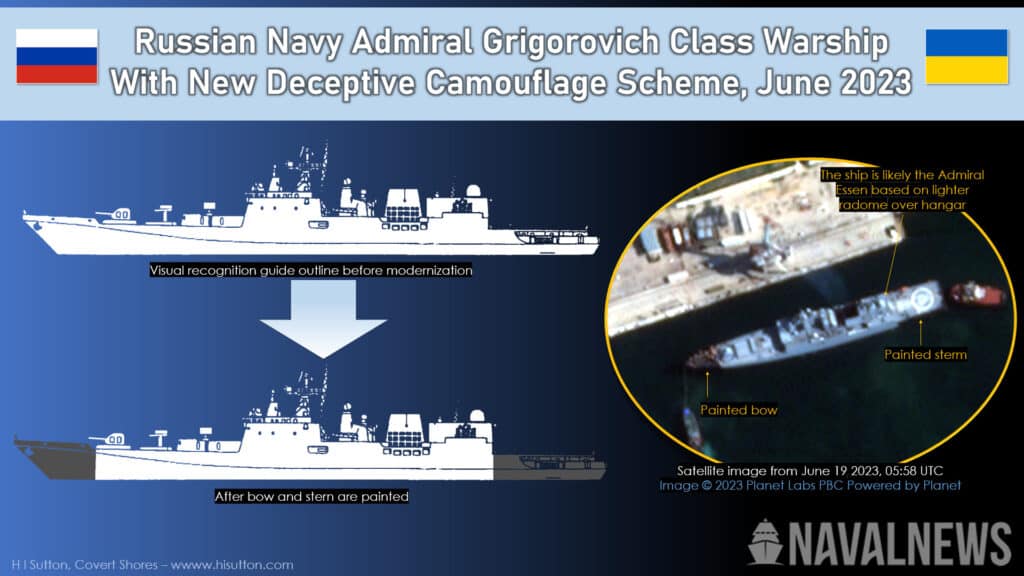
On 19 June 2023 a Planet Labs satellite image captured Admiral Essen at Sevastopol with new paintwork: dark patches on the bow and stern of the hull. Essen became the first ship of the 11356R series to receive such camouflage.[5] As events in 2026 would show, the camouflage did not save it.
Relocation
In autumn 2023 Sevastopol ceased to be a safe base. On 13 September, Storm Shadow cruise missiles struck the large landing ship Minsk and the diesel submarine Rostov-on-Don at the Sevastopol Maritime Plant. On 22 September — a Storm Shadow strike on the Black Sea Fleet headquarters. Planet Labs imagery from 1–3 October 2023, published by MT Anderson, records the arrival of two frigates at Novorossiysk port — Admiral Essen and Admiral Makarov. This was the largest change of basing in the Black Sea Fleet during the full-scale war.
First Strike at Novorossiysk
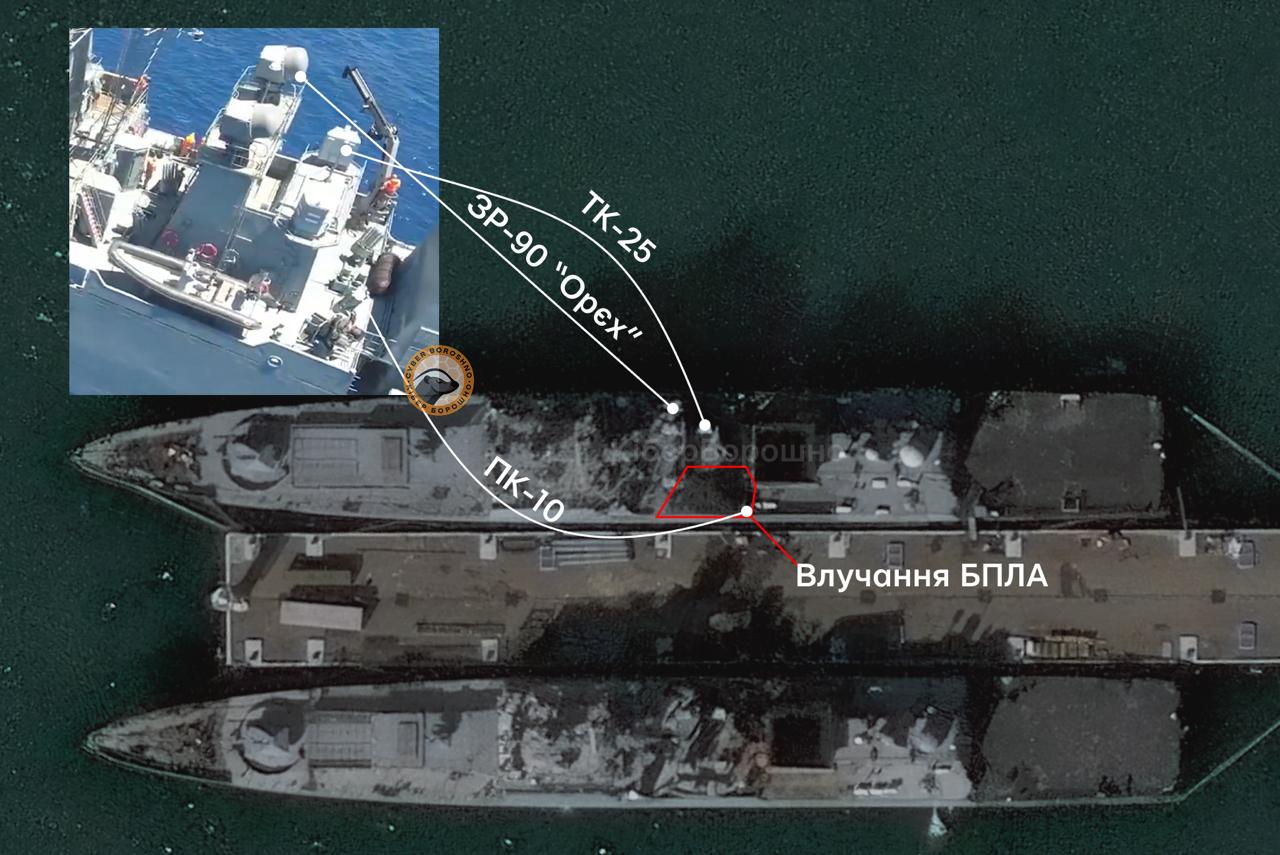
In the night of 2 March 2026, Ukraineʼs Security Forces and Defence Forces conducted a combined strike against the Novorossiysk naval base. Admiral Essen took a hit to the midship superstructure; secondary detonations followed. Confirmed damage to the PK-10 decoy system, TK-25 EW system, MR-90 and Fregat-M2M radars. A fire on deck burned for approximately 18 hours.[6]
“Following additional analysis of the damage inflicted on 2 March 2026 on the Novorossiysk naval base in Krasnodar Krai, damage to two Black Sea Fleet ships — frigates Admiral Essen and Admiral Makarov — has been confirmed.”
Second Strike at Novorossiysk
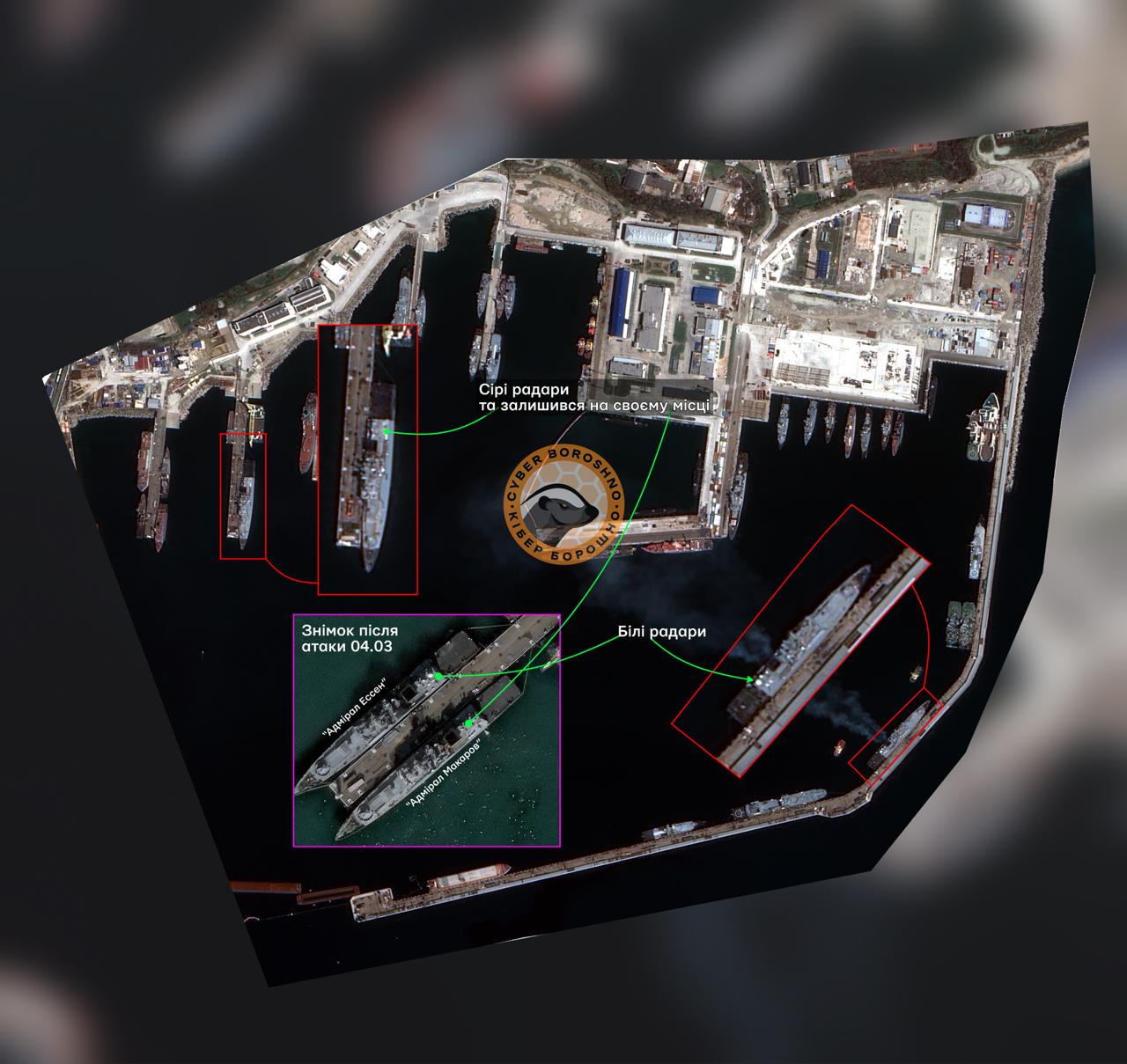
In the night of 6 April, Ukraineʼs Security Forces and Defence Forces struck the Sheskharis terminal and ships directly in the Novorossiysk naval base. According to OSINT analysis by CyberBoroshno based on satellite imagery taken on 7 April, Admiral Essen was struck in the bow section — in the area of the 100mm A-190 gun mount. In the same zone below the waterline sits the MHK-335M Platina hydroacoustic complex: damage to it would deprive the ship of submarine detection capability. The OSINT identification of Essen — as opposed to the neighbouring Makarov — was based on a distinctive feature: the radar antennas on Essen are painted white, while those on Makarov are grey.
Third Strike at Novorossiysk
In the night of 23 May 2026, the 1st Separate Centre of the Unmanned Systems Forces delivered the fourth confirmed strike against Admiral Essen at Novorossiysk. Several kamikaze drones attacked the frigate in the hull near deck level; the ship attempted to intercept them with its Osa-M surface-to-air missile system. The operation was part of the UAS Forcesʼ 48-hour massed “Birds” raid on Novorossiysk port — alongside strikes on the Sheskharis oil terminal and the Grushova Balka oil storage facility. UAS Forces Commander Robert ʼMagyarʼ Brovdi personally confirmed the strike: “You are doomed to sink, there is nowhere to hide.”[12]
Fourth Strike at Novorossiysk: a “Unique Operation”
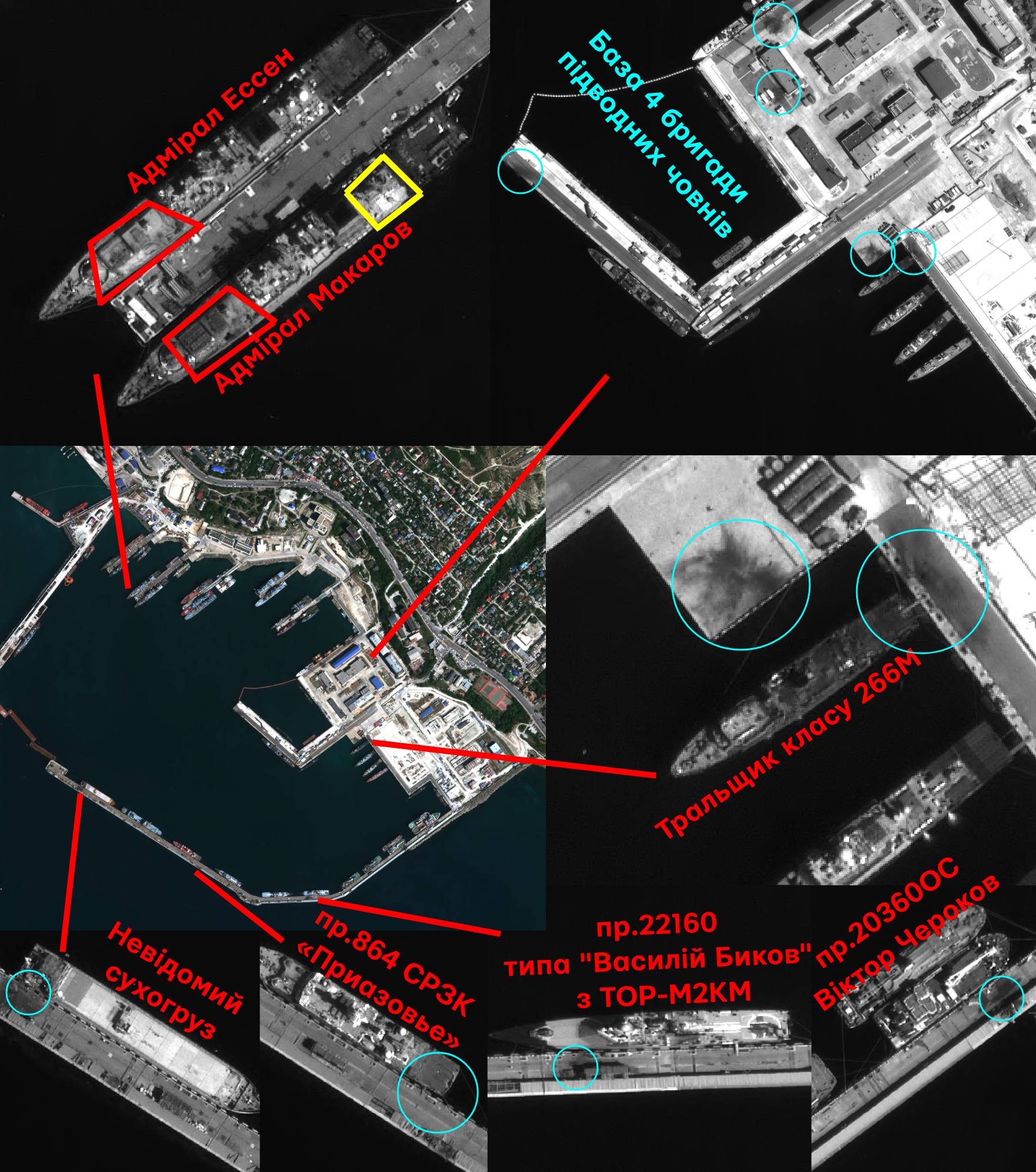
In the night of 12 August 2026, Ukraineʼs Defence Forces conducted what President Volodymyr Zelensky called a “unique operation” against the Novorossiysk naval base — “the last main stronghold of the Russian fleet in the Black Sea”, more than 300 km from the front line. The strike package combined “Palianytsia” jet-powered drones, Neptune missiles, and naval unmanned systems; confirmed hits were recorded on air-defence positions, berths, and port infrastructure.[13]
“I thank the soldiers of the Armed Forces, the Security Service of Ukraine, and our intelligence services for their accuracy and good results. The occupying fleet and all the infrastructure that supports it will not be safe as long as Russian aggression continues.”
According to the General Staff of the Armed Forces of Ukraine, four ships sustained damage of varying severity: both 11356R-class frigates — Admiral Essen and Admiral Makarov — the Project 21631 “Buyan-M” missile corvette, and the Project 22160 patrol ship “Vasily Bykov.”[14] Ukraineʼs Defence Intelligence (HUR) specified that the operation was a joint deep-strike effort: operators from HURʼs Active Actions Department and Unmanned Systems Department, the SBU, the Navy, and the State Border Guard Service worked together with the General Staff. Beyond the ships, the strike also hit the “Grushovaya” oil depot, the Sheskharis oil-loading terminal, and a 30N6E radar from an S-300 air-defence battery.[15]
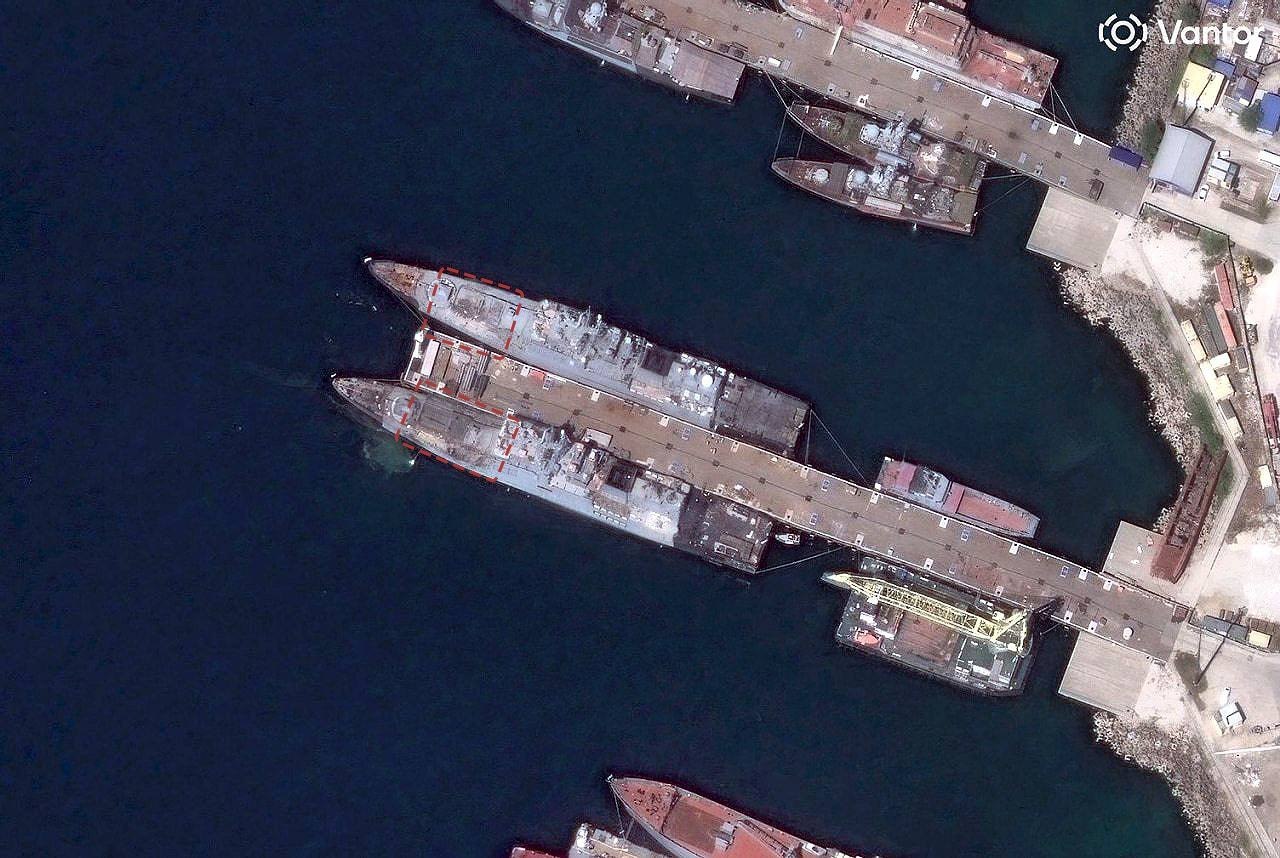
The Telegram channel Exilenova+, which had previously attributed the April 2026 damage to Makarov, published a broader breakdown identifying additional targets not named in the official HUR and General Staff statements: a Project 266M-class minesweeper showing signs of fire, infrastructure of the 4th Submarine Brigade, the Project 22160 patrol ship “Vasily Bykov” fitted with a Tor-M2KM air-defence system, the Project 20360OS “Viktor Cherokov,” the Project 864 support vessel “Priazovye,” and an unidentified cargo ship.
Fifth strike on Novorossiysk: the “Long Neptune”
On the night of 8–9 September 2026, Ukraineʼs Defence Forces struck the Novorossiysk naval base once more. Ukraineʼs Defence Intelligence (HUR) reported that operators of its Active Actions Department, working within a joint deep-strike operation, hit the baseʼs infrastructure and the frigate Admiral Essen. A fire broke out on the shipʼs deck superstructure.[23] The same day the Ukrainian Navy named the weapon — a Neptune missile —[24] and a day later specified that it was the extended-range variant, the “Long Neptune.”[26]
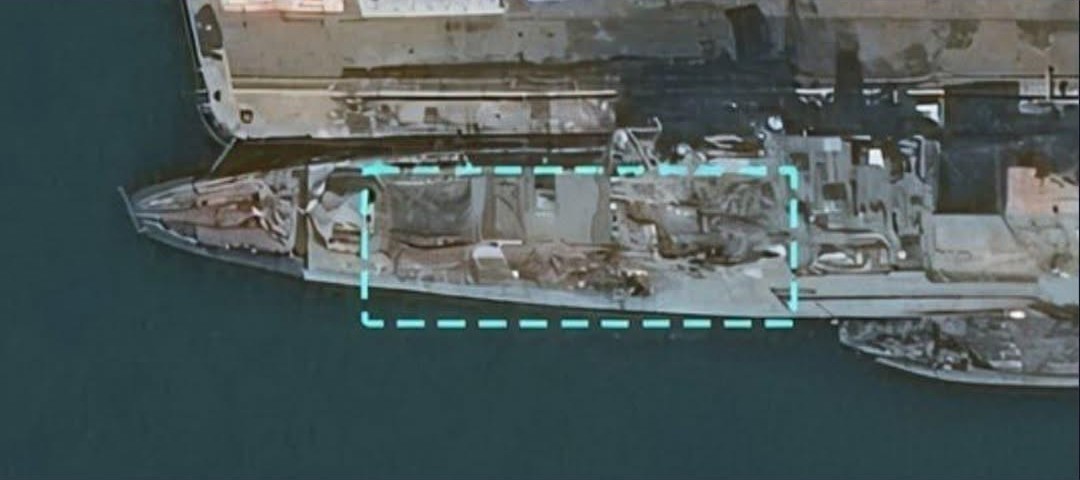
“Satellite imagery confirms the ship was hit in the upper superstructure. The damage sustained prevents the ship from performing combat missions. The missile carrier will require lengthy and costly repairs.”
According to an analysis by Defense Express, the missile struck the forward part of the superstructure, destroying the bridge and a number of control stations for the shipʼs combat systems and machinery.[29] The first combat launch of a Neptune in this war was aimed at this same frigate — in early April 2022, at sea off the Tendra Spit, where the missile detonated close alongside rather than striking the hull (see above). Eleven days after that launch, two Neptunes sank the cruiser Moskva. Four years on, the extended-range variant of the same missile reached Essen at its pier: the Neptune-D system, firing RK360L missiles with a range of up to 1,000 km and a 260 kg warhead, whose use President Volodymyr Zelensky confirmed in late 2025.
The frigate was not the only target along the Krasnodar Krai coast that night. Unmanned Systems Forces commander Robert “Madyar” Brovdi reported that a Su-33 carrier-based fighter and an Mi-8 helicopter had been destroyed near Anapa, and that two radars — a Kasta-2E2 and a 92N6 from an S-300/S-400 battery — had been hit in the Gelendzhik area. In Novorossiysk itself the fuel oil terminal was burning; it handles roughly 20 million tonnes of petroleum products a year.[25]
Sources differ on which other ships were hit. After analysing additional data, Ukraineʼs General Staff named at least three damaged vessels;[27] the OSINT project Exilenova+, working from satellite imagery, also named three — but not the same ones.[28] Essen is the only ship on both lists.
| Ship | General Staff | Exilenova+ |
|---|---|---|
| frigate Admiral Essen | hit | hit in the superstructure |
| frigate Admiral Makarov | — | hit again in the superstructure |
| missile corvette “Buyan-M,” Proj. 21631 | — | hit |
| small sea minesweeper “Zheleznyakov” | hit | — |
| large landing ship “Pyotr Morgunov,” Proj. 11711 | hit | — |
The General Staff says “at least,” so its list is not exhaustive, while Exilenova+ shows only what is visible from orbit. Hits on Makarov and the Buyan-M have not been officially confirmed; for Makarov, see its section below.
Russia reported no strike on the ships. Novorossiysk mayor Andrey Kravchenko initially attributed the fires to falling debris; Krasnodar Krai governor Veniamin Kondratyev later claimed four people had been killed, among them a child, and 29 injured in the townʼs residential areas.
Sergei Tomashkov (2014 – December 2016) — first commanding officer, took charge of the ship while it was still under construction; relieved after the mooring accident of 10.10.2016 (see above). Anton Kuprin (December 2016 – 2019) — under his command Essen entered combat service and took part in combat operations in Syria. In 2019 he moved on to command Admiral Makarov, and later the cruiser Moskva, where he was killed on 14.04.2022.
Career officer of the Russian Navy. Born in Murmansk. Before taking command of Essen he progressed through the executive officer position on two frigates of the 11356R series — first Grigorovich, then Essen.
The Truth Hounds investigation of August 2022 identifies Smirnov as the commanding officer of the carrier ship from which the cruise missile was launched against the Mykolaiv RMA. Legal attribution of a specific strike to a specific individual is a rare achievement in the documentation of war crimes.
In spring 2023 he was promoted — appointed deputy commander of the BSFʼs 30th Surface Ships Division (the same post Serhiy Romanenko moved into from Makarov in late 2022).
As of 2021 was listed as executive officer on the sister frigate Admiral Makarov. In spring 2023 he took command of Essen from Alexander Smirnov — likely just ahead of the May festivities marking the BSFʼs 240th anniversary. Officially confirmed in the post as of October 2025.
It was under Kruhlovʼs command that Essen went through all the documented hits at Novorossiysk in 2026 described above.
Admiral MakarovFlagship by Default
The third and last frigate of the 11356R series joined the Black Sea Fleet on 27 December 2017 with hull number 499. Before the full-scale invasion Makarov was on routine service at Sevastopol. That changed on 14 April 2022 — the day Moskva sank in the Black Sea.
Moskvaʼs Legacy
On 14 April 2022 two Ukrainian Neptune missiles struck the cruiser Moskva — flagship of the Black Sea Fleet. The cruiser sank; among the dead was commanding officer Anton Kuprin — who until 2020 had commanded Makarov itself, and before that Essen. The flagship status passed to Admiral Makarov — by residual default. Among the BSFʼs combat-ready ships it was the most capable and newest vessel with long-range missile armament: 8 Caliber launch cells.
The de facto flagship was at that point actually commanded by Captain 2nd Rank Serhiy Romanenko, who had taken over the ship back in the autumn of 2020 — he is the one who gave the orders for the warʼs first missile strikes.[17] More on him in the biography card below.
Strike on Prydniprovska Power Plant

At 07:57 on 18 October 2022 Admiral Makarov carried out a precision strike with two sea-launched 3M-14T Caliber cruise missiles against the Prydniprovska thermal power station in Dnipropetrovsk Oblast. The strike caused major damage to the plantʼs buildings, property and equipment, and damaged nearby homes and cars[21]. In April 2026 the SBU filed a notice of suspicion in absentia against Captain 1st rank Volodymyr Kuzmin — commander of the 30th Surface Ships Division of the BSF. Following the strike, the Kremlin promoted Kuzmin to the rank of rear admiral.[7] Then, on 28 August 2026, the SBU and the Prosecutor Generalʼs Office announced suspicions against two more figures in the same strike under Part 1, Art. 438 of Ukraineʼs Criminal Code (war crimes). The investigation divides their roles as follows: Captain 1st rank Oleh Kniazev, chief of staff and first deputy commander of the 30th Surface Ships Division, organised the attack and controlled its execution from the flagship command post; Captain 2nd rank Serhiy Romanenko directed the launch[21]. Three officers of the 30th Division are now under suspicion over this single strike.
The Worldʼs First USV Operation
At 4:20 a.m. on 29 October 2022, a combined force of 9 aerial and 7 naval unmanned vehicles attacked Black Sea Fleet ships at Sevastopol. This was the first joint operation in history by the Ukrainian Navy and SBU using exclusively unmanned systems. Three naval drones headed for the outer roadstead where Admiral Makarov was anchored. The defence was directed personally by Captain 3rd Rank Denys Kudashkin — from which post is not established in open sources.[18]
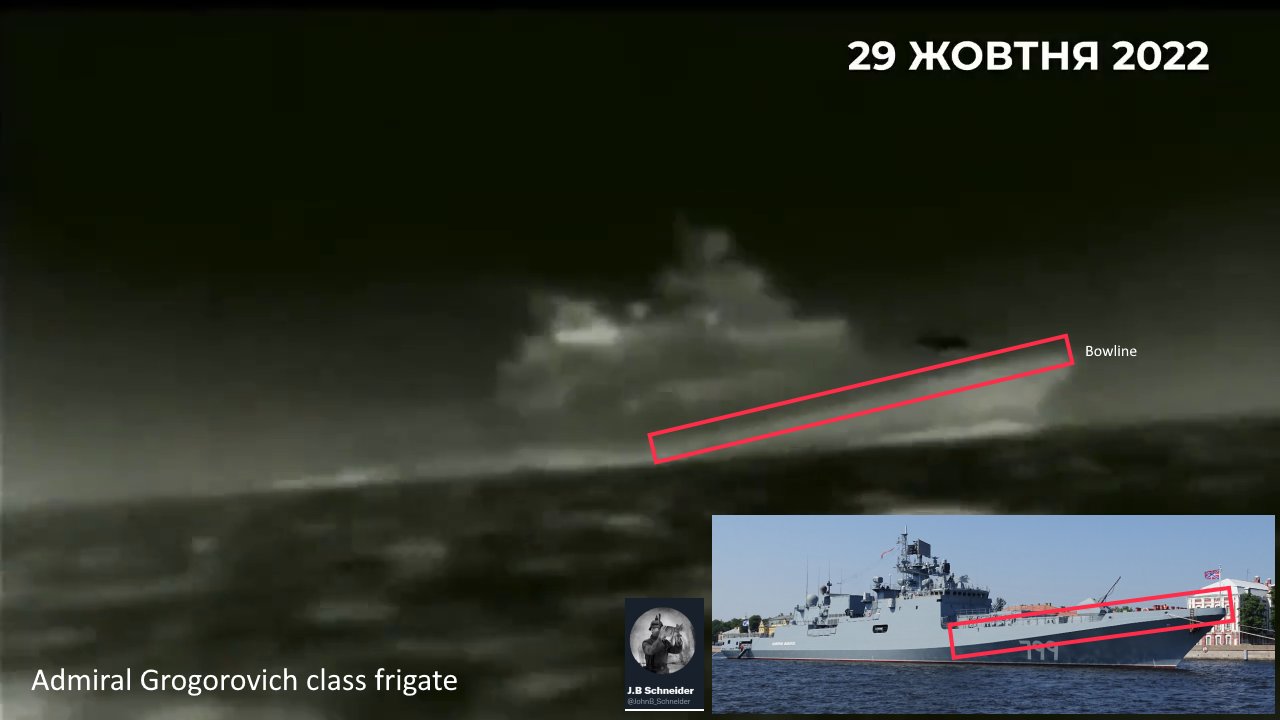
The Russian side officially acknowledged damage to the minesweeper Ivan Golubets, but made no statement about a strike on Makarov. OSINT analyst Benjamin Pittet published imagery of Sevastopol Bay showing the frigate under tow in open water.[8]
Relocation to Novorossiysk
Planet Labs imagery from 1–3 October 2023, published by MT Anderson, recorded the arrival of Admiral Makarov and Admiral Essen at Novorossiysk port.
Strikes at Novorossiysk
In the night of 2 March 2026, Ukraineʼs Security Forces and Defence Forces conducted a combined strike against Novorossiysk. Among the ships struck were Admiral Essen and Admiral Makarov. However, notwithstanding official statements regarding damage to Makarov, corroborating evidence from satellite imagery and other open sources could not be confirmed.
Less than a month later, in the night of 6 April, operators of the 1st Separate Centre of the Unmanned Systems Forces struck the Sheskharis terminal at Novorossiysk. According to Exilenova+ assessment, the frigate was struck at least twice: the first hit — in the area of the UKSK 3S14 vertical launch cells; the second — on port infrastructure nearby. Admiral Makarov attempted to defend itself — Shtil-1 SAM launches were fired from the ship. They did not stop the drones.[9]
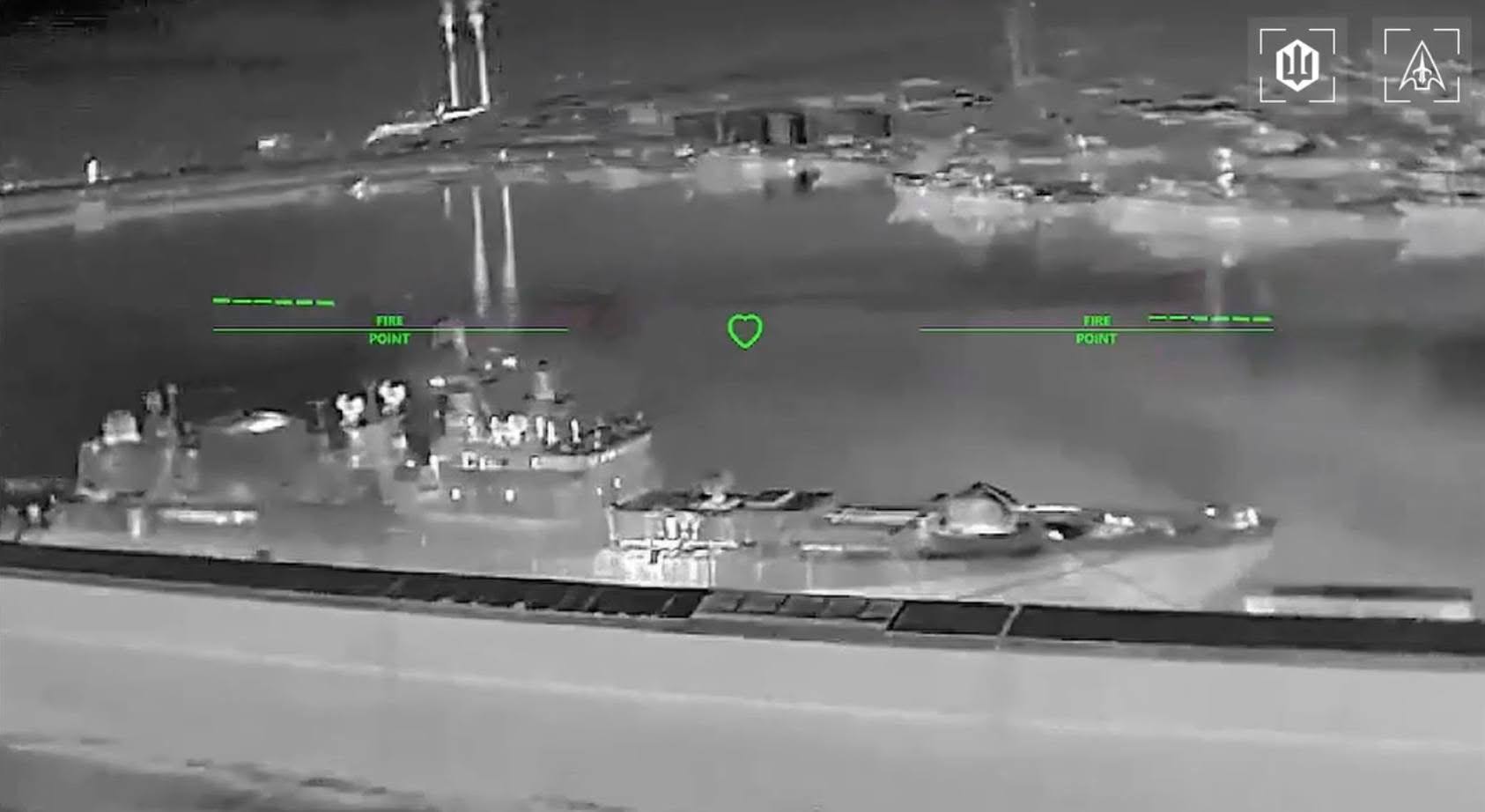
In the night of 12 August 2026, Makarov sustained another confirmed hit — this time as part of a large joint deep-strike operation by Ukraineʼs Defence Intelligence (HUR), the SBU, the Navy, and the Defence Forces, alongside Essen, the patrol ship “Vasily Bykov,” and the “Buyan-M” missile corvette. President Zelensky called the operation “unique” given the targetʼs distance — more than 300 km from the front line. A full account of the operation appears in the Admiral Essen section above.[13]
A repeat hit, per OSINT
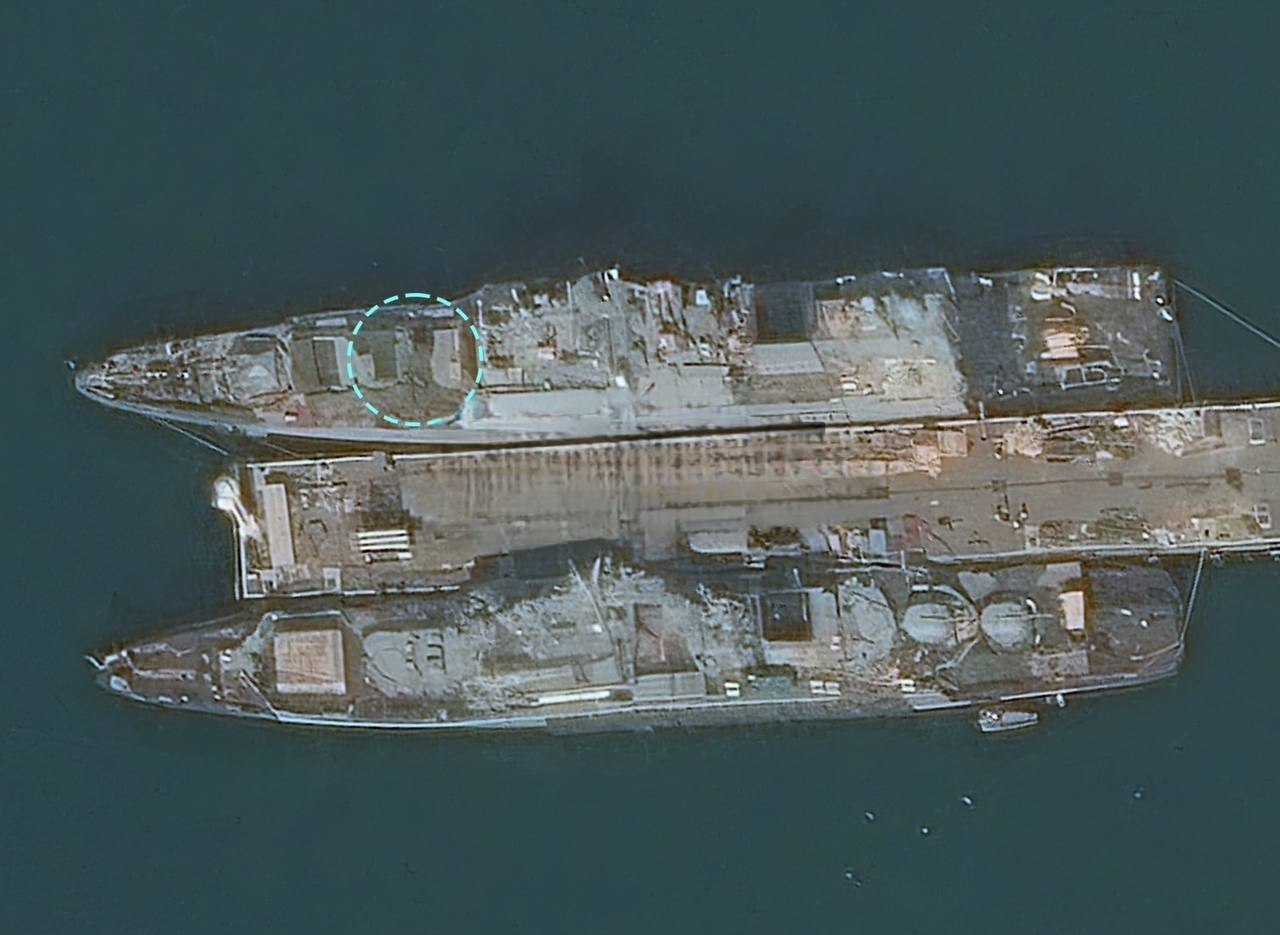
After the 9 September strike, the OSINT project Exilenova+ reported that Makarov had taken a repeat hit to its superstructure.[28] This has not been officially confirmed: Ukraineʼs General Staff does not list Makarov among the ships hit that night,[27] and according to Defense Express the extent of its damage is yet to be established.[29] A full account of the operation appears in the Admiral Essen section.
Hryhoriy Breev (2016 – autumn 2019, Captain 1st rank) — first commanding officer, took charge of the ship at handover. Born in Vinnytsia Oblast, a 1996 graduate of the Nakhimov Sevastopol Naval Institute; in the 2000s he commanded Ukrainian Navy corvettes Lutsk and Ternopil. Until March 2014 — Captain 2nd rank, Ukrainian Navy, commander of the Sevastopol Naval Base. In March 2014 he refused to follow orders from the Ukrainian command and took an oath to the Russian Armed Forces. Ukraineʼs State Bureau of Investigations filed a notice of suspicion for high treason (Art. 111 Part 1 of the Criminal Code); on 7 June 2023 a court convicted him in absentia and sentenced him to 15 years.[10]
Anton Kuprin (autumn 2019 – summer 2020, Captain 2nd rank) — before Makarov he had commanded Essen. In November 2019 he reported successful Caliber launches during the “Ocean-2019” exercises. After summer 2020 he was transferred to command the missile cruiser Moskva, where he was killed on 14 April 2022 by a Neptune missile strike.
Born in Sevastopol (b. 15.06.1981). A 2004 graduate of the Saint Petersburg Naval Institute, and in 2009 completed the Russian Navyʼs Advanced Special Officer Courses. Before Makarov — executive officer on the patrol ship Smetlivy.
Took command of the ship in the autumn of 2020. Press reports cite him as the frigateʼs commanding officer during deployments to the Syrian port of Tartus (30.09.2020), and in April–May 2021 he commanded the ship in the Mediterranean while shadowing a US carrier strike group.[17]
Was Makarovʼs de facto commanding officer at the start of the full-scale invasion (from February 2022), giving the orders for the warʼs first missile strikes. In late 2022 he moved to the post of deputy commander of the BSFʼs 30th Surface Ships Division.
Born in Saransk, resides in occupied Sevastopol. A 2012 graduate of the Baltic Naval Institute (Kaliningrad). In 2012 — lieutenant, commander of the BCh-2 (missile-artillery) battery on the patrol ship Pytlivy; from 2018 — aboard Makarov as commander of the missile-artillery combat unit.
He had served aboard Makarov since at least 2018. On 29 October 2022 he personally directed the defence against an unprecedented Ukrainian naval drone attack at Sevastopol.[18] In December 2022 the ship received the “Best Ship (Submarine), 1st and 2nd Rank, of the Black Sea Fleet” cup, handed over personally by the fleet commander at a session of the BSF Military Council[22]. This is the first documentary reference to Kudashkin as the frigateʼs commanding officer, and the point from which we date his command. In the fleet newspaperʼs account the commander said of the crew of Admiral Makarov, “commanded by Captain 3rd Rank Kudashkin”, that it had “shown high proficiency and professional skill in the course of the special military operation.” In spring 2023 he was featured in a Solovyov TV segment, where he confirmed he had “risen through the ranks on this very ship.”
Handed over command to Havrylchenko in the autumn (around October) of 2023. After a pause, in late 2025 he was transferred to command the sister frigate Admiral Grigorovich — detailed in that shipʼs section.
Born 23 May 1991 in Rodynske, Donetsk Oblast. A 2013 graduate of the Naval Academy. From May 2020 to July 2023 — executive officer on Grigorovich, followed by a brief independent command of the patrol ship Ladny.
Appointed commanding officer of the flagship frigate Admiral Makarov (military unit 52994) in the autumn of 2023 — and remains in the post. According to the SBU, it was Havrylchenko who gave the order to launch missiles at the civilian Flex plant in Mukachevo on the night of 21 August 2025.[16]
§ 02 · Caspian FlotillaProject 11661K Gepard-3.9 Frigates
Tatarstan (yard number 951, hull 691) and Dagestan (yard number 952, hull 693) — the only two Project 11661K frigates in the Russian Navy. Both were laid down at the Zelenodolsk Plant named after A.M. Gorky during the Soviet period (1990 and 1991), but due to the USSRʼs collapse and lack of funding took 10–20 years to complete. Tatarstan was commissioned on 31 August 2003, Dagestan on 28 November 2012. Both ships are based at Kaspiysk and assigned to the 106th Surface Ships Brigade of the Caspian Flotilla. Sharing the same hull and propulsion, the ships carry fundamentally different strike armament — and it is precisely this that makes them two distinct threat categories.
TatarstanFlagship Without Calibers
The lead ship of the series, flagship of the Caspian Flotilla since 2003 — as per official Russian media. Armament: Uran anti-ship system with Kh-35 missiles (two quad-tube KT-184 launchers, 8 missiles total; in the Kh-35U variant range increases to 260 km). Kh-35 missiles are anti-ship missiles with a 145 kg warhead, designed to strike surface targets. They are poorly suited for attacks against land infrastructure, and their range does not allow reaching Ukraine from the Caspian. Tatarstan physically cannot be a source of missile strikes against Ukraine. RIA Novosti in November 2022 incorrectly referred to Tatarstan as a Caliber carrier — a common misconception in Russian media.
Born in Kaliningrad Oblast. A fourth-generation naval officer: his father was a Captain 1st rank who commanded a Baltic Fleet surface ships formation. Graduated from the missile-artillery faculty of the Baltic Naval Institute in 2010.
His entire career was on Tatarstan: Uran missile battery commander, CO BU-2, executive officer, commanding officer — 7 years. During this period he conducted nine live missile firing exercises. In 2023 he participated in an experimental firing exercise jointly with a Buyan-M MRK — effectively taking part in the acceptance trials of the lead Caliber-NK carrier.
In October 2025 he was promoted to commander of the Caspian Flotillaʼs surface ships and boats division — meaning he continues to oversee Tatarstan from a higher level of the command structure.
The First Ukrainian Strike in the Caspian
The attack was carried out by ultralight A-22 Flying Fox drones that covered approximately 1,500 kilometres. According to HUR MO sources, at least two objects in Kaspiysk port were struck, identified as Tatarstan and Dagestan. ISW noted that imagery did not allow unambiguous identification of damage specifically to the frigates — one vessel of the Gepard class was visible, along with three Buyany, two Buyan-Ms and a Tarantul-class boat.[11] Governor Melikov reported only the “destruction of a UAV by air defences”; Makhachkala airport was suspended. The fact that within a month Tatarstan had departed on an extended voyage calling at Aktau allows the damage to be assessed as non-critical.
Preparing for Drones
As part of a naval strike group, Tatarstan conducted live-fire exercises against surface and air targets. Separately, the destruction of unmanned surface boats using heavy-calibre machine guns was practised — a direct acknowledgement that the flotilla is deliberately preparing for further Ukrainian naval drone strikes.
A Report of a Second Strike
On the night of 10–11 September 2026 Kaspiysk came under attack. Around 05:30 local residents’ footage of explosions and fire glow over the port began circulating on OSINT channels.[30] That evening the Exilenova+ project published a satellite image and reported that Tatarstan — “the lead ship of the Caspian Flotilla, Project 11661K Gepard, armed with Uran anti-ship missiles and the Osa-MA air defence system” — had “probably” been hit in Kaspiysk.[31] That is the only source for this episode.[34]
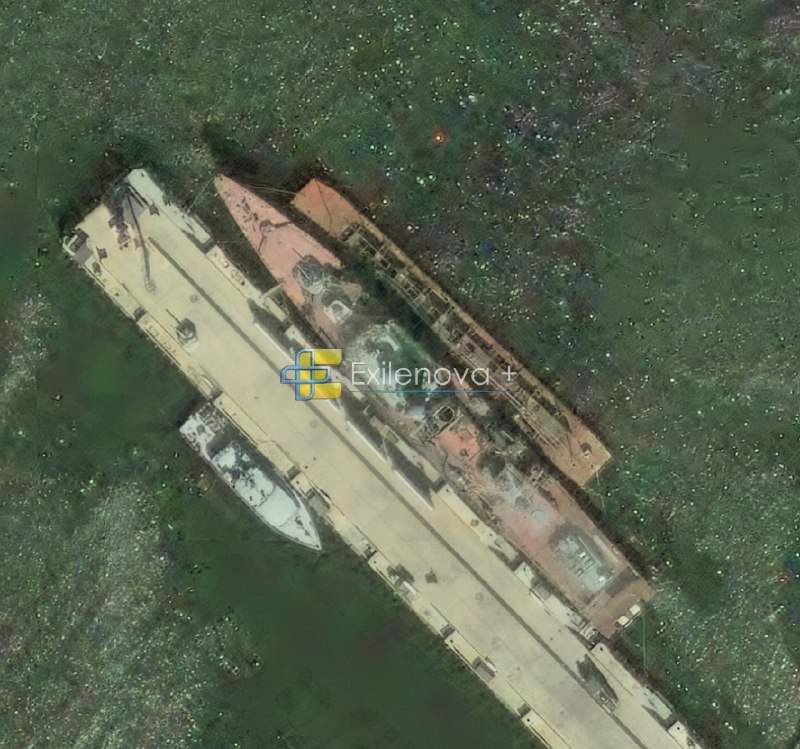
The image does not allow the report to be checked. No fire blackening or damaged equipment is visible.[33] Identifying this ship as Tatarstan, or establishing from the image that a strike took place at all, is difficult.
President Volodymyr Zelensky listed the targets of that night’s long-range strikes the same day — Dagestan among them, alongside Udmurtia and the Tula, Nizhny Novgorod, Perm and Samara regions.[32] Russia’s Defence Ministry claimed 777 Ukrainian drones had been launched overnight and also named Dagestan among the regions hit.[33] No one mentioned the ship. Neither General Staff report, for 10 or for 11 September, mentions the Caspian.
DagestanThe Only Caliber Carrier Frigate in the Caspian
Laid down in 1991, launched on 1 April 2011. 17 September 2012 — a successful test launch of the 3M14 long-range cruise missile from Dagestan: the first such launch from a surface ship in Russian Navy history.
ArmamentWhat Makes Dagestan Unique
Dagestan is the first Russian Navy ship equipped with the UKSK 3S14 vertical launch system for 8 missiles. The UKSK can employ:
- 3M14 — long-range cruise missile for strikes against land targets. These are the missiles used against Ukraine.
- 3M54 — anti-ship missile with a supersonic terminal stage.
- 91R — anti-submarine rocket-torpedo.
“Caspian Sword”
Putinʼs birthday. That night, Dagestan and three Buyan-Ms fired 26 Caliber-NK cruise missiles at 11 ISIS targets in Syria. The missiles flew over 1,500 km above Iran and Iraq. This was the first strike in Russian Navy history against a real adversary using surface ship-fired long-range cruise missiles.
Second Strike
Following the terrorist attack against the Russian airliner over Sinai, the same strike group — Dagestan and three Buyan-Ms — fired 18 Caliber-NK missiles at 7 targets in the provinces of Raqqa, Idlib, and Aleppo.
Likely Participation in Strikes against Ukraine
British military intelligence and Ukrainian Navy spokesman Dmytro Pletenchuk confirmed the use of the Caspian Flotilla for strikes against Ukraine in 2022 and sporadically in 2023–2024. Defense Express assessed the most likely period of active launches as April–May 2024. The first documented video confirmation of Calibers flying over the Caspian appeared on 8 July 2024 — the day of the strike on Kyivʼs Okhmatdyt hospital; on the same day a missile that went off course fell and exploded in Kalmykia. Whether Dagestan specifically launched has not been publicly confirmed, but it is the only frigate in the flotilla technically capable of doing so.
A-22 Flying Fox · 1,500 km
The first and only documented Ukrainian UAV attack in which Dagestan figured among the probable targets. OSINT researcher MT_Anderson published imagery showing the dispersal of the Caspian Flotilla — “the surviving ships were scattered across the sea.”
Born in the village of Dylim, Kasbukov District, Republic of Dagestan. Graduated from the St. Petersburg Naval Institute and the Advanced Special Officersʼ Courses of the Russian Navy.
Career — a steady ascent from small vessels to the flagship: assistant commander on minesweeper German Ugryumov, commanding officer of minesweeper Magomed Gadzhiyev, commanding officer of missile boat Stupenets (2010–2012), commanding officer of MAK Makhachkala (2013–2015), commanding officer of RK Dagestan — since 2015.
Dadaevʼs move to Dagestan in 2015 coincided with the pivotal moment when the ship became the Caspian Flotillaʼs principal Caliber carrier — he was already the commanding officer at the time of its first combat use in Syria in 2015.
§ 03 · Whatʼs NextMRKs, Karakurts, Varshavyankas
The 2024–2025 period, during which Makarov and Essen were on routine duty with infrequent launches, was nonetheless not a period of silence. The Caliber cycle against Ukraine in those years was sustained by other platforms — smaller, more numerous, harder to detect and harder to strike.
These are small missile ships of two projects — 21631 Buyan-M and 22800 Karakurt. And also diesel submarines of Project 636.3 Varshavyanka, which throughout the war remained the hardest-to-track and hardest-to-strike segment of the Russian missile threat.
The next instalment covers each hull of both classes in detail: Tsiklon, Askold, Grad, Grayvoron, Ingushetiya, Vyshniy Volochek, Orekhovo-Zuyevo, Serpukhov; Rostov-on-Don, Novorossiysk, Krasnodar, Stary Oskol.
Sources
- HUR MO Ukraine. Statement on Admiral Grigorovich departing Tartus · 08.12.2024.
- The Telegraph. Footage from RFA Tideforce — Grigorovich between Universal and Enigma in the English Channel · 08.04.2026.
- Truth Hounds. Investigation of the strike on the Mykolaiv Regional Military Administration · 08.2022.
- Ukrainska Pravda. Interview with Vice Admiral O. Neizhpapa · 11.01.2024.
- Naval News / H. I. Sutton (covertshores.com). Analysis of 11356R deceptive camouflage · 22.06.2023.
- Defence Express. Assessment of the combined strike on Novorossiysk · 03.2026.
- SBU. Notice of suspicion to Rear Admiral V. Kuzmin · 04.2026.
- Benjamin Pittet. Imagery of Sevastopol Bay · 01.11.2022.
- Unmanned Systems Forces / Exilenova+ / t/k “Magyar”. Strike on Sheskharis · 06.04.2026.
- State Bureau of Investigations of Ukraine. Notice of suspicion for high treason · Art. 111 Part 1 CC · 14.06.2022.
- ISW / J. Röpcke (BILD) / MT_Anderson. Analysis of A-22 strike on Kaspiysk · 06–07.11.2024.
- 1st Separate Centre, Unmanned Systems Forces / Robert “Magyar” Brovdi. Fourth strike on Admiral Essen · Novorossiysk · 23.05.2026.
- President of Ukraine Volodymyr Zelensky. Statement on the Novorossiysk operation · 12.08.2026.
- General Staff of the Armed Forces of Ukraine. “Four enemy warships struck at Novorossiysk” · 12.08.2026.
- Defence Intelligence of Ukraine (HUR). “Essen, Makarov, Bykov — enemy ships and other high-value targets struck at Novorossiysk” · 12.08.2026.
- SBU. Attribution of the strike on the Flex plant in Mukachevo to Admiral Makarovʼs commanding officer S. Havrylchenko · UA.News, ZN.UA · 08.2025.
- Krym.Realii, 1TV, Nezavisimoye Voyennoye Obozreniye — S. Romanenkoʼs command of Admiral Makarov · 2020–2022.
- Krym.Realii — D. Kudashkinʼs command during the naval drone attack of 29.10.2022.
- Sevastopol city government. Report on the BSFʼs 240th anniversary celebrations — commendation of Captain 3rd Rank A. Kruhlov as commanding officer of Admiral Grigorovich · Sevastopol.su, 13.05.2023.
- Kommersant; official broadcast of the Vyborg diocese of the Russian Orthodox Church — D. Kudashkin receives a blessing as commanding officer of Admiral Grigorovich at Kronstadt · 03.02.2026.
- SBU and the Prosecutor Generalʼs Office. Notices of suspicion against Captain 1st rank O. Kniazev and Captain 2nd rank S. Romanenko over the strike on the Prydniprovska thermal power station · Part 1, Art. 438 of Ukraineʼs Criminal Code · 28.08.2026.
- Flag Rodiny, newspaper of Russiaʼs Black Sea Fleet (Sevastopol) — presentation of the “Best Ship” cup to the commanding officer of Admiral Makarov, Captain 3rd Rank D. Kudashkin · December 2022.
- Defence Intelligence of Ukraine (HUR). “Missile carrier Admiral Essen and other targets hit: details of the HUR and Ukrainian Defence Forces operation at Novorossiysk” · 09.09.2026.
- Naval Forces of the Armed Forces of Ukraine. Statement on the Neptune missile strike against Admiral Essen · Facebook · 09.09.2026.
- Unmanned Systems Forces of Ukraine / Robert “Madyar” Brovdi. Results of the strike on Novorossiysk, Anapa and Gelendzhik · 09.09.2026.
- Naval Forces of the Armed Forces of Ukraine. “The Long Neptune finally got Essen” — satellite confirmation of the hit · Facebook · 10.09.2026.
- General Staff of the Armed Forces of Ukraine. “Makhachkala sea port hit. Hits on three ships in Novorossiysk confirmed” · Telegram · 10.09.2026.
- Exilenova+. Satellite imagery of ships in Novorossiysk after the 9 September strike · Telegram · 10.09.2026. OSINT project.
- Defense Express. “Can Russia repair the Buyan-M, Admiral Essen and Admiral Makarov hit by Neptunes — and, above all, where?” · 10.09.2026. In Ukrainian.
- Exilenova+, Supernova+. Residents’ footage of explosions in Kaspiysk · Telegram · 11.09.2026. OSINT projects.
- Exilenova+. Satellite image of Tatarstan after the strike on Kaspiysk · Telegram · 11.09.2026. OSINT project; the hit is reported as probable.
- President of Ukraine Volodymyr Zelensky. Statement on the results of long-range strikes · Telegram · 11.09.2026. In Ukrainian.
- Focus. “Drones attacked Tatarstan, the lead ship of the Caspian Flotilla: what is known” · 11.09.2026. In Ukrainian; describes the satellite image.
- NV, Oboronka, Ukrainska Pravda, United24 Media and other reports of a hit on Tatarstan · 11–12.09.2026. All cite the same Exilenova+ post and add no evidence of their own.