Italy is entering a period of quiet but tectonic political transformation. While Giorgia Meloniʼs government remains one of Ukraineʼs key partners in Southern Europe, a force is taking shape inside the Italian right that is capable of swinging Romeʼs foreign policy sharply towards the Kremlin.
The chief destabiliser of the centre-right camp is General Roberto Vannacci — formerly Italyʼs military attaché in Moscow, now the leader of the newly founded party Futuro Nazionale (National Future)[1]. Already polling at around 7% on ultra-conservative, anti-migrant rhetoric, Vannacci is not merely launching another populist movement: because of the way the new electoral system works, he becomes the golden share without which the current coalition cannot be held together.
Section 1The political landscape and the “Stabilicum trap”
Italy is due to hold general elections in 2027, for both the Senate and the Chamber of Deputies. After almost five uninterrupted years of the Meloni government, this electoral season promises to be tense and unpredictable, not least because of possible changes to the electoral system. Two large blocs are already taking shape: a centre-left one (most likely built around the Democratic Party and the Five Star Movement) and a centre-right one.
2022 figures are the official results of the Italian Interior Ministry (Viminale) and the Camera dei Deputati. 2026 figures come from a Lab21 poll for Affaritaliani.it, 12.08.2026. “Total” is the sum of the parties listed for that bloc (minor forces excluded, so it may differ from official coalition figures).
Despite the confident first place held by Meloni and her party — on average around 27% of the electorate — inter-party competition inside the centre-right camp is intensifying, which puts another Meloni term in doubt, and with it her foreign policy course and support for Ukraine. The main destabiliser of the right camp can safely be called General Roberto Vannacci and his young party Futuro Nazionale, whose creation he announced in February 2026. In that time — above all thanks to radical and aggressive rhetoric, such as actively pushing the idea of “remigration” into public discourse — the party has won the support of roughly 6.5–7% of the electorate.
The reason is that the Chamber of Deputies has voted for a bill changing the electoral system, one Meloni herself is actively pushing[2]. The current system is mixed: roughly 37–38% of parliamentary seats are elected on a first-past-the-post basis, the rest proportionally. In traditionally polarised Italian politics — a left camp and a right camp — parties did not fight for new voters but mobilised as large a share of their own electorate as possible, in order to secure the necessary parliamentary majority and place their people in ministerial chairs. Although the approach remains broadly the same, the emergence of new and, crucially, more radical forces could substantially reshape coalitions and electoral results. In 2013 the arrival of the Five Star Movement was an “earthquake”: absorbing both right-wing and left-wing voters, the party took a full 25% — and entered “big” politics, where it remains to this day.
The reform is meant to guarantee greater governability, which is why journalists nicknamed it the “Stabilicum”. It proposes granting the coalition (or party) that wins at least 42% of the vote an additional 70 (out of 400) seats in the Chamber of Deputies and 35 (out of 200) in the Senate; the finer technical details are beyond the scope of this article.
The “Stabilicum” math
+70 of 400 seats in the Chamber of Deputies and +35 of 200 in the Senate — a bonus large enough for an unobstructed legislative process[2].
In this context Futuro Nazionale, with its 6.5–7% in the polls, holds a pivotal position: Meloniʼs coalition risks falling short of the required threshold without the junior partner. According to a forecast by the research firm YouTrend[3], without Vannacci the right can count on 42% of the vote — exactly the Stabilicum threshold; with him, on 48%, meaning a stable majority. That is below the 50% Futuro Nazionale and the rest of the right camp show in the latest Lab21 poll (see the chart above): the YouTrend forecast and the raw polling data are calculated differently, but the conclusion is the same — without the young party Meloni and her partners may lack the votes for a confident majority. That position gives Vannacci powerful leverage he can use to dictate terms to the other players, Meloni and Tajani included; there is hardly any point for the general in joining forces without concessions on remigration or Ukraine. Proud solitude may in this case work well for the Futuro Nazionale brand and its party organisation — allowing it not only to cannibalise the voters of other right-wing parties, but also to mobilise a share of politically passive young people.
Another problem is the programmatic crisis of the Italian right. If in 2022 the mediator between the liberal Forza Italia and Meloniʼs right-conservative Fratelli dʼItalia was Silvio Berlusconi, with his prestige and media capital, today there is hardly a figure capable of playing that same role of go-between and unifier. Especially given that Forza Italia is drifting gradually towards even greater liberalism, particularly on social issues, while Futuro Nazionale stands openly on traditionalist ground.
These considerations are, of course, still speculation and simple arithmetic — but they are necessary to build the context.
Before turning to the general himself, it is worth understanding where the other right-wing forces stand on the war.
Section 2Three parties, three positions on the Kremlin
Since 2022 the ruling coalition has consisted of Ms Meloniʼs Fratelli dʼItalia, Forza Italia under Foreign Minister Antonio Tajani[4], and Matteo Salviniʼs Lega. There are smaller forces too, but there is no point discussing them here.
Meloniʼs position is, I assume, more or less familiar to the Ukrainian reader. Still in opposition in February 2022, Meloni condemned Russian aggression and supported military aid to Ukraine, seeing in it an opportunity to increase the Italian defence budget as well. As President of the Council of Ministers she continued providing military aid to Ukraine while also backing the diplomatic initiatives of the Trump administration. It is worth noting, however, that the full volume of Italian military aid is unknown. According to the Kiel Instituteʼs Ukraine Support Tracker, Italy has allocated €3 billion in purely military aid[8]. For comparison: Poland has allocated almost 4.5 billion, France slightly more than 6, and Germany over 24. Official figures are classified, so the aid can only be inventoried through OSINT.
| Party | Leader | Position on the war |
|---|---|---|
| Fratelli dʼItalia | Giorgia Meloni | Pro-Ukrainian — military aid, support for US diplomacy |
| Forza Italia | Antonio Tajani | Reserved — aid is provided, but strikes on Russia are barred; Berlusconiʼs Kremlin trail |
| Lega | Matteo Salvini | Pro-Russian — anti-sanctions rhetoric, a standing agreement with United Russia |
Forza Italia deserves a separate remark. From its founding in 1994 until June 2023 the party was effectively Silvio Berlusconiʼs private property. There is little need to recall how warmly Berlusconi felt about Russia and Putin; a certain loyalty to the Russian president survived into 2022 as well. That year LaPresse published an audio recording in which Berlusconi repeated the Russian narrative that Ukraine had “torn up” the Minsk agreements and committed aggression against the Donbas “republics”[9]. But after the death of the cavaliere, leadership of the party passed to Antonio Tajani, who by then already headed the Foreign Ministry. In that post Tajani has generally supported aid to Ukraine, though he did prohibit the use of Italian weapons during the Kursk operation.
Salviniʼs Lega held distinctly pro-Russian positions even before the full-scale war. That includes anti-sanctions rhetoric, Russian money — notably from Konstantin Malofeev, who financed right-conservative events and congresses in Europe — and an agreement on “coordination and cooperation” with United Russia, in force since 2017 and never once terminated. Not to mention that it was Lega politicians in Veneto, Lombardy and Liguria who pushed for recognition of the annexation of Crimea and organised business delegations to the occupied peninsula. In 2022 Salvini publicly opposed transferring weapons, although he voted in favour in parliament.
To sum up: the foreign policy course of the right camp has so far been set by whoever won the election, with the others following along, largely out of party discipline. That trend now looks set to change substantially.
Section 3Reporting for duty, General!
There is no point within this article in dissecting Vannacciʼs military and institutional career — it is rich enough and connected to the overwhelming majority of Italian foreign military missions. What interests us above all is his political career, which began with the publication of his autobiography Il mondo al contrario[10] in 2023; the bookʼs central message is a critique of modernity, the need to return to traditional values, the defence of national identity against multiculturalism, and a revival of patriotism.
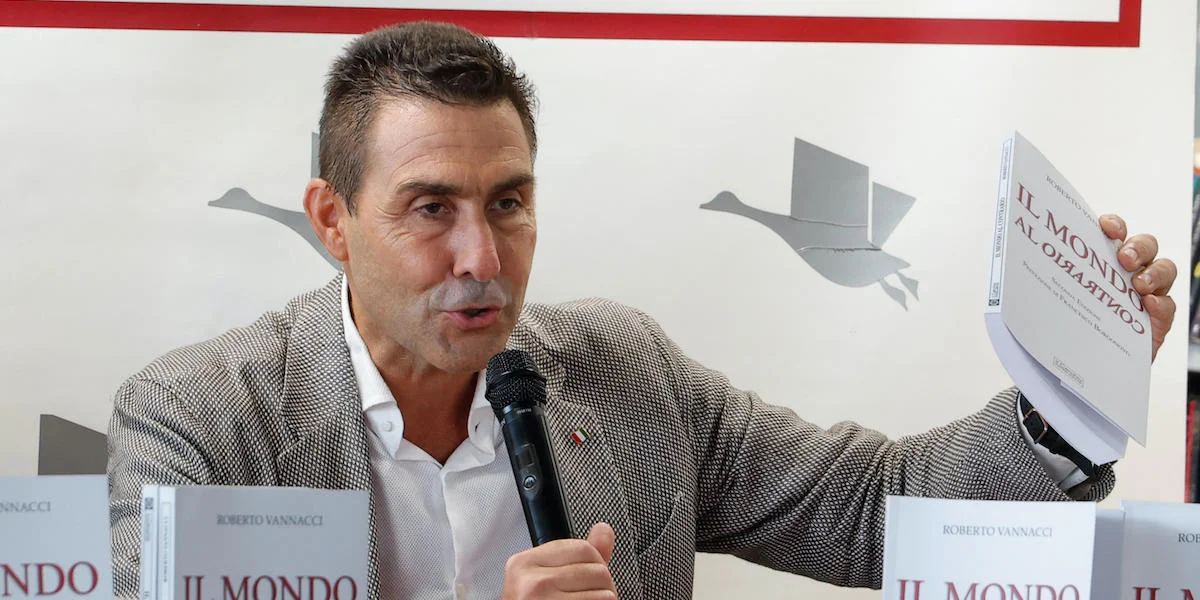
The autobiographyʼs unexpected popularity and the loud scandals around its content gave the general a certain media capital, which attracted the attention of Matteo Salvini — who at that moment was holding more radical positions himself, particularly on migrants. So in the 2024 European elections Lega put Vannacci forward as its candidate. After a campaign that openly appealed to fascist symbolism — notably through the use of the insignia of the Decima Flottiglia MAS — Vannacci became a member of the European Parliament.
Already in that post the general openly declared his sympathies for the Russian Federation and its leadership: choosing between “a comedian and a politician with twenty years of experience”, he would pick the politician who “brought prosperity to his country”[11].
“Between a comedian and a politician with twenty years of experience, I would choose the politician who brought prosperity to his country”Roberto Vannacci · on Putin, on air
Nor should it be forgotten that from 2020 to 2022 Vannacci was Italyʼs military attaché in Russia, with additional accreditation in Belarus, Armenia and Uzbekistan; he has kept friends there ever since, something he does not hide[12]. Quite recently, on one television broadcast, Vannacci declared himself open to Russian funding — provided it was “legal”[13].
Among the generalʼs associates is the “black baron” Roberto Jonghi Lavarini, long tied to far-right movements both in Italy and abroad. His pro-Russian stance is well known: years of contacts with Alexander Dugin and the popularisation of his geopolitical ideas. Jonghi Lavarini recently stated that Futuro Nazionale is actively building an international network of contacts — including with Russian circles close to Dugin and with the MAGA milieu[14]. Another example is Trieste city councillor Ugo Rossi, who joined the party already carrying no-vax and pro-Putin positions from before his entry into Futuro Nazionale.
But there are at least two more interesting figures among the “futurists”.
Section 4Russians among the futurists
Five figures around the general — from party co-founders to recent arrivals — and what is known about their ties to Russia:
| Name | Role in the party | Pro-Russian trail |
|---|---|---|
| Roberto Vannacci | Leader | Attaché in Moscow 2020–2022, public sympathies for Putin, openness to Russian funding |
| Roberto Jonghi Lavarini | Associate, the “black baron” | Years of contacts with Dugin, a network spanning Russian circles and the MAGA sphere |
| Ugo Rossi | Trieste city councillor | No-vax and pro-Putin positions before joining the party |
| Pietro Stramezzi | The “count”, head of the Milan branch | Lives in Russia, works for the Russian oil sector, founder of “Friends of Russia” |
| Larisa Yudina | Delegate to the founding congress | Born in Russia, publicly called Ukrainian cities “Russian cities” |
The “count” Pietro Stramezzi
One of them is the “count” Pietro Stramezzi, also known as Pyotr Venyaminovich Stramezzi — judging by certain certificates the nobleman has published on social media himself.
The aristocrat was born in Milan in 2001, the son of Dr Andrea Stramezzi — in his time a candidate for the micro-party Italexit and an opponent of coronavirus vaccination. Since 2024 he has lived in Russia, where, by his own account, he moved after receiving a job offer in the oil sector[15]. To get ahead of ourselves: he does indeed work for the Russian oil sector, specifically at 1oil Management[16], a consulting company registered in 2014 where, by some accounts, Stramezzi heads the foreign projects department. Officially 1oil employs 20 people, while the companyʼs net assets as of 31.12.2025 stand at minus 200 million roubles[17].
The “count” Stramezzi is an active and regular participant in various forums held in Russia. Judging by his Telegram channel, one can compile an entire list of conferences he has taken part in; the most interesting are “Back to the Future” run by the Sorok Sorokov movement[18], the All-Russian Patriotic Forum[19], the 13th Moscow International Engineering Forum[20] and the international youth forum in Sochi[21]. Worth singling out separately is a conference in the building of the Russian Senate on “developing” soft power for the struggle against the “American-Zionist deep state”[22].
Mr Stramezzi is also the founder and head of the association “Friends of Russia” (Druzya Rossii), whose only known public event was a congress in Moscow in September 2025. Among the participants were Fabrice Sorlin (a former member of Rassemblement National and head of the sanctioned International Russophile Movement), Andrea Palmieri (a former leader of the Lucca Calcio ultras and a separatist volunteer convicted of recruitment in 2024[23]), the Duceʼs great-grandson Caio Giulio Cesare Mussolini, and Italyʼs honorary consul in Yekaterinburg, Roberto DʼAgostino[24]. Stramezziʼs network of contacts does not end there: one might also mention the Italian propagandist Andrea Lucidi and Viktor Bout.
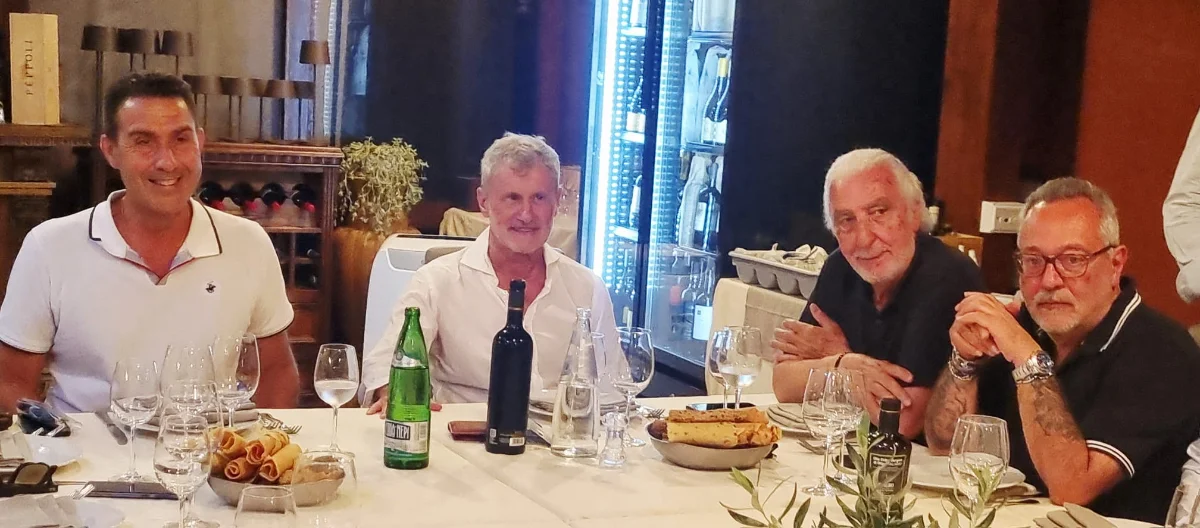
In Italy the “count” has managed to get acquainted with Gianni Alemanno and with General Vannacci himself, with whom he dined at the end of June[25] — right after Alemannoʼs release from prison. Alemanno was historically a member of the Movimento Sociale Italiano, mayor of Rome from 2008 to 2013, and from 2019 to 2022 a member of Meloniʼs Fratelli dʼItalia. He also went on to head the committee Fermare la Guerra (“Stop the War”)[26], where Stramezzi was “president” of the Milan branch[27], and is now an associate of General Vannacci.
Larisa Yudina
Besides Italian nobility, Futuro Nazionale also includes a Russian-born member. Among the heads of one of the partyʼs Milan branches and the delegates to the founding congress held this June is the lyric singer Larisa Yudina.
Ms Yudina was born in Maykop and began her singing career in Kaliningrad, but by the early 2000s had tied it to Italy[28], where she studied at the Giuseppe Verdi Conservatory in Milan. In 2005 she received Italian citizenship[29]. Her undeniably impressive musical career gave her little particular occasion to comment on the full-scale war in Ukraine — but there is one episode.
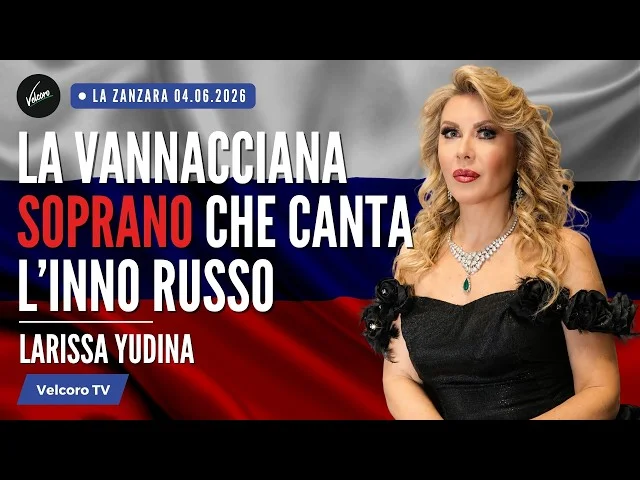
In March 2022 Ms Yudina and her cultural and musical association Stravinsky Russkie Motivi staged a charity concert in Milan “to help” Ukrainian refugees[30]. On Facebook, however, Ms Yudina calmly referred to Dnipro, Kharkiv, Kherson, Sumy and Luhansk as “Russian cities”, asking “and what does Ukraine have to do with it?”. In her subsequent public statements Yudina has not commented on the war, and her public role in the party is so far limited to performing the Italian anthem at various events[31]. That may be merely a matter of time — especially given Mr Vannacciʼs own general position on the war.
Section 5A new right?
The emergence of Futuro Nazionale on the political scene has been something of a shock both for society and for the political space. It can already be said that Vannacci is actively stealing voters from other right-wing parties — above all from Salviniʼs Lega — and will most likely be able to dictate terms to his political partners, for the reasons we have already examined.
Under the new electoral system a party on 6.5–7%, which is what Futuro Nazionale is, will play a key role in the new parliament and in the formation of the new Council of Ministers. The general himself has already stated that he will join a right-wing coalition only on the condition of a written agreement setting out, among other things, an end to military support for Ukraine[32] and the development of a “peace strategy”. Against the backdrop of the Trump administrationʼs unstable approach to Ukraine and Italyʼs desire to maintain good relations with Washington, this risk is becoming ever more concrete.
To sum up: Ukraine has few friends in Italy, especially among influential people and large political coalitions. In the left camp the Democratic Party has still failed to work out a clear and unified position on the war, promoting a general rhetoric of peace and pacifism. The Five Star Movement, for its part, is rather pro-Russian — especially its current leader Giuseppe Conte. One might recall the tour of Russian CBRN troops across Italy in 2021, when he headed the Council of Ministers. Or one might recall his very recent words that Russia is “being turned into a threat”[33], and his call to sit Zelensky and Putin down at the negotiating table[34].
In the near future it will become clear what General Vannacciʼs aggressive, populist rhetoric actually translates into, and how it will affect Italyʼs role in supporting Ukraine.
Sources
- Here and below: Futuro Nazionale translates as “National Future”.
- Corriere della Sera, 16.07.2026 — what the electoral-system bill passed by the Chamber of Deputies (“Stabilicum”) actually provides for. corriere.it
- YouTrend — dossier on the electoral reform, July 2026: projected distribution of seats under the new system. youtrend.it (PDF)
- Antonio Tajani — leader of Forza Italia after Berlusconiʼs death, currently Italyʼs foreign minister.
- Linkiesta, July 2026 — who funds Futuro Nazionale: the sectors and companies among the partyʼs donors. linkiesta.it
- Futuro Nazionale — the partyʼs own funding-transparency report as of 23.06.2026: the total of voluntary donations. The partyʼs figures about itself. futuronazionale.it (PDF)
- For comparison: Meloniʼs party had roughly 204,000 members and a budget of €10.8 million in 2022; Forza Italia — 250,000 members and €7.2 million for 2025.
- Ukraine Support Tracker, Kiel Institute for the World Economy — the volume of Italian military aid to Ukraine. kielinstitut.de
- Today.it — the Berlusconi audio recording published by LaPresse on the “rupture” of the Minsk agreements and on Donbas, 2022. today.it
- “Il mondo al contrario” translates as “The World Upside Down”.
- ANSA, 09.09.2025 — Vannacci on choosing between Zelensky and Putin: he picks Putin, “with him there was prosperity”. ansa.it
- Il Messaggero — video: Vannacciʼs slip about Crimea and a “villa in Russia”, and his correction at the press conference. ilmessaggero.it
- Adnkronos — Vannacci says he is open to Russian funding for the party, “provided it is legal”. adnkronos.com
- Open, 17.03.2026 — interview with Roberto Jonghi Lavarini: Futuro Nazionaleʼs international network, contacts with Dugin-adjacent circles and the MAGA orbit, and the meeting with Peter Thiel. open.online
- YouTube — interview with Pietro Stramezzi (from 05:04): born in Milan, moved to Russia in 2024 and works in the oil sector, in his own account. youtube.com
- Valigia Blu — analysis of the Russian propaganda network around “remigration” and Vannacci: Stramezziʼs work in the Russian oil sector. valigiablu.it
- Audit-it — registry data on OOO 1oyl Management: year of registration, headcount, net assets as of 31.12.2025. audit-it.ru
- The Telegram channels Sorok Sorokov t.me/sorok40russia and Italia — Russia t.me/italianrussia — Stramezziʼs attendance at the “Back to the Future” forum. Telegram channel content is presented as those channelsʼ own claims.
- Telegram channel Italia — Russia — attendance at the All-Russian Patriotic Forum. t.me/italianrussia
- Telegram channel Italia — Russia — attendance at the 13th Moscow International Engineering Forum. t.me/italianrussia
- Pietro Stramezzi on X — post about the international youth forum in Sochi. x.com/PStramezzi
- Telegram channel Italia — Russia — the conference in the Russian Senate building on “soft power”. t.me/italianrussia
- ANSA, 14.03.2024 — the Court of Cassation upholds a five-year sentence for the pro-Russian volunteer fighter Andrea Palmieri over recruitment. ansa.it
- Telegram channel Italia — Russia — the roster of participants at the Moscow gathering in September 2025. t.me/italianrussia
- Pietro Stramezzi on X — posts about the dinner with Gianni Alemanno and General Vannacci, June 2026: firstand second.
- “Fermare la Guerra” translates as “Stop the War”.
- Telegram channel Italia — Russia — Stramezzi as “president” of the Milan branch of the Fermare la Guerra committee. t.me/italianrussia
- Arte Viva association — biographical profile of the singer Larissa Yudina: Maykop, Kaliningrad, the move to Italy. associazionearteviva.com
- YouTube — interview with Larissa Yudina (from 05:23): studies at the Giuseppe Verdi conservatory in Milan and Italian citizenship. youtube.com
- MilanoToday — the Milan charity concert “to help” Ukrainian refugees and the objections to its content. milanotoday.it
- Larissa Yudina on Facebook — post about performing the Italian anthem alongside General Vannacci in Imperia. facebook.com
- Corriere dellʼUmbria — Vannacci on his terms for joining a coalition with Meloni: a written agreement and a new line on Ukraine. corrieredellumbria.it
- Il Post, 10.07.2026 — Giuseppe Conteʼs position, and that of the “broad field”, on the Russian threat. ilpost.it
- YouTube — recording of Giuseppe Conte calling for Zelensky and Putin to be brought to the negotiating table. youtube.com
- ANPI — the organisationʼs position on Ukraine and on recognition of the separatist “republics”. anpi.it
- ANPI — statement by Gianfranco Pagliarulo: the organisation condemns the invasion of Ukraine, and he offers no self-criticism of its own line. anpi.it