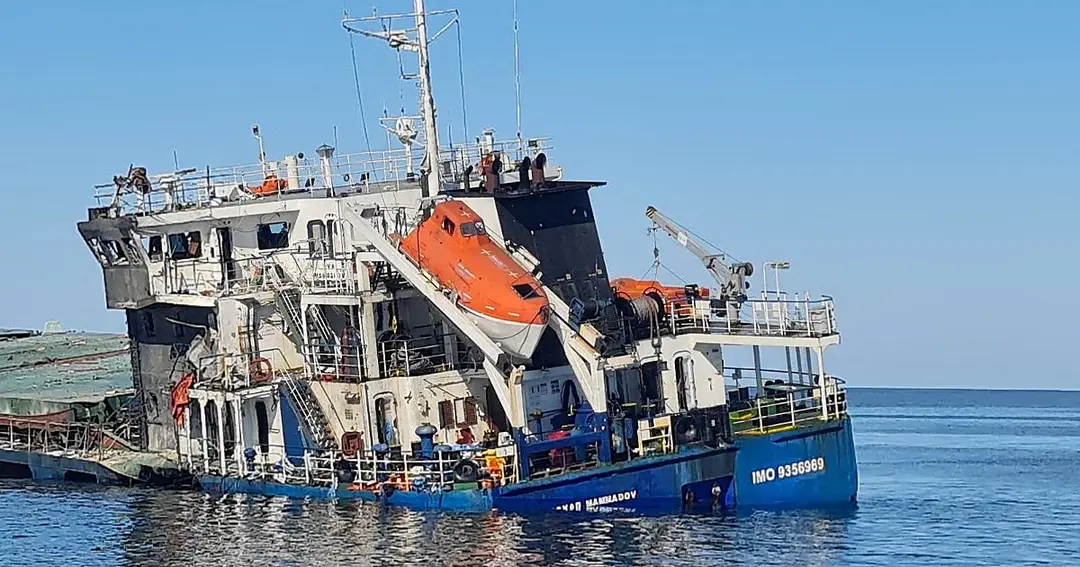
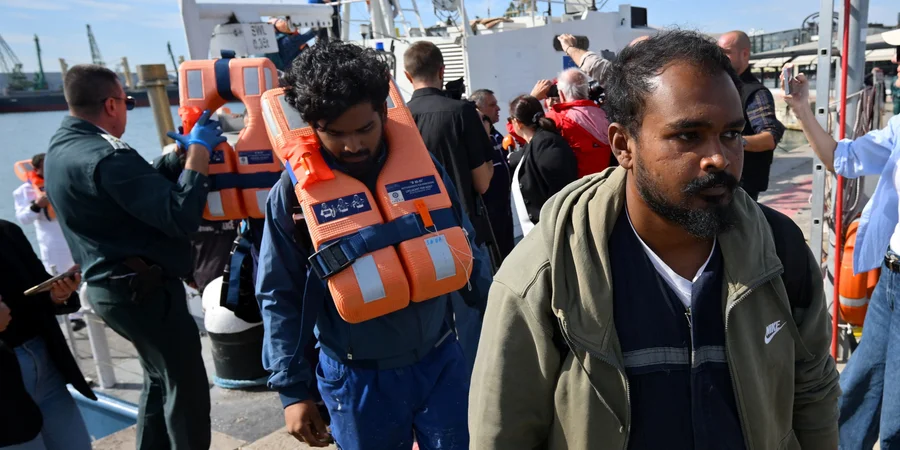
Those that sank were the grain carrier Royad Mammadov with Ukrainian maize, the cargo ships Alfa Watan, HS Dignity and Able, and, on 23 October off Constanța, the Khoryv with ten Ukrainians in its crew[4][1][5][6]. According to Bulgaria's Chief of Defence, Admiral Emil Eftimov, the crew of the Alfa Watan had three minutes to save themselves[7]. The tanker Yara J and the bulk carrier Sea Destiny were caught by drones already inside Romanian territorial waters[1]. The war on shipping in the Black Sea keeps crossing new lines and growing more brutal by the day.
On 1 October 1946 the International Military Tribunal at Nuremberg found Grand Admiral Karl Dönitz guilty of violating the London Protocol of 1936. The protocol forbade any warship, surface or submarine, to sink a merchant vessel without first placing its crew in a place of safety, and lifeboats did not count as one[8]. The tribunal wrote in its judgment that the protocol was explicit: if a commander cannot save the crew, he may not sink the ship and should allow it to pass harmless before his periscope[9]. Both the United States and the Soviet Union acceded to the protocol[10].
Eighty years on, the rule protected none of these ships. Three thousand kilometres to the east, in the Strait of Hormuz, tankers have been burning for eight months. Why does neither a flag, nor neutral waters, nor the country whose waters a merchant ship is crossing protect it today, and who will pay for the war at sea out of their own pocket and with an empty stomach? PLITKA Analytics investigates.
§ 00 · The seaShipping in dangerous waters
The ships that carry grain, oil and fertiliser across the Black Sea mostly belong neither to Ukraine nor to Russia. The Alfa Watan, built in 1976, flew the flag of Togo and was owned by Baraka Shipping of Mersin in Turkey[11]. The twenty-year-old Royad Mammadov flew the flag of Saint Kitts and Nevis, was registered to a company called MG Shipping 5 and was commercially managed by Spring Marine of Istanbul[12]. On board the Able, the second ship hit off Byala, were eleven Turkish and seven Indian nationals[7]; the Royad Mammadov had Azerbaijani and Indian crew[13]. This is what the tramp fleet that carries world trade looks like. The ship, the flag, the owner and the crew belong to different states, and often none of them is a party to the war whose victim the ship becomes.
On 16 September 2026 the Joint War Committee of the London insurance market extended its war-risk listed area to the whole of the Black Sea. Only the 12-mile territorial waters of Turkey, Romania, Bulgaria and Georgia were left outside it[14]. Until then the area covered only the waters off Russia and Ukraine. Sailing through it is not prohibited, but the shipowner must notify the insurer and pay an additional premium, and is sometimes refused cover altogether[15].
By the count of the maritime security company Ambrey, in the twelve months to 21 September 2026 45 merchant ships were hit outside the old listed area, against none in the twelve months before. Inside the old area, in the fifth year of the war, an average of 28 ships a month are hit, against four a year earlier[14].
Ambrey explains the jump by both warring sides having set up industrial production of aerial and sea drones and turned them first of all against the enemy's trade rather than its navy. Russia strikes Ukraine's export corridor: the ports of Greater Odesa and the Danube, and ships at berth, at anchor and at sea. Since late November 2025 Ukraine has been attacking ships calling at Russian ports, above all shadow-fleet tankers, and since July 2026 dry cargo ships, container ships and ro-ros as well[14].
Almost six times as many floating explosive objects were found outside Russian and Ukrainian waters in the past year, 65 against 11, and instead of mines it is now uncrewed boats and drone debris that drift[14]. The International Maritime Organization (IMO) calls the war a "serious and imminent threat" to crews and ships in the Black Sea and the Sea of Azov[13]. Since the start of the full-scale invasion at least 274 civilian vessels have been damaged in the Black Sea[16].
But back to Hormuz. The US and Israeli war with Iran, which began on 28 February 2026, turned the Strait of Hormuz, through which a fifth of the world's oil passed before the war, into a hunting ground[17]. According to the IMO, at least twenty seafarers and port workers had been killed there by the end of August[18]. Both theatres hit the markets for grain, fertiliser and diesel, and the whole world market suffers badly for it[19].
§ 01 · WestPort Ukraine
The Royad Mammadov was sailing along the Romanian coast, on a route that by every logic should have been safe, since under international law these waters belong to a NATO country[20]. Like hundreds of merchant ships before it, it chose the safest route available. For a long time that route paid off, once a ship had slipped past Ukraine's territorial waters. After all, Moscow openly acknowledged strikes on vessels further north. In particular, the day before the strike on the Royad Mammadov, the Russian Ministry of Defence said that "two dry cargo vessels delivering military property to the port of Odesa have been hit". It did not name the ships or show any evidence[21]. After the Alfa Watan sank, the Russian embassy in Bulgaria was far more modest and told Reuters that neither ship had been "on the list of targets" of the defence ministry and called for an investigation into whose drones they were[22].
After the first sinkings, neither of the two states in whose waters the ships sank dared to name the aggressor. Romania's interior ministry gave no cause for the fire on the Royad Mammadov[23]. Bulgaria's prime minister Rumen Radev said the drones were "clearly either Russian or Ukrainian" [7], and that there is no evidence that would allow responsibility to be placed on it directly[24]. Bulgaria's defence minister Dimitar Stoyanov was also careful not to say too much: "Drone debris has to be found, or one of the sides has to claim responsibility, but that has not happened, so we cannot confirm whether they are Ukrainian or Russian" [25].
Sofia's caution has a context. In June 2026 Bulgaria halted military aid to Ukraine, and in August, after a drone exploded near the Balkan Stream gas pipeline, its defence ministry said the drone was of a type "widely used by the Ukrainian military" [26].
When drones hit tankers off Sulina on 14 and 15 October, Bucharest changed its tone. Romania's foreign minister Oana Țoiu called the attacks "callous and murderous" and said that "Russia bears full responsibility" [27]. After the Khoryv sank, President Nicușor Dan called it "a new example of the tragic consequences of Russia's aggression against Ukraine" [2]. Sofia summoned the Russian ambassador, but Radev went on insisting there is no hard evidence, even though "it is simply illogical for Ukraine to attack ships carrying its own grain"[28]. The drone debris Stoyanov was missing has now been found by the Bulgarians aboard the Chelsea 3, and military prosecutors have opened a case[5].
The European Commission, as usual, shows more courage. Its spokesman Christian Wigand called the attacks on ships carrying wheat "absolutely unacceptable" and called on Russia specifically to "stop all actions that endanger international shipping and the lives of seafarers". At the request of Romania and Bulgaria, the EU is passing satellite imagery to them[29].
Syria, whose nationals went missing with the Alfa Watan, is demanding an independent investigation from the IMO and Bulgaria and asking why the search for the crew was called off without establishing their fate[24].
The strikes off Romania and Bulgaria continued a campaign Russia has been waging against Ukraine's maritime corridor since early summer. In July 2026 alone it attacked port facilities 67 times, ships at berth 35 times and ships in the corridor another 22 times[30]. On 13 July five foreign sailors were killed off Chornomorsk aboard a Togo-flagged ship carrying fertiliser, and on 17 and 18 July four more in the ports of Mykolaiv and Odesa[31].
On 19 July three cruise missiles hit the Guinea-Bissau-flagged bulk carrier Golden Leo as it was leaving Greater Odesa with maize. Ten people were killed, among them a Ukrainian pilot[31]. Ukraine's Seaports Authority called this strike one of the events that changed how shipowners and insurers see the risk of calling at Odesa. On 22 July not a single ship entered the ports of Greater Odesa, for the first time since the corridor opened. In all of July 169 ships called there, and in the first eleven days of August just seven[32].
Cargo went where it could still be loaded: to the Danube. By Ambrey's count, the Danube ports' share of cargo handled by Ukrainian ports rose from about 10% in the first half of the year to 74% in August. The Greater Odesa cluster fell from 7.9 million tonnes in April to 430,000 tonnes in August, while the Danube almost doubled in a month, to 1.24 million tonnes. Ship calls at the Danube ports rose from 363 to 737[33].
The strikes followed the cargo to the Danube. In July–September there were 3.7 times as many incidents a month near Izmail, Reni and Kiliia as in the first half of the year. Since July Ambrey has counted at least nine ships hit on the approaches to the Danube, five of them in Romanian waters[33]. The company put it this way: "The Danube is no longer simply an alternative route. It is now part of the contested front line of Ukraine's maritime trade. Where the volumes go, the strikes follow, from the berth to the open sea" [33].
The Danube cannot bear such a load. In July, during a record drought, the river's flow on the Romanian stretch fell to 1,700 cubic metres a second against the usual 4,700, the lowest since 1996, and barges stood idle[32]. At the end of August some 80 ships were waiting to enter the Danube[34], and on 5 October up to 125 ships were queuing off Sulina, with waits of 14–17 days. Ambrey notes that the queue gathers ships at predictable points within drone range[33].
Lorries to Izmail and Reni take the Odesa–Reni highway across the bridge over the Dniester near Maiaky. It is the last Ukrainian bridge over the Dniester in the Odesa region, since the bridge at Zatoka has long been impassable after hundreds of strikes[35]. Russia first struck it in December 2025; traffic to the west of the region then stopped, and Ukraine and Moldova agreed on detours through Moldovan territory[36]. In August 2026 analysts at the Institute for the Study of War noticed that Russia was shifting its strikes from seaports to the overland routes of the Odesa region in order to disrupt grain exports, and that the Maiaky bridge was under threat[37].
On 5 October a ricocheting shell hit a scheduled bus near the Palanca–Maiaky–Udobne border crossing, and the crossing was closed[38]. Moldova is building drone shelters at its border crossings and pulling its border guards out of the joint Palanca and Criva checkpoints onto its own territory[39]. On 9 October Ukraine's Air Force twice warned of jet-powered drones heading for Maiaky[40][41]. On 7 and 9 October the pro-Russian Telegram channel Voenny Osvedomitel published videos of jet-powered Geran-4 drones hitting columns of Ukrainian lorries on the highway near Maiaky. By its account, the 9 October strike hit lorries stuck in a jam after yet another strike on the bridge[42][43].
Those who still call at Odesa keep coming under fire. On 17 September a Russian drone killed the captain of a Tanzania-flagged ship bound for a Ukrainian port, and on 3 October a sailor from a Liberia-flagged ship was killed in a port of the Odesa region[44][13].
In this way Russia is deliberately demonstrating that the old rules of naval warfare no longer apply, nor do the old routes, that it will strike any ship, even in the waters of neutral countries, and that if it happens to hit a ship that had nothing to do with Ukraine, nothing much will change. The Black Sea countries, for their part, have confirmed that they are not prepared to deter such a threat. They find it easier to stand aside from potential confrontation. Appeasing the enemy opens the way to deeper terror.
The National Bank of Ukraine calls what began on 23 July a new phase of the maritime blockade. In recent years Ukraine exported an average of 4–4.5 million tonnes of agricultural produce a month, about 90% of it by sea. Alternative routes, by the NBU's estimate, can handle about 2.5 million tonnes in August–October. The bank puts the direct loss of export revenue in the second half of 2026 at more than $2 billion, and the contribution of the attacks, above all the destruction of logistics and the blocking of seaports, to GDP growth at minus 0.9 percentage points[45]. Market estimates are harsher: each day the Black Sea ports stand idle costs Ukraine about $70 million in export earnings, and the foreign trade deficit reached $28.3 billion in the first half of the year alone[46]. According to the Financial Times, agricultural exports from Ukrainian ports have fallen by about 75% from pre-war levels[3].
Farmers pay first, because the price they get equals the world price minus delivery. As soon as grain is forced onto a more expensive route, the difference comes off the purchase price. Between 16 July and 6 August class-2 wheat in central Ukraine fell 31% in price, from 9,200 to 6,400 hryvnias a tonne, barley 27% and maize 15%. By the estimate of the Ukrainian Agribusiness Club, wheat is already selling about $15 a tonne below production cost, barley by more than $40[32]. Bypass routes cost at least $50 a tonne more than the sea route[34]. NIBULON counts $70 of additional costs, of which higher world prices offset only $15–20[32]. Agriculture minister Taras Vysotskyi puts the extra logistics burden at almost $3 billion, money neither farmers nor the state have, and expects less to be sown for the 2027 harvest, above all winter wheat[34].
The All-Ukrainian Agrarian Council and the government estimate the surplus of grain building up in the country because of the port shutdown at roughly 30–35 million tonnes[46][47]. As early as the beginning of September the council advised exporters to plan on the deep-water ports staying shut until December or January[34]. The neighbours are in no hurry to help: Romania and Poland have refused Kyiv additional transit. "The interests of our own farmers remain the priority," explained Romania's agriculture minister Barna Tánczos[47].
According to the Ukroliyaprom association, Ukraine is shipping about 300,000 tonnes of sunflower oil a month, half the usual amount[48]. Agricultural produce and metals together make up 70% of all Ukrainian exports, and most of it went by sea[32]. For those who still dare to make the voyage, insurance is getting more expensive. At the end of August the additional war-risk premium for calls at Greater Odesa and the Danube was 1–1.25% of the ship's value, while earlier the figures had been up to 0.75% for Odesa and 0.3–0.5% for the Danube[49]. In October Ambrey reported that many insurers are refusing to cover calls at Ukrainian ports at all[33]. By the end of October war-risk cover in the Black Sea had reached 15% of a ship's value, twice as much as in the Persian Gulf[3].
§ 02 · EastPort Russia
The Aframax Rio was under the sanctions of only one country: Ukraine. The National Security and Defence Council added it to its list on 12 February 2026 together with another 90 shadow-fleet vessels. According to the council, the tanker belongs to Rio Enterprises, registered in the Marshall Islands, and was chartered through the Singapore operator Navig8 and Greek managers. In 2024–2026 it repeatedly carried oil from Ust-Luga, Novorossiysk and Taman to India, Singapore and Saudi Arabia[50].
In its last weeks before the strike the tanker pretended to be heading for Romania. Its AIS destination was set to Constanța[50], but Constanța does not appear among its port calls over the past year as shown by MagicPort. Tuzla, Samsun, Çanakkale, Suez and Port Said do[51]. It caught fire 11 kilometres from Sochi, in Russian territorial waters[52]. All 23 crew members, Indian nationals, were rescued[53]. The next day Zelensky reported a strike in the Black Sea without naming the target[54].
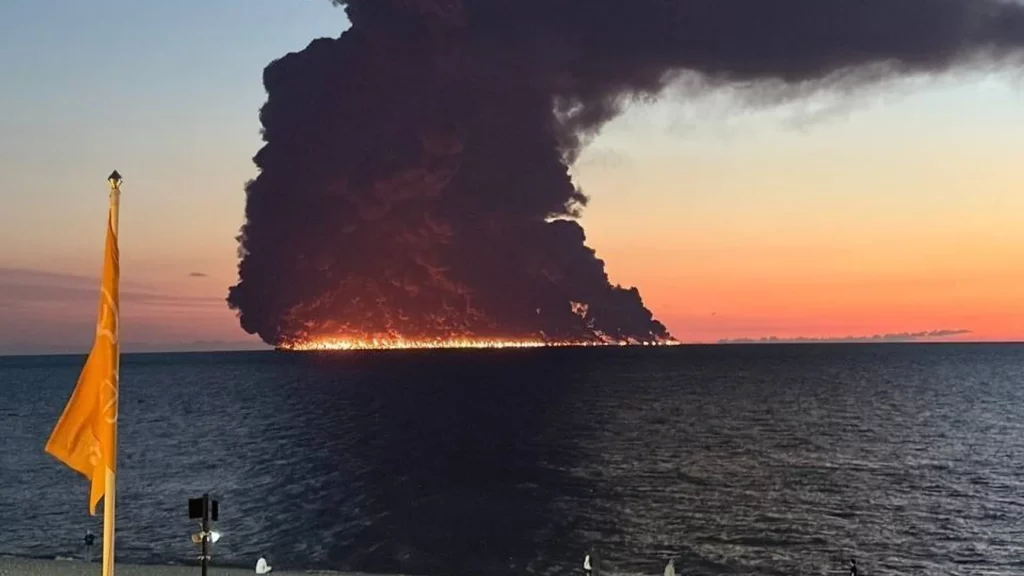
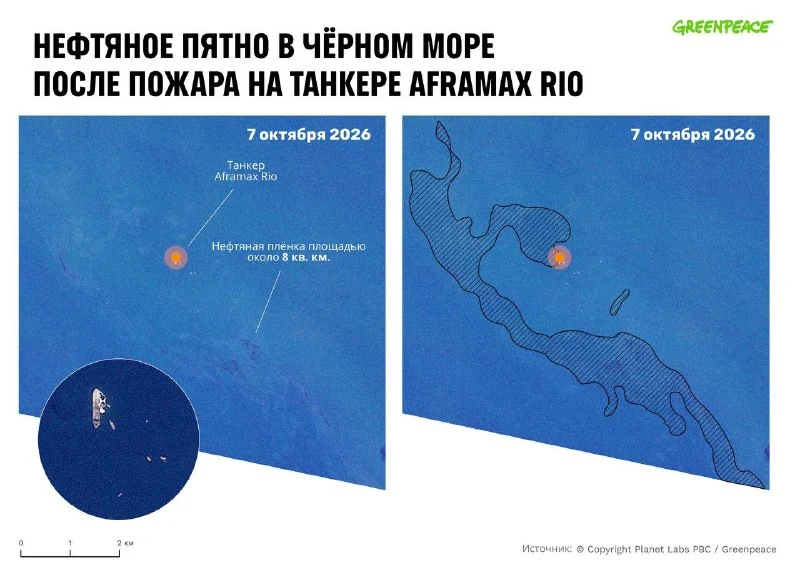
The Russian authorities called the attack terrorism[55]. Within a day of oil burning openly on the water, the transport ministry declared that there was no pollution of the sea. The clean-up is being handled by a joint task force of the transport ministry, the emergencies ministry, Krasnodar region and the defence ministry[56]. Greenpeace warns of "unprecedented pollution of the Black Sea", larger than the two previous major spills in the region[55]. According to Greenpeace's analysis of satellite imagery, by 8 October the slick behind the tanker had grown to about 25 km², and the Aframax Rio itself had been towed north-west past Tuapse[57]. The organisation believes that what burned was most likely the ship's own bunker fuel, and bluntly calls the Russian authorities' claims that there was no pollution untrue[58]. Within a week oiled birds began turning up on the beaches of Anapa, Novorossiysk and Lazarevskoye[59]. And on 20 October, according to video from environmental activists, the tanker was still lying at Novorossiysk with oil on board[60].
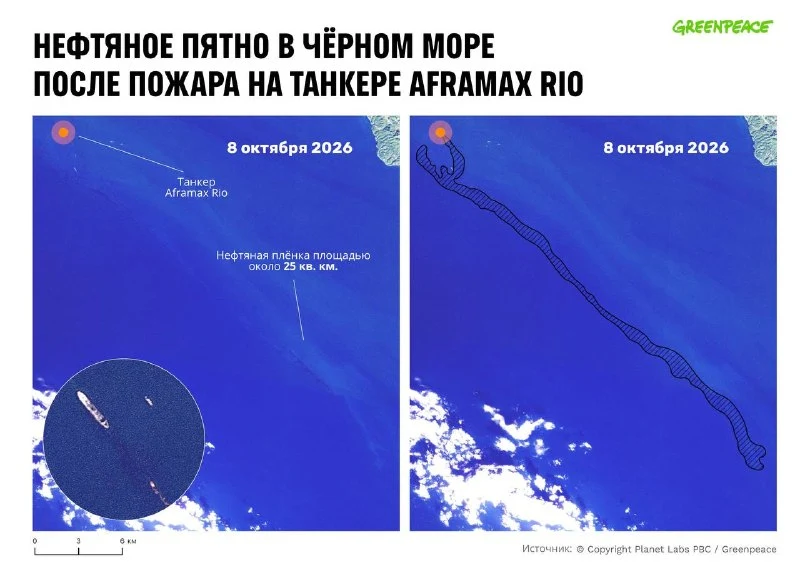
The Aframax Rio became another bright point in the campaign Ukraine has been waging against Russian seaborne exports since the end of 2025. Strikes attributed to Ukraine now land on average 58 nautical miles from shore, off Turkey's northern coast and in open sea south of Novorossiysk and Sochi[14]. On 10 July 18 Russian vessels, 13 of them tankers, were hit in the Sea of Azov in a single night, and 35 within 96 hours. On 15 July drones hit up to 20 vessels in the Black Sea in one night, among them 17 tankers and 2 gas carriers[31]. On that same 10 July Russia restricted shipping in the Sea of Azov[61].
Since 21 July the Sheskharis terminal in Novorossiysk has not loaded a single tanker. In the first seven months of the year it shipped about 650,000 barrels of oil a day, roughly a fifth of Russia's seaborne exports. Drones also forced the neighbouring Caspian Pipeline Consortium terminal, which handles about 80% of Kazakhstan's oil, to stop, and Kazakhstan began cutting output. The Russian authorities warned all ships in Russia's Black Sea economic zone that the area was dangerous[62]. On 12–13 August all three grain terminals in Novorossiysk, KSK, NZT and NKHP, stopped work: 24.6 million tonnes a year between them, about 75% of Russia's Black Sea grain capacity[61].
In the north, where the threat is of a different kind, namely the detention of ships, Russia responds with naval convoys. In the Black Sea it cannot do that. Only recently the large anti-submarine ship Admiral Levchenko and the frigate Neustrashimy escorted the sanctioned cargo ships General Skobelev and Sparta through the North Sea and the English Channel, while the Royal Navy shadowed them[63]. The First Sea Lord, General Sir Gwyn Jenkins, explains this by saying that after the British seized the sanctioned tanker Smyrtos in June, shadow-fleet ships have been forced to change routes, and Moscow is diverting warships to guard cargoes[63]. Retaliatory provocations followed: in the Baltic on 30 September FSB border guards detained for several hours the Cypriot cargo ship Västerbotten, which was sailing from Sweden to Sillamäe in Estonia[64].
Grain is getting stuck in Russia just as it is in Ukraine. According to the Russian Grain Union, in the middle ten days of September the country exported 347,000 tonnes of wheat against 1.3 million a year earlier, and only 72,500 tonnes went through Novorossiysk, 9.6 times less. Wheat buyers fell from 29 countries to eight, Egypt took 3.6 times less, and Turkey only 6,100 tonnes against more than 200,000 a year earlier. For the whole of September the union forecasts no more than a million tonnes against 5.7 million a year earlier, and shipments increasingly go through the Baltic ports of Vysotsk and Ust-Luga[65]. Analysts at SovEcon estimate the fall in July–September at half, and the Baltic ports can replace less than a tenth of the usual southern volumes[66].
Kuban, Russia's main grain region, has declared a state of emergency. "We have harvested a large grain crop, but we have run into a problem selling it because of restrictions on the ports," the governor explained. At federal level export duties have been scrapped, a moratorium on farm bankruptcies introduced, and subsidies for sowing winter crops are being prepared[67]. A 20,000-tonne shipment of Russian sunflower oil for India was cancelled because the supplier could not load it, and another 60,000 tonnes or so were delayed[48].
On 24 September exports of diesel and gasoil through the Black Sea fell to zero for the first time on record, and all of Russia's seaborne diesel exports went only from the Baltic port of Primorsk[68]. On 9 October, after a call with Putin, Trump announced that Russia would supply its diesel to US and world markets, and the US Treasury authorised transactions in it until 7 April 2027[69]. The next day Russia partially lifted its own ban on diesel exports[70]. Even analysts doubt there will be much to export. According to Kpler, Russian refineries are running at about 60% of capacity. "Russia does not have an export problem. It has a refining problem," says Michelle Brouhard of Kpler[71]. The first tankers are already on their way. The PVT Azura is carrying diesel from St Petersburg to Norfolk, and the Agioi Fanendes 40,000 tonnes from Primorsk to New York[72]. Supplies to Turkey and Brazil have resumed as well[73]. Even so, diesel is unlikely to risk going by the Black Sea, perhaps only in the event of a real ceasefire. Crude oil is a different story. In September, according to market sources, loadings from Novorossiysk recovered to about 650,000 barrels a day[74]. Meanwhile weekly revenue from seaborne oil exports, according to Bloomberg, reached its highest since the start of the full-scale invasion[68].
The war in the Persian Gulf doubled the price of Urals crude, from about $45 a barrel to more than $92. Yet the federal budget's oil and gas revenue for the first nine months of 2026 fell by 17%, production is falling, the government has cut its output forecast to a 17-year low, and refineries remain under attack[75]. In September revenue was down 22% year on year, and the entire gain in mineral extraction tax was eaten up by compensation payments to refiners[76]. The finance ministry has cut its estimate of oil and gas revenue for 2026 from 8.9 to 7.6 trillion roubles[77].
§ 03 · WorldOther seas
Before the war about 125 large commercial ships passed through the Strait of Hormuz every day[78]. After 28 February Iran effectively closed the strait, and since 13 April the US has been blockading Iranian ports. Formally the blockade does not affect transit to non-Iranian ports, but ships heading to or from Iran are turned back or disabled by US forces[79]. On 5 October US Central Command summed up twelve weeks of the blockade: 130 ships stopped, three disabled, 13 commercial vessels destroyed[79]. The strikes continue to this day[80].
On 5 September, after Iran's Islamic Revolutionary Guard Corps fired ballistic missiles at a US aircraft carrier and destroyer, the US struck three Iranian tankers. Two were disabled; the third, the empty Kylo, was destroyed and sank in the Gulf of Oman[81]. Before the strike on the Stark 1, a US aircraft came on the emergency channel: "Tanker STARK 1, this is the United States military aircraft. I am preparing to fire at your stern. You have 10 minutes to clear the crew from the stern of your ship." Then came the final warning: get into the lifeboats and abandon ship[82]. On 8 and 9 September the US destroyed five more tankers, each time ordering the crews to abandon ship before the strike[17]. "If Iran shoots at U.S. ships, we will destroy (and sink) their oil tankers," explained Pete Hegseth, head of the Pentagon[82].
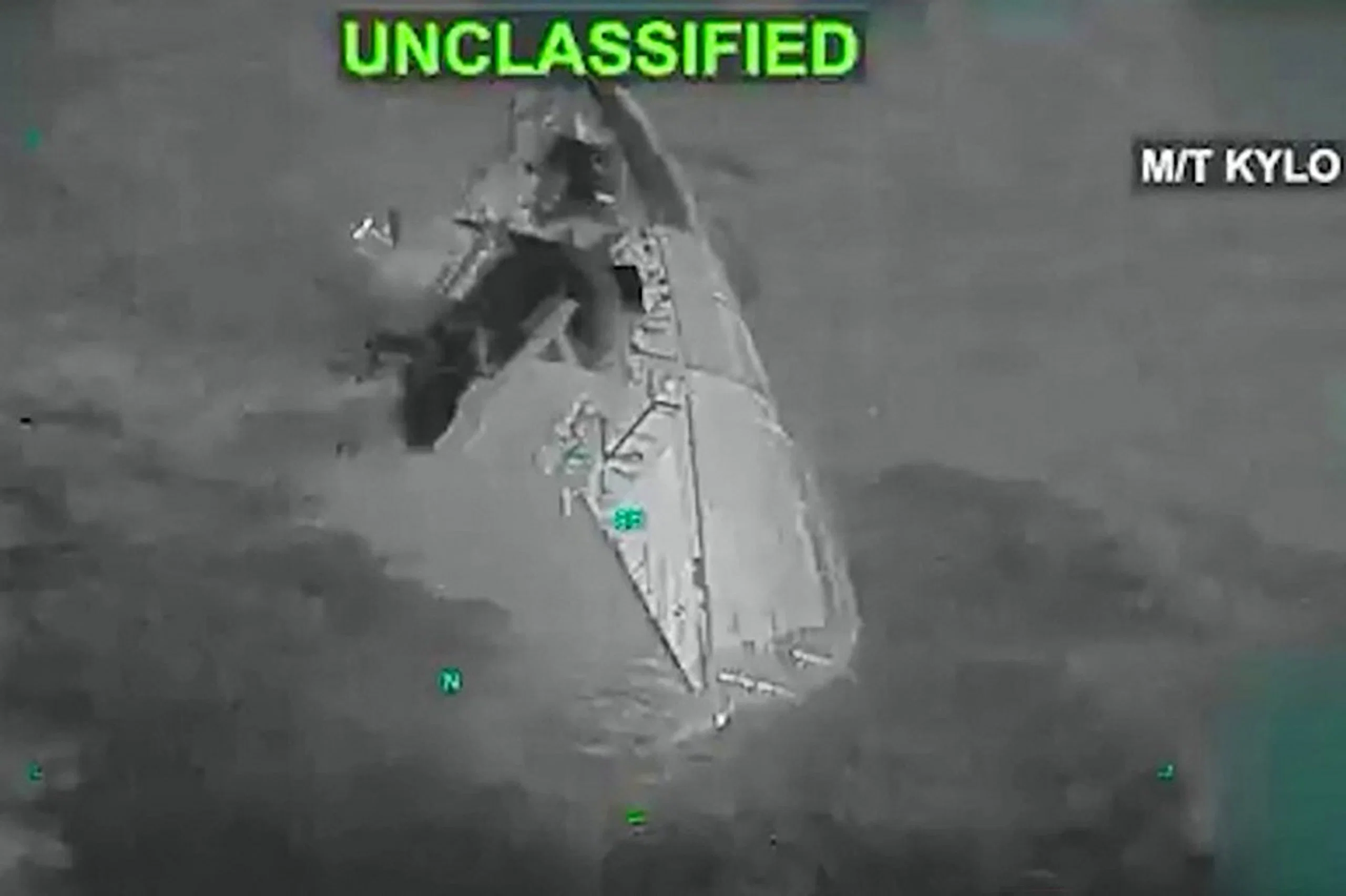
In June the US blockade killed seafarers for the first time. An aircraft hit the engine room of the Palau-flagged tanker Settebello because, according to Central Command, the crew was not following instructions. Three Indian nationals were killed. India summoned the US deputy ambassador and lodged a strong protest[83].
Attacks, naturally, come from the Iranian side too. On 2–3 October four such attacks were confirmed off the Omani coast; in one case a drone flew into a ship's funnel and fell into the engine room. Separately, the Revolutionary Guard ordered a tanker 11 miles north of Khasab by radio to turn back or be attacked, and the master complied[84]. In the first six days of October nine tankers were attacked in Hormuz, as many as in the whole first half of September[78].
On the evening of 7 October several projectiles hit a tanker 51 miles north of Madinat ash Shamal in Qatar. There were casualties, but UKMTO did not report how many, nor the name of the ship or the origin of the projectiles[85]. It was the first strike in the Persian Gulf outside Hormuz, 54 kilometres from Ras Laffan, Qatar's main gas terminal. No one claimed responsibility[86]. It happened in Qatar's exclusive economic zone, and Doha, like Sofia and Bucharest a week earlier, chose not to comment[78]. Two days later a projectile hit the fully laden Panama-flagged supertanker GEM NO.2 at anchor 13 miles off the coast of the UAE[87]. The Revolutionary Guard threatened that from now on it would pursue ships on "unauthorised routes" across the whole region, not only in the Strait of Hormuz[88]. According to Lloyd's List, there were 12 attacks in the region between 28 September and 7 October, the highest weekly total since the war began[89]. On 11 October six ships were hit in a single day in the strait and off Oman[90], and on the 14th a container ship, the GFS Pride, and a bulk carrier sank after being hit[91][92]. Britain and France are planning a multinational mission to escort ships through the strait[93], while Iran offers to reopen it in exchange for lifting the US blockade[94].
About 20,000 seafarers remain in the region, some of them on ships that cannot leave the Persian Gulf. An IMO plan to evacuate six thousand of them has been suspended[95]. By the end of August the International Maritime Organization had confirmed 68 attacks in the region, on average one every 2.6 days. Half of them involved tankers, most often under the flags of Liberia, Panama and the Marshall Islands[18].
The International Energy Agency estimates that in August more than 10 million barrels a day of production was shut in across the Persian Gulf. In February the Gulf and Russia together still accounted for almost 45% of world seaborne trade in diesel; in August their net exports were 1.6 million barrels a day lower. The agency ties these losses directly to Ukrainian strikes on Russian refineries and the near-complete halt of Russian product exports. In early September diesel in the US cost more than $200 a barrel, 94% more than before the war[19].
In Yemen, on the coast of the Red Sea, another key shipping corridor, the situation is not stable either. Yemeni government forces backed by Saudi Arabia are fighting the Houthis for Mocha and the coast of the Bab el-Mandeb, and the Houthis answer with missiles at Saudi airports. As for ships, the Houthis say they act only against those linked to Saudi Arabia[96]. On 4 October a series of explosions went off near the tanker Chrystal Sky 60 miles south of Mocha, one of them a hundred metres from its side[97]. On 7 October a small boat fired on a Chinese container ship in the northern Bab el-Mandeb. The crew was unharmed; who fired is unknown[96]. On 22 October the Houthis struck Dammam airport and the Shaybah oil field in Saudi Arabia, and Brent rose to almost $113 a barrel[98].
The Caribbean offers the most direct example of how declaring an "armed conflict" strips a civilian boat of any protection. Since September 2025 the US military has carried out at least 70 strikes on boats the Trump administration calls narco-terrorists, killing at least 235 people. The latest strike, on 4 October, killed four. The military offers no evidence that the boats were carrying drugs, and more often than not there is none[99].
§ 04 · LawNobody's ships
The Alfa Watan flew the flag of Togo, belonged to a Turkish company, probably had a Syrian crew[22] and sank in Bulgaria's economic zone. None of these four states is obliged to protect it. An exclusive economic zone is not a state's territory. A coastal state's sovereignty extends only to its 12-mile territorial waters and the airspace above them; in the economic zone it has rights to resources but cannot forbid a foreign warship or drone from entering. Even an aerial drone over the Bulgarian economic zone does not formally violate Bulgarian airspace[100].
That is why Radev ruled out consultations under Article 4 of the North Atlantic Treaty, let alone Article 5. In his words, although this is Bulgaria's economic zone, the waters are considered neutral[101]. Article 6 of the treaty defines where an attack on allied ships counts as an attack on the Alliance, and the Black Sea is not among those places. Togo and Palau, whose flags the Alfa Watan and the Able flew, are not parties to the Rome Statute, so even the International Criminal Court has no obvious jurisdiction here[100]. Back in 2003 the International Court of Justice, ruling on the attacks on tankers in the Persian Gulf, found that a strike on a ship not flying the US flag cannot be treated as an attack on the United States[100].
In October the drones reached the 12-mile zone as well. The Yara J and the Sea Destiny, as the Romanian authorities acknowledged, were hit in Romanian territorial waters, and in law such a strike counts as an attack on the territory of the state itself[1]. Even Romania did not request consultations under Article 4[102].
The law that ought to protect precisely these ships exists, but it has never worked. Privateering, the licensing of private ships to plunder the enemy's merchant vessels, was abolished by the Paris Declaration of 1856, signed after the Crimean War, a war for the Black Sea[103]. Among the seven states that adopted it were Russia and Turkey[104]. Besides the United States and the Soviet Union, the London Protocol of 1936 was joined by Turkey, Bulgaria and Iran, that is, by almost every state in whose waters or by whose forces ships are being sunk today[10].
At Nuremberg Dönitz was never sentenced for breaching the protocol. The grounds were an order of the British Admiralty of 8 May 1940 to sink without warning all ships in the Skagerrak. The second ground was the written answers of Admiral Chester Nimitz that the US had waged unrestricted submarine warfare in the Pacific from the first day of the war[9]. The rule was written down, but even the victors did not dare to punish its breach.
As in the old days, protection appears only where there is a naval convoy. In Hormuz, oil from the Persian Gulf is partly saved by US naval escorts[19]; in the Red Sea ships are escorted by the EU's Aspides mission[96]; in the English Channel the Royal Navy shadows the Russian warships escorting the shadow fleet[63]. In the Black Sea there are no convoys.
The bulk carrier Emil shows what happens to a ship that nobody protects. A Russian drone hit it on 5 August about 21 miles off Greater Odesa, and the crew abandoned ship. For two months the 292-metre bulker drifted across the sea with no one aboard, and on 4 October it turned up in Bulgaria's economic zone, 40 miles from Cape Shabla. No one is taking on its salvage; the Bulgarian navy merely monitors its drift[105].
Andrii Klymenko believes the attacks could have been prevented only by joint patrols by Turkey, Bulgaria and Romania beyond their 12-mile zones[106]. But the NATO members Bulgaria, Romania and Turkey have only a joint mine countermeasures group[107]. On 7 October Bulgaria's Consultative Council for National Security recommended putting Black Sea security on the agenda of the European Council on 15–16 October and creating an EU mechanism for freedom of navigation with satellite monitoring and compensation for losses. The Romanian MEP Dan Barna proposes taking Operation Aspides as the model, but with the combined navies of Romania and Bulgaria, funded by the EU[108].
After the wave of strikes in mid-October, Romania proposed that NATO's Black Sea members set up a joint military command against drones[109], and Bulgaria asked the Alliance for combat aircraft, missile systems and counter-drone systems[110]. On 17 October Romanian F-16s shot down two jet-powered Geran drones over the sea[111]. On 20 October the North Atlantic Council decided to send more maritime patrol aircraft, drones and electronic warfare assets to the region, along with forensic teams to analyse the explosives[112][113]. The European Parliament called on the EU to consider a naval operation in the Black Sea, and on NATO to consider a "Black Sea Sentinel"[114]. Escort ships are not among these decisions. Ships, meanwhile, now take a longer route, hugging the Bulgarian coast to reduce the risk[1].
The EU High Representative Kaja Kallas has called for a moratorium on attacks in the Black Sea, and Turkey and the UN are preparing talks on a maritime ceasefire[115]. On 7 October Recep Tayyip Erdoğan discussed shipping safety with Vladimir Putin[116]. India has proposed a three-part ceasefire, one part of which concerns commercial shipping specifically, and the Ukrainian side called it the most comprehensive it has received[117]. Back in August Ukraine proposed through an intermediary that both sides stop striking civilian targets in the Black Sea, but received no answer[61], and Moscow had already rejected a similar proposal from Kyiv before[115]. On 9 October US and Ukrainian delegations met in Miami to discuss, among other things, a possible partial ceasefire covering strikes on energy and grain shipments[118]. According to US and Ukrainian officials, Moscow is prepared to discuss an energy ceasefire only in exchange for the lifting of US sanctions, and links it to a ceasefire in the Black Sea. Publicly, Kremlin spokesman Dmitry Peskov says Russia sees no sense in sectoral ceasefires[119]. That same day Trump announced his diesel deal with Putin, and the Miami talks, planned for two days, ended after the first[69]. According to Axios, Witkoff and Kushner threatened to cut off intelligence sharing with Kyiv unless Ukraine stopped striking Russian refineries. A US official denied an explicit threat but confirmed the pressure[71]. According to The New York Times, the US offered Moscow economic incentives, including the unfreezing of sovereign assets, for a limited ceasefire on energy or at sea[120]. On 11 October Trump announced that an energy ceasefire was in force "from this moment"[121]. It came as a surprise to Zelensky, but he replied that Ukraine would agree if Russia did[122]. The ceasefire never came. In the week after the announcement Russia struck Ukrainian energy 76 times, according to Zelensky[123], and on 21 October Peskov said Putin was not considering an energy ceasefire[124]. Trump postponed sanctions on Russia under the "Graham Act" for 60 days[125], and US Energy Secretary Chris Wright promised to move sanctioned tankers "from the bad-guy fleet to the good-guy fleet"[126]. On 24 October foreign ministers of eight countries met in Istanbul to discuss shipping security in the Black Sea, Hormuz and the Bab el-Mandeb[127].
Despite all the statements, appeals and expressions of concern, the war on merchant ships is only growing crueller and wider. No country, union or force has managed to offer an effective solution. It looks as though ships will go on dying off the shores of the Black Sea, the Red Sea and other seas.
§ 05 · The costWho pays for losses at sea
Russia and Ukraine together account for 27.3% of world wheat exports[128]. SovEcon estimates that in July–September 2026 the two countries together will export roughly half of last year's wheat volume[128]. The FAO Food Price Index rose to 136 points in September, 5.8% higher than a year earlier. The cereal index rose 17.2% over the year, and wheat rose 6.3% in a month to its highest since August 2023. FAO links this primarily to logistical constraints in the Black Sea region, which are pushing importers to switch to other suppliers[129]. "We are seeing a persistent and increasingly broad-based build up in global commodity prices, as disruptions in the Strait of Hormuz and the Black Sea combine with climate shocks," says FAO chief economist Maximo Torero. "If sustained, these pressures will soon pass through to consumer food prices, especially in food and energy import-dependent countries"[130].
There is no less grain in the world. FAO forecasts that the 2026 world cereal harvest will be the second largest on record[130]. The grain is stuck where it was grown: Ukrainian farmers sell their crop well below production cost, while importers, on the contrary, pay more because they compete for access to a commodity that has slipped out of reach[34]. Sunflower oil in the FAO index has been getting cheaper for the third month in a row precisely because there is plenty of it in the Black Sea region[129], while India is short of it. The country needs about 250,000 tonnes a month, and in October only 160,000 may arrive. Indian buyers bought 150,000 tonnes of palm oil as a substitute within three days[48].
The country most dependent on the Black Sea is Egypt, one of the world's largest wheat buyers. It imports about 12.5 million tonnes a year, 62% of its consumption, and its subsidised bread programme alone needs 8.6 million tonnes of grain[131]. In the first half of 2026 Russia and Ukraine supplied about 80% of Egypt's imported wheat. In September imports fell by 77%. The price per tonne rose from about $245 in early July to $320[131]. Some of Egypt's wheat went through the Russian port of Kavkaz in the Kerch Strait, where it was transshipped onto larger vessels, but after the shipping restrictions the port closed altogether[132].
"The shock in supply we are seeing now is far bigger than the one we saw at the start of the war between Russia and Ukraine in February 2022," Andrey Sizov, head of the analytics firm SovEcon, says of the African market. Food inflation exceeds 20% in Nigeria and 15% in Ethiopia, and reaches 9% in Kenya[133]. Yevgeniy Karabanov of the Grain Union of Kazakhstan estimates that Russia and Ukraine together may fail to deliver 30–40 million tonnes of grain to the world market, which would push world food prices up by 15–20%[61].
Hormuz, in turn, is hitting next year's harvest too. Up to 30% of world fertiliser trade passed through the strait, including 30–35% of urea exports, and after its closure 3–4 million tonnes of fertiliser got stuck there. Unlike oil, the world has no strategic fertiliser reserves[134]. According to the World Bank, urea rose in price by more than 80% in February–April, and on average fertilisers will be 31% more expensive in 2026[135]. FAO warns that the shortage of fertiliser and costlier energy threaten crop yields worldwide[134].
As early as March the World Food Programme warned that the war with Iran could push up to 45 million more people into acute hunger. In total their number could reach 363 million. That is more than after Russia's invasion of Ukraine in 2022[136]. In Sudan, according to WFP, about 20 million people are already in acute hunger, and staple foods have risen in price by almost 40% in seven months[128].
The world of shipping has changed, and it will never again be as safe as it was. A year ago the war at sea still had clear rules, and international shipping enjoyed a certain sovereignty. Now ships sink in the economic zones of NATO countries, random tankers burn in the world's most important trade arteries, and a boat in the Caribbean can be sunk because of a simple mix-up by men in uniform. Just like in the golden age of piracy.
What kept the merchant fleet safe was not warships but international rules. For a long time a merchant ship was believed to enjoy the protection of international institutions, and a neutral flag in neutral waters was thought to count for something. World trade flourished and grew for decades, troubled only by piracy off poor countries, which was seen as an anomaly. This autumn those rules vanished, and the reaction of the victim states and of the guarantors of the world order makes it clear that no one intends to restore them.
The safe waters shipping grew used to after the Second World War are gone. Total war at sea is back.
Sources
- The Maritime Executive — “Is Russia Probing NATO Weakness in the Black Sea?”, 19.10.2026. Analysis. maritime-executive.com
- The Maritime Executive — “Romania Blames Russia for Ship Attack Leaving 1 Dead and 3 Missing”, 23.10.2026. maritime-executive.com
- RBC-Ukraine — “The Black Sea has become more dangerous than the Persian Gulf”, 25.10.2026. Summary of the Financial Times, Ambrey and IMO data. rbc.ua
- Euronews — “Turkish grain ship sinks in Black Sea after deadly drone attack”, 05.10.2026. euronews.com
- The Maritime Executive — “Bulgaria Recovers Drone Fragments from Ship Attack While Second Ship Sinks”, 20.10.2026. maritime-executive.com
- The Sofia Globe — “Drone strike sinks merchant ship off Romania’s coast, one dead, three missing”, 23.10.2026. sofiaglobe.com
- BTA — “Drone Attack on Two Merchant Ships in Bulgaria's Exclusive Economic Zone Prompts President to Convene Security Council”, 06.10.2026. bta.bg
- Procès-verbal relating to the Rules of Submarine Warfare set forth in Part IV of the Treaty of London of 22 April 1930, London, 06.11.1936. Text via the University of Minnesota Human Rights Library. hrlibrary.umn.edu
- International Military Tribunal, Nuremberg — Judgment: Doenitz, 01.10.1946. Text via the Avalon Project, Yale Law School. avalon.law.yale.edu
- Fedlex / LexFind — Procès-verbal concernant les règles de la guerre sous-marine, 1936: list of states parties. lexfind.ch
- MagicPort — vessel profile ALFA WATAN (IMO 7510884). Commercial AIS aggregator. magicport.ai
- MagicPort — vessel profile ROYAD MAMMADOV (IMO 9356969). Commercial AIS aggregator. magicport.ai
- The Kyiv Independent — “Russian drones strike cargo ship in Black Sea, kill captain, Zelensky says”, 05.10.2026. kyivindependent.com
- Ambrey — “JWLA-035: Why the Whole Black Sea Is Now a Listed Area”, 23.09.2026. ambrey.com
- Regulas Shipping — “Joint War Committee Lists Almost the Entire Black Sea as War-Risk Area”, 10.2026. regulasshipping.com
- Kyiv Post — “Sybiha Presses WTO Chief on Black Sea Shipping, Remote Audits”, 09.10.2026. Ministry for Development data. kyivpost.com
- NPR — “U.S. military says it destroyed 5 Iranian oil tankers after attacks on Navy warship”, 09.09.2026. npr.org
- ShareSansar (AFP) — “Six months of war: 20 dead in 68 incidents near Hormuz, IMO says”, 25.08.2026. sharesansar.com
- IEA — Oil Market Report, September 2026, 11.09.2026. iea.org
- Voenny Osvedomitel (Telegram), 05.10.2026. Pro-Russian channel. t.me/milinfolive
- Interfax — “Two dry cargo ships with military property hit in the Black Sea en route to the port of Odesa”, 04.10.2026. Russian defence ministry statement, as claimed. interfax.ru
- The Maritime Executive — “Bulgaria Suspends Search for Missing Crew as Russia Denies Attack”, 07.10.2026. Russian embassy statement via Reuters, as claimed. maritime-executive.com
- Al Jazeera — “Ukraine says Russian drone attack sinks ship in Romanian waters”, 05.10.2026. aljazeera.com
- Ukrinform — “Syria calls for investigation into the sinking of a ship in the Black Sea in which its citizens went missing”, 08.10.2026. ukrinform.ua
- Ukrainska Pravda / Yevropeiska Pravda — “Bulgarian minister calls the Russia–Ukraine war hybrid and is unsure whose drones hit the ships”, 06.10.2026. Statement on bTV. pravda.com.ua
- Euronews — “Ukraine denies targeting Bulgaria as drone explodes near pipeline, Kyiv promises inquiry”, 09.08.2026. euronews.com
- Kyiv Post — “Romania Holds Russia Responsible as Attacks on 4 Black Sea Merchant Ships Kill 8”, 15.10.2026. kyivpost.com
- Ukrainska Pravda — “Bulgaria’s prime minister says there is no proof of Russian involvement in the attacks on ships”, 15.10.2026. pravda.com.ua
- Ukrainska Pravda / Yevropeiska Pravda — “EU calls strikes on merchant ships in the Black Sea unacceptable”, 07.10.2026. pravda.com.ua
- UNN — “Ukraine's grain exports have collapsed due to the situation in the Black Sea: what happened to the maritime corridor”, 14.08.2026. Ministry for Development data. unn.ua
- DC Marítimo — “Ukraine's Ports in H1 2026: Growth, Disruption and the July Crisis”, 04.07.2026, with updates. dcmaritimo.es
- Kyiv Post — “Ships Not Entering Odesa Ports: What This Means for Ukraine's Grain Exports”, 18.08.2026. Data from the Ukrainian Seaports Authority, UCAB and the NBU. kyivpost.com
- Splash247 — “Aframax Rio blaze underscores widening Black Sea threat”, 07.10.2026. Ambrey estimates. splash247.com
- Ag Policy & Markets Daily — “Ukraine Grain Trade Told to Plan for Odesa Ports to Stay Shut Into Winter”, 02.09.2026. agbull.com
- Kyiv Post — “Odesa Region Cut Off From Romania and Moldova After Bridge Attack”, 19.12.2025. kyivpost.com
- The New Voice of Ukraine — “Ukraine and Moldova agree on alternative routes after Russian strike on Dniester bridge”, 27.12.2025. english.nv.ua
- Intent — “Analysts have warned of the threat of Russian strikes on the bridge on the Odesa-Reni highway”, 10.08.2026. Summary of the ISW report of 09.08.2026. intent.press
- Ukrainska Pravda / Yevropeiska Pravda — “Ukraine discusses changes to border operations with neighbouring countries due to Russian strikes”, 07.10.2026. pravda.com.ua
- RBC-Ukraine — “Threat of drone strikes: Moldova builds shelters on the border and withdraws border guards”, 07.10.2026. Moldovan interior ministry data via NewsMaker. rbc.ua
- Ukrainian Air Force (Telegram), 09.10.2026, 04:37. t.me/kpszsu
- Ukrainian Air Force (Telegram), 09.10.2026, 08:08. t.me/kpszsu
- Voenny Osvedomitel (Telegram), 07.10.2026. Pro-Russian channel, video. t.me/milinfolive
- Voenny Osvedomitel (Telegram), 09.10.2026. Pro-Russian channel, video; description as claimed. t.me/milinfolive
- RBC-Ukraine — “Drones attacked a ship with Ukrainian grain off Romania: Zelensky responds”, 05.10.2026. rbc.ua
- National Bank of Ukraine — Inflation Report, July 2026. bank.gov.ua
- Agroportal — “Port shutdown: minus 70 million in export earnings every day. Will the hryvnia hold?”, 31.07.2026. Signed analysis. agroportal.ua
- The Insider — summary of Politico reporting on Romania and Poland refusing additional transit, 04.10.2026. theins.ru
- NV Business — “Not just oil. Ukraine is disrupting deliveries of another Russian commodity to India”, 08.10.2026. Reuters and Ukroliyaprom data. biz.nv.ua
- Centre for Transport Strategies — “War-Related Risks and More: Five Questions About Marine Insurance in the Black Sea”, 28.08.2026. cfts.org.ua
- Ukrinform — “A Russian shadow-fleet tanker under Ukrainian sanctions is burning off Sochi”, 06.10.2026. NSDC and MarineTraffic data. ukrinform.ua
- MagicPort — vessel profile AFRAMAX RIO (IMO 9273844). Commercial AIS aggregator. magicport.ai
- Krymsky Veter (Telegram) — location of the fire from satellite data, 06.10.2026. Monitoring channel. t.me/Crimeanwind
- PortNews (Telegram) — Russian transport ministry statement on the attack on the tanker Aframax Rio, 06.10.2026. Russian source, figures as claimed. t.me/PortNews_ru
- RBC-Ukraine — “Ukraine hit targets in three Russian regions and in the Black Sea — Zelensky”, 07.10.2026. rbc.ua
- The Maritime Executive — “Greenpeace Warns of Environmental Fallout From Tanker Attack in Black Sea”, 07.10.2026. maritime-executive.com
- PortNews (Telegram) — Russian transport ministry report on the clean-up, 07.10.2026. Russian source, figures as claimed. t.me/PortNews_ru
- The Insider — the slick behind the tanker Aframax Rio according to Greenpeace, 08.10.2026. theins.ru
- The Insider — Greenpeace on the fire aboard the Aframax Rio, 09.10.2026. theins.ru
- The Insider — oiled birds found on the coast of Krasnodar region, 12.10.2026. theins.ru
- Twitter i TikTok (Telegram) — video of the tanker Aframax Rio at Novorossiysk, 20.10.2026. Original source: the Ekozashchita channel. Telegram channel. t.me
- Baird Maritime — “Port shutdowns push Russia into deeper grain export slowdown”, 13.08.2026. Reuters data. bairdmaritime.com
- The Moscow Times — “Major Russian Black Sea Oil Terminal Halts Operations Amid Ukrainian Drone Threat”, 25.07.2026. Bloomberg data. themoscowtimes.com
- Royal Navy — “Royal Navy shadows Russian warships and shadow fleet activity in UK waters”, 29.08.2026. royalnavy.mod.uk
- The Maritime Executive — “Russia Briefly Detains Cargo Ship Taking Short Cut to Estonia”, 10.2026. maritime-executive.com
- UkrAgroConsult — “Russia may export only around 1 mln tons of wheat in September”, 09.2026. Russian Grain Union data, as claimed. ukragroconsult.com
- The Sizov Report — “Russian Wheat Exports Start 2026/27 at Half Last Year's Pace”, 09.2026. sizov.report
- PortNews (Telegram) — state of emergency in Krasnodar region, 28.09.2026. Russian source, figures as claimed. t.me/PortNews_ru
- The Insider — “Russian diesel exports via the Black Sea fall to zero for the first time on record”, 29.09.2026. S&P Global and Bloomberg data. theins.press
- Kyiv Post — “Trump’s Putin Diesel Deal Overshadows Miami Peace Talks”, 10.10.2026. kyivpost.com
- Ukrainska Pravda — “Russia partially lifts its diesel export ban after the Trump–Putin deal”, 10.10.2026. TASS reporting, as claimed. pravda.com.ua
- Kyiv Post — “US Envoys Warn Kyiv on Intel Cuts Over Refinery Strikes”, 10.10.2026. Axios and Kpler data. kyivpost.com
- gCaptain — “Rare Russian Diesel Shipment Expected to Arrive in Norfolk on November 2”, 23.10.2026. rbc.ua
- RBC-Ukraine — “Russia resumes diesel exports to two key buyers after the deal with Trump”, 21.10.2026. Reuters reporting. gcaptain.com
- Newsquawk — “Russia's oil exports from Black Sea Novorossiysk Port reportedly surged to 650k bpd in September”, 22.09.2026. Market sources. newsquawk.com
- The Insider — “Russia's oil and gas revenues fall 17% in 2026 despite doubling of Urals crude prices”, 05.10.2026. Reuters and Russian finance ministry data. theins.press
- Ukrainska Pravda — “Russia's oil and gas revenues dropped by 22% in September despite rising oil prices”, 05.10.2026. Russian finance ministry data via The Bell. pravda.com.ua
- Newsquawk — “Russia cuts oil and gas revenues estimate for 2026 to RUB 7.6tln from RUB 8.9tln previously”, 28.09.2026. newsquawk.com
- Al Jazeera — “Tanker hit by multiple projectiles off north coast of Qatar, UKMTO says”, 08.10.2026. aljazeera.com
- IranWire — “CENTCOM Destroys 13 Vessels and Reroutes 130 Ships Enforcing Maritime Blockade on Iran”, 06.10.2026. iranwire.com
- Ukrainska Pravda — “CENTCOM says it hit a ship that had left an Iranian port”, 11.10.2026. pravda.com.ua
- Air & Space Forces Magazine — “US Fighters, Drones Strike 3 Iranian Oil Tankers After Iran Fires on Navy Ships”, 05.09.2026. airandspaceforces.com
- CNN — “US military strikes three Iranian tankers in retaliation for missile attacks”, 05.09.2026. Audio of the radio warnings verified by CNN. cnn.com
- Baird Maritime — “India confirms three of its sailors died in US tanker strike, another incident reported”, 06.2026. bairdmaritime.com
- gCaptain — “More Tankers Hit in Hormuz as IRGC Orders Ship to Turn Back”, 05.10.2026. UKMTO and JMIC data. gcaptain.com
- Arab Times — “Tanker Hit by Multiple Projectiles Off Qatar, Casualties Reported”, 07.10.2026. UKMTO data. arabtimesonline.com
- Discovery Alert — “Tanker Struck 51nm North of Qatar in New Gulf Shipping Attack”, 10.2026. Comment by M. Kelly (EOS Risk Group); analytical aggregator. discoveryalert.com
- gCaptain (Reuters) — “Vessel Struck by Unknown Projectile Off UAE Coast Amid Surge in Attacks, UKMTO Says”, 09.10.2026. gcaptain.com
- The Insider — the IRGC threatens to pursue ships on “unauthorised” routes across the whole region, 09.10.2026. theins.ru
- USNI News — “October Sees Near Daily Strikes on Ships in Hormuz”, 09.10.2026. Lloyd’s List data. news.usni.org
- gCaptain — “New Reports Reveal Five More Ships Hit Near Hormuz”, 12.10.2026. UKMTO data. gcaptain.com
- Ukrinform — “Two ships sink near the Strait of Hormuz after attacks”, 15.10.2026. Reuters reporting. ukrinform.ua
- The Maritime Executive — “Iran Claims Containership Hit Mine and Sank in Strait of Hormuz”, 14.10.2026. maritime-executive.com
- UK Defence Journal — “Britain and France to lead Hormuz transit mission”, 24.10.2026. ukdefencejournal.org.uk
- RBC-Ukraine — “Iran says it is ready to reopen the Strait of Hormuz, on one condition”, 25.10.2026. AP reporting. rbc.ua
- IMO — “Middle East: information related to shipping and seafarers — Strait of Hormuz and the Middle East”, updated 06.10.2026. imo.org
- The Maritime Executive — “Shots Fired at Chinese Containership in the Red Sea”, 07.10.2026. maritime-executive.com
- Seatrade Maritime — “Product tanker attacked in Red Sea as hostilities escalate”, 05.10.2026. seatrade-maritime.com
- The Maritime Executive — “Oil Prices Jump After Houthi Strikes and Iranian Shipping Attacks”, 22.10.2026. maritime-executive.com
- CBS News — “Another U.S. strike on alleged drug-smuggling boat kills 4, SOUTHCOM says”, 05.10.2026. cbsnews.com
- Diplomacy and Law — “Drone Attacks on Merchant Ships in Bulgaria's Black Sea EEZ: What International Law Says”, 06.10.2026. Legal analysis. diplomacyandlaw.com
- RBC-Ukraine — “Bulgaria will not invoke NATO Articles 4 and 5 over the attack on ships in the Black Sea”, 06.10.2026. BNT data. rbc.ua
- Kyiv Post — “Muted Response by NATO to First-Ever Russian Drone Attack vs. Cargo Ship in Romanian Territory”, 16.10.2026. Analysis. kyivpost.com
- Wikipedia — “Paris Declaration Respecting Maritime Law”. wikipedia.org
- Encyclopædia Britannica (1911) — “Declaration of Paris”. Text via Wikisource. wikisource.org
- The Maritime Executive — “Large Bulker Abandoned After Attack Drifts Hundreds of Miles in Black Sea”, 08.10.2026. maritime-executive.com
- NV — “Russia's hunt for ships of Turkish owners. A second ship in two days sinks off Bulgaria after a drone attack”, 06.10.2026. Comment by A. Klymenko. nv.ua
- Türkiye Today — “11 Turkish sailors rescued, Alfa Watan crew still missing after Black Sea drone attack”, 06.10.2026. turkiyetoday.com
- Ukrinform — “Bulgaria demands an EU plan for navigation security in the Black Sea”, 08.10.2026. ukrinform.ua
- The Insider — Romania proposes a joint command of NATO’s Black Sea states against drones, 15.10.2026. theins.ru
- Ukrainska Pravda — “Bulgaria asks NATO for the ‘full spectrum’ of counter-drone systems”, 16.10.2026. pravda.com.ua
- RBC-Ukraine — “Romania shoots down two Russian jet-powered drones over its territory”, 18.10.2026. Romanian defence ministry data. rbc.ua
- RBC-Ukraine — “NATO to send planes and drones to the Black Sea over attacks on ships”, 21.10.2026. Reuters reporting. rbc.ua
- The Maritime Executive — “NATO to Support Increased Black Sea Surveillance”, 21.10.2026. maritime-executive.com
- Ukrainska Pravda — “European Parliament calls on the EU to deploy a military operation in the Black Sea”, 23.10.2026. pravda.com.ua
- Euromaidan Press — “Two ships sunk and a third set ablaze off NATO coasts in two days, and neither Bucharest nor Sofia will say ‘Russia’”, 06.10.2026. euromaidanpress.com
- Ukrinform — “Erdoğan discussed Black Sea shipping safety with Putin by phone”, 07.10.2026. ukrinform.ua
- Ukrainska Pravda — “Media: India proposed a three-part ceasefire to Ukraine and Russia, including on Black Sea security”, 07.10.2026. Hindustan Times reporting. pravda.com.ua
- Kyiv Post — US–Ukraine talks in Miami, 09.10.2026. kyivpost.com
- Ukrainska Pravda — “Russia wants US sanctions lifted in exchange for an ‘energy ceasefire’”, 09.10.2026. pravda.com.ua
- RBC-Ukraine — “US offered Russia ‘bonuses’ in exchange for halting strikes on energy”, 11.10.2026. The New York Times reporting. rbc.ua
- Ukrinform — “Trump announces the start of an energy ceasefire between Russia and Ukraine”, 11.10.2026. ukrinform.ua
- Ukrainska Pravda — “Zelensky did not know about the ‘energy ceasefire’ but is ready to agree”, 11.10.2026. Zelensky’s words as relayed by an Axios journalist. pravda.com.ua
- Kyiv Post — “Zelensky: Russia Hit Energy Grid 76 Times Since Ceasefire Call”, 18.10.2026. rbc.ua
- Kyiv Post — “Kremlin Rejects Energy Ceasefire But Says Full Peace Deal Requires Ukraine’s Participation”, 21.10.2026. kyivpost.com
- Ukrainska Pravda — “Rubio explains why Trump signed a waiver of sanctions against Russia”, 18.10.2026. kyivpost.com
- gCaptain (Bloomberg) — “U.S. To Allow Dark Fleet Tankers To Shed Sanctions, Wright Says”, 20.10.2026. pravda.com.ua
- Ukrinform — “Foreign ministers of eight countries discuss shipping security in Istanbul”, 24.10.2026. ukrinform.ua
- Down To Earth — “Disruptions across Strait of Hormuz, Black Sea and alternative routes raise global food and fuel security risks”, 25.09.2026. S&P Global, SovEcon and WFP data. downtoearth.org.in
- FAO — FAO Food Price Index, release of 02.10.2026. fao.org
- Daily Maverick (Reuters) — “World food prices near four-year high in September, UN says”, 02.10.2026. dailymaverick.co.za
- Al Manassa — “Egypt's wheat imports drop 77% in September”, 04.10.2026. manassa.news
- Al Manassa — “Russian port restrictions threaten Egyptian wheat supply chains”, 30.07.2026. manassa.news
- African Business — “Wheat prices spike as Ukraine and Russia trade Black Sea blows”, 24.08.2026. african.business
- FAO — “Global agrifood implications of the 2026 conflict in the Middle East”, 2026. openknowledge.fao.org
- World Bank — Food and Nutrition Security Update 122, 29.05.2026. worldbank.org
- Bloomberg — “UN Warns Prolonged Iran War Could Spur Record Global Hunger”, 17.03.2026. WFP data. bloomberg.com