§ 00 · IntroductionTartus
Tartus is a small port on the Syrian coast, some 150 kilometres north of Beirut. The Soviet Union obtained a logistics support point there back in 1971, when it lost its Egyptian ports and had to move its Mediterranean ship repair base somewhere. After the collapse of the USSR the 720th support point lay idle for almost twenty years, until the base and the squadron were restored against the backdrop of the Syrian civil war. Until recently Russia had only two naval bases abroad: Sevastopol and Tartus.[13].
The importance of Tartus is out of all proportion to its size, and the reason is technical. The port gave three things: fuel, supplies and — most importantly — repairs. It was the repair base that let Russian ships stay away from home for months. Without it, a ship that breaks down thousands of kilometres from its own yards either sails home or stops working[11].
This was the foundation the Russian group in the Mediterranean rested on — the 5th Operational Squadron, re-established in 2010. On paper it was to have fifteen pennants; in practice it was three frigates, one or two submarines and several auxiliaries[22]. Analysts who follow the fleet put the real presence of recent years at no more than eleven ships, three to five of them auxiliaries[11].
Russia neither intended nor was able to fight seriously with such a force. The squadron did other work: it showed the flag, gathered intelligence, escorted Iranian oil tankers to Syria so that no one would try to stop them, and from 2015 struck Assadʼs opponents with Kalibr missiles. Above all it simply was there: a permanent presence beside NATOʼs southern flank is in itself a serious lever on the alliance.[11].
Map failed to load — check your connection
The Syrian Express
The squadron was supplied not by one-off runs but by a standing route — on a schedule and under guard. The press nicknamed these convoys the Syrian Express: dry cargo ships and ro-ros shuttling between Novorossiysk and Tartus. The blue line is their path: the Black Sea, the Bosphorus, the Dardanelles, the Aegean. Turkey controls both chokepoints on it.
The escorted stretch
The orange line is the stretch the convoys did not sail alone: frigates and corvettes led the cargo ships from Tartus to the Turkish straits so that no one in the Aegean would try to inspect or detain them.
A port and an airfield
Moscow needed Syria for more than the Mediterranean. Thirty-five miles north of Tartus stands the Khmeimim air base — and that is where the aircraft carrying equipment and people to Africa refuelled.
The leg into Africa
The African presence was built separately; only infrastructure tied it to Syria. From the end of 2021 fighters of Wagner — Yevgeny Prigozhin’s private structure — worked in Mali: its mercenaries fought for local governments in exchange for access to resources. The pattern repeated in the Central African Republic, Libya and Sudan. The dashed lines are directions, not specific corridors.
The Sahel
In parallel Moscow backed coups after which the French and the Americans left: Mali in 2021, Burkina Faso in 2022, Niger in 2023. The date beside each capital is the year of the coup.
The state instead of Wagner
In December 2023 Russian deputy defence minister Yunus-Bek Yevkurov founded the Africa Corps — a state replacement for Wagner, answering to the defence ministry and the GRU. The corps deployed to Mali at the end of 2024, and in the summer of 2025 Wagner formally handed over its operations and left. More than the signboard changed: a private company that earned its own keep gave way to a state structure that has to be supplied from the budget and by the navy.
It all rested on one man
The whole construction rested on Assad. He paid for the 2015 intervention that saved his regime, and he paid generously: a repair base for the fleet, an airfield for the African flights and legal immunity for the military — all of it from a single guarantor.
The first crack in the structure appeared before Assad fell. On 28 February 2022, four days after the start of the full-scale invasion, Turkey closed the straits to warships. The Mediterranean squadron lost its link with the Black Sea Fleet: from then on it could only be reinforced from the Baltic and the North, sailing all the way around Europe[15].
But the final collapse of the logistics came at the end of November 2024, when the coalition led by Hayat Tahrir al-Sham began its offensive against government forces and took Aleppo. On 8 December Damascus fell. Assad was flown out of that same Khmeimim and ended up in Moscow[13][15].
In two weeks Russia lost the guarantor who had given it a repair base for the fleet, an airfield for the African flights and legal immunity for its military. The question that followed mattered a great deal: how much of that could be salvaged — and at what price.
In April 2022 the Mediterranean held[9]:
- two Project 1164 cruisers — Varyag and Marshal Ustinov;
- two Project 1155 destroyers;
- the Project 22350 frigate Admiral Kasatonov and the Project 11356 frigate Admiral Grigorovich;
- two Improved Kilo submarines;
- the Project 21631 small missile ship Orekhovo-Zuyevo — a Kalibr carrier;
- intelligence ships, minesweepers and auxiliary vessels.
As of 1 July 2026 there were no combat ships left: the frigate Admiral Kasatonov and the replenishment tanker Akademik Pashin were already in the Atlantic after calling at Algiers. Open sources do not say when exactly they left — 1 July is the date of the first report, not of the event[9].
It is worth noting that when the worldʼs media wrote about an absence of ships in the Mediterranean, they meant large surface combatants. Project 21980 and 03160 boats were recorded at Tartus in June 2026[15]. In January 2025 it was the port that was empty; in July 2026 it was the waters.
What followed was mostly dramatised by the international press: Russia has left Syria, Russia has lost the Mediterranean, the Russian presence is disappearing. Those statements have grounds. But they buried events that were unfolding very close by.
§ 01 · ExitThe Russians go home
The first thing the Russian navy did was take its ships out of the harbour. The reason is simple: a base in a port no longer held by an ally turns from shelter into a trap. A ship at the quay cannot manoeuvre, and nobody knew who would hold the shore the following week.
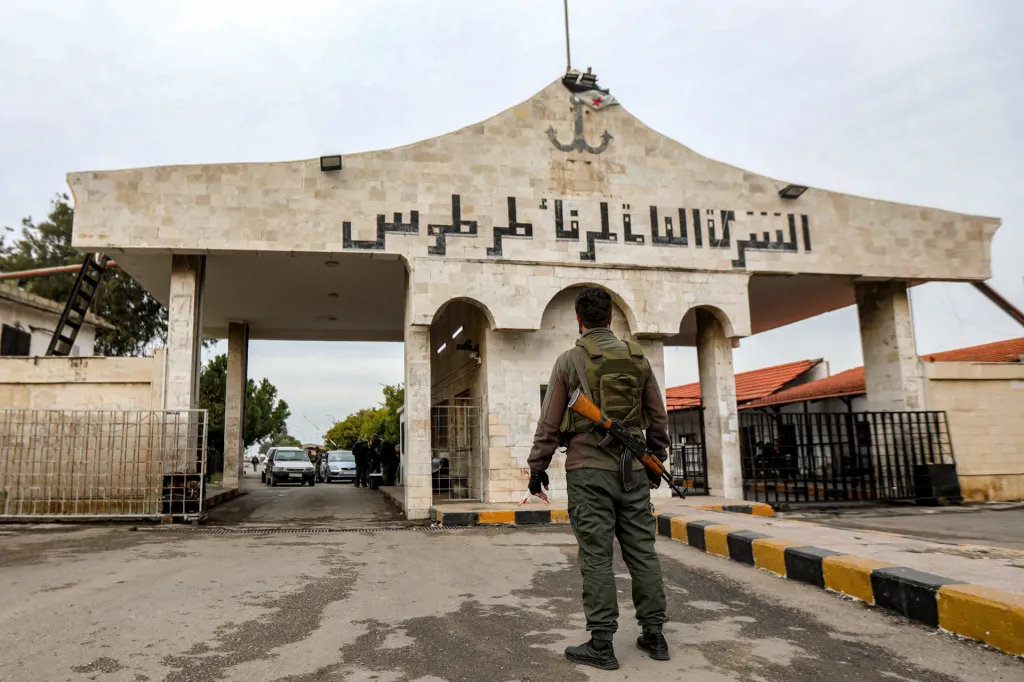
On 3 December 2024 the ships began to leave. By evening satellite imagery analysts recorded empty quays. Two frigates left the base — one Project 22350, one Project 11356 — together with one Improved Kilo and two auxiliaries, among them the tanker Yelnya[15].
That same day, according to TASS, the submarine B-261 Novorossiysk fired a Kalibr at a barge target at sea. She fired alongside the frigates Admiral Gorshkov and Admiral Golovko, under the command of the navyʼs commander-in-chief, Admiral Alexander Moiseyev. These were demonstration exercises. It may be that the exercises were exactly how the Russian military tried to explain its own manoeuvres and cover the shipsʼ departure to sea. But neither the submarine nor the surface group ever returned to Tartus[16].
Five days later the Russian foreign ministry announced that the base had been put on heightened alert. The same day the Rybar channel, considered close to the Russian defence ministry, wrote that Russiaʼs military presence in the Middle East was “hanging by a thread”. Its list was specific: the ships had left Tartus and taken station off the coast for safety; Khmeimim was effectively cut off after rebels seized a neighbouring town; Kurdish forces had begun blockading Russian sites beyond the Euphrates; positions at the oil facility in Homs had been shut off[15].
A day later Kremlin spokesman Dmitry Peskov said channels of communication had been opened with Hayat Tahrir al-Sham — to negotiate keeping the naval and air bases[15]. At the same time Ukraineʼs HUR reported that a frigate and a dry cargo ship had been withdrawn from Tartus, and that the remaining weapons were being flown out of Khmeimim by military transport aircraft. Intelligence estimated that “several hundred” Russian special forces remained at Tartus, overseeing the evacuation[18].
On the night of 2 January 2025 Novorossiysk passed through the Strait of Gibraltar westbound and left the Mediterranean. The passage was logged by the watch of the British patrol ship HMS Cutlass[16]. On 14 January the submarine passed the Danish straits on her way to the Baltic, escorted by the corvette Boikiy[17]
Novorossiysk and Krasnodar are assigned to the Black Sea Fleet and based at Sevastopol. When the full-scale invasion began in February 2022 both were in the Mediterranean — and could no longer go home: Turkey had closed the straits[17].
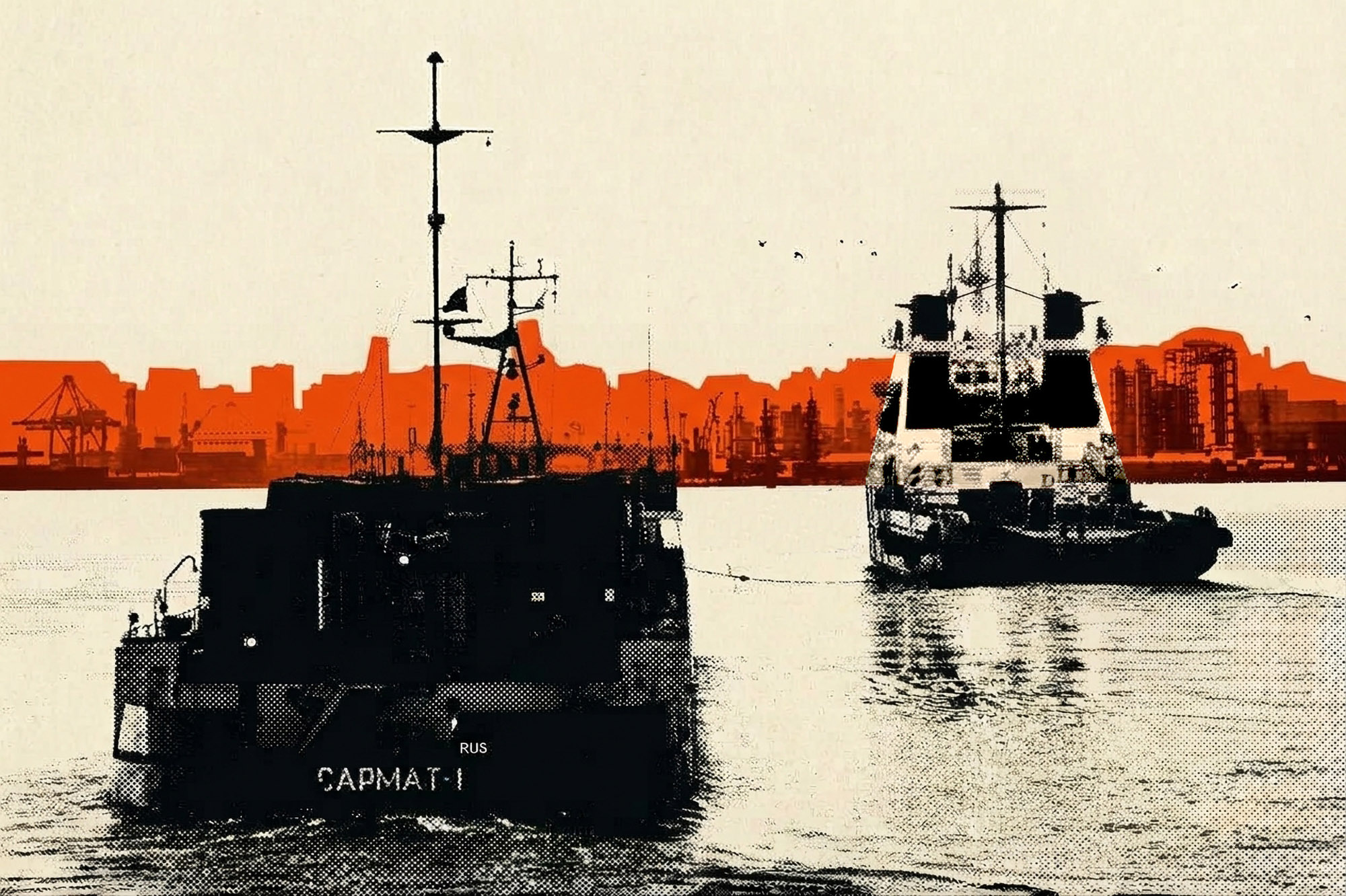
At the end of January the equipment began to be shipped out. A Maxar image from 25 January 2025 shows the ro-ros Sparta and Sparta II under the Russian flag at the Tartus quay — before that they had waited several days at anchor for permission to enter. A Planet Labs image from 27 January records that the equipment which had piled up on the quay for weeks was gone and one of the two ships had left; beside it a dense mass of containers had appeared[23].
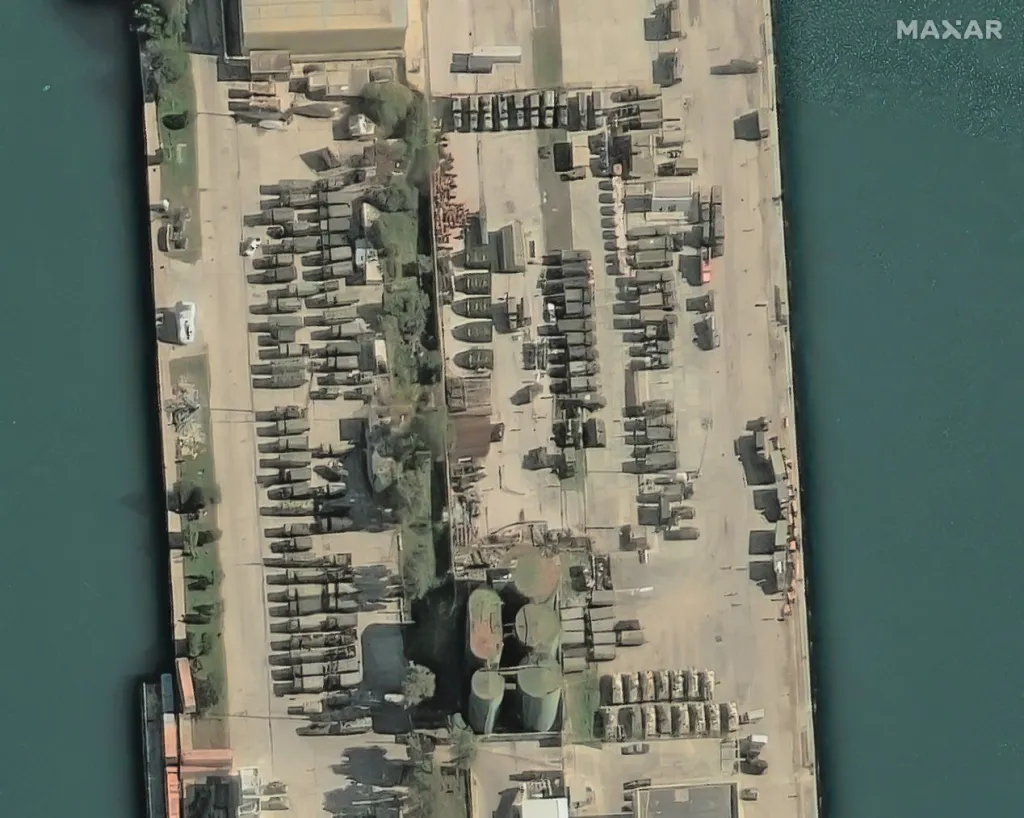
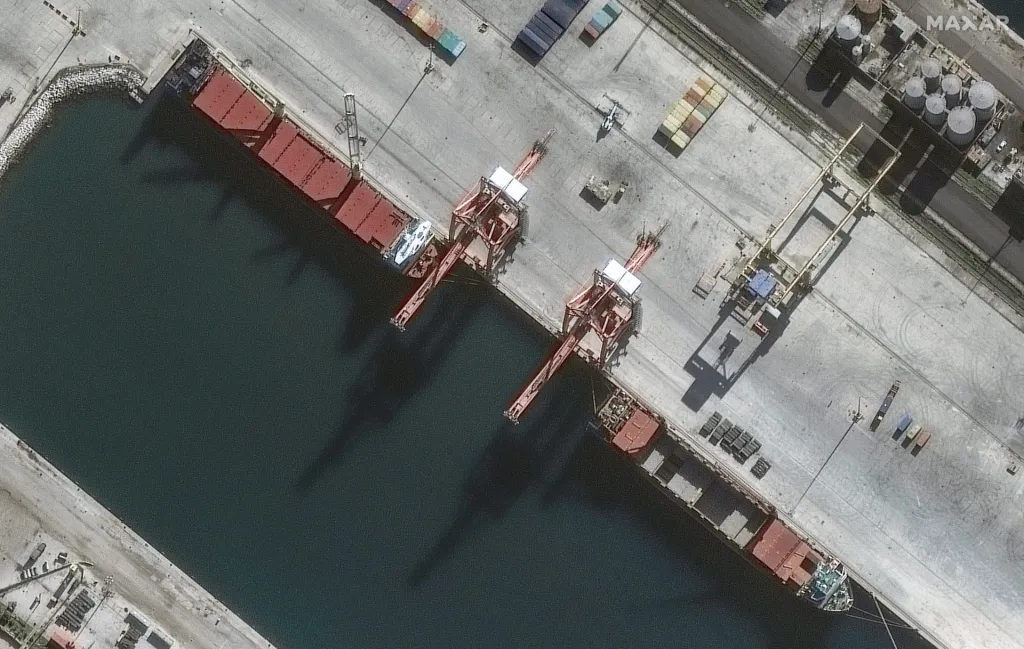
The withdrawal was covered from the air: Ka-52s and Mi-8s worked over the port, and a Project 21980 Grachonok boat — designed precisely for guarding an anchorage — stood in the harbour itself. The same was done while Khmeimim was being wound down. It meant dismantling the baseʼs existing defences — and, accordingly, its growing vulnerability, above all to drones[26].
A Planet Labs image from 27 January 2025: the equipment on the Tartus quay is gone along with the departure of Sparta II, and containers now stand packed tightly beside it.
@kromark — оригінал допису
On 2 February 2025 all Russian ships previously based at Tartus were reported as gone. Satellite imagery at the same time showed them still present nearby, in Syrian territorial waters[15].
A snapshot of May 2026 shows that the Russians were still trying to be present in the Mediterranean, but their forces had shrunk by almost half compared with the Tartus period. At that point the sea held[12]:
- Admiral Grigorovich — off Tartus;
- the corvette Soobrazitelny and the auxiliary Kola — off the Moroccan coast;
- the tanker Vyazma — on a visit to Alexandria;
- the intelligence ship Viktor Leonov — shadowing the HMS Prince of Wales carrier group off Sicily and refuelling in Algiers.
In July 2026, for the first time since 2013, not a single Russian warship was left in the Mediterranean.[24].
§ 02 · NegotiationsThe lease that was never cancelled
While the ships were leaving the harbour, the fate of the base itself was being decided in Damascus — and here it is worth stepping back two weeks. On 22 January 2025 reports appeared that the new Syrian authorities had torn up the agreement on the Russian military base at Tartus — the very one signed in 2017 for 49 years. The Moscow Times relayed this citing the Syrian opposition outlet Shaam, which in turn cited the ministry of information[14]. The wording spread through dozens of stories and settled in as fact.
What was actually cancelled was something else. Back on 19 January the head of Tartus customs, Riyad Judi, told the newspaper Al-Watan that the interim government had terminated the 2019 agreement with a former subsidiary of Stroytransgaz on refurbishing the civilian part of the port. It had nothing to do with the naval base agreement[15]. The disinformation nevertheless kept spreading through the worldʼs media[20]. TWZ, the outlet that first published satellite imagery of the withdrawal, cautiously called those reports unconfirmed[23].
The difference is not terminological. The cancelled commercial contract meant Russia had lost the civilian berth and the revenue from it. The base agreement remained in force — which is exactly why negotiations over the future of Tartus went on for another year and a half.
The confusion in the information space persisted. A month later the Russian company STG Engineering said it was still running the port and had received no notice of cancellation. Stroytransgaz at the same time denied having anything to do with the port at all, and said it was not connected to STG Engineering[15].
The port did eventually change hands, in favour of the Gulf. On 13 November 2025 the Emirati DP World began operations in Tartus under a thirty-year concession[15].
The status of the military base itself was still awaiting review. On 15 October 2025, at a meeting with Putin where — by the Russian sideʼs account — the status of Tartus and Khmeimim was on the agenda, Syrian president Ahmed al-Sharaa said: “we respect all agreements concluded”. Journalists read that as consent to Russia continuing to use both bases. Four days earlier Russia had begun supplying Khmeimim by road convoys from Tartus — at least five times in the first half of the month[15].
The final revision came on 9 August 2026. The memorandum had been about eighteen months in preparation. It handed Khmeimim and the fourth commercial berth at Tartus to civilian management, while the military facilities were to become training centres after a three-month transition. Russian troops may stay — but on Damascusʼs terms[13].
The agreement does not mean a complete withdrawal of Russian forces from Syria. But, judging by what has been announced, it does mean the end of the “Russian bases” model established under Assad, and a shift to a new presence regulated by the consent of Syriaʼs new government.
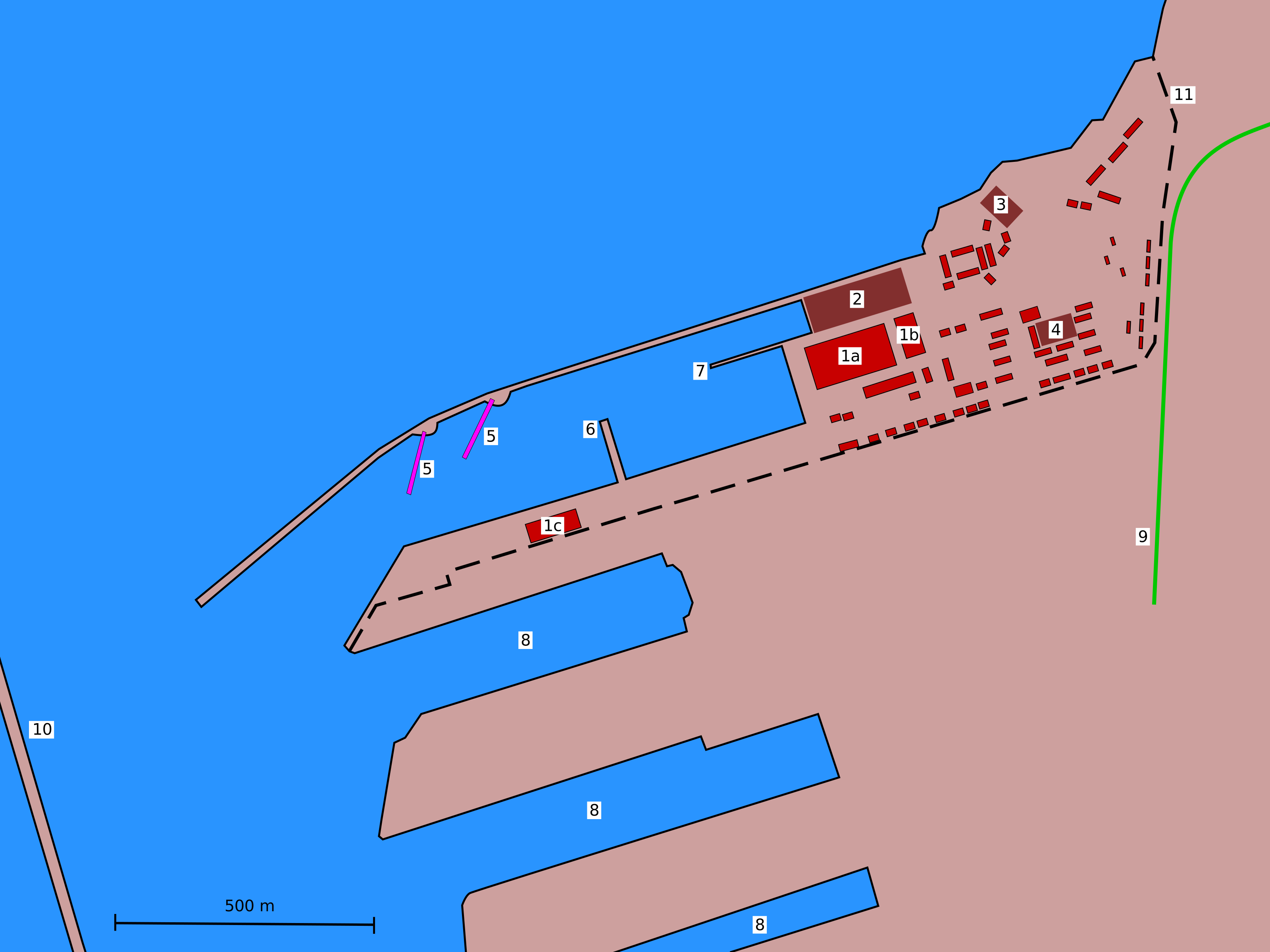
Boundary of the Syrian navy compound — missile boat brigade
- 1
Hangars and warehouses — three plots on the plan, 1a–1c
- 2
Dry dock
- 3
The “park” — vehicles and weaponry
- 4
Parade ground
- 5
Floating piers — Russian, two of 100 m each, PM-61M type
- 6
Concrete quay
- 7
Pile-founded mooring pier
- 8
Civilian port basins — five in all; the northern one is military
- 9
Rail spur — cargo out of the port
- 10
Breakwater — exit to the open sea to the north-west
Plan — Bin im Garten / Wikimedia Commons, CC BY-SA 3.0, from OpenStreetMap data, 2012
§ 03 · The squadronWill the navy come back
Tartus offered not so much a berth as repairs. It is the repair base that explains why ships like Admiral Grigorovich did not go home for months. Without it the ratio of combatants to auxiliaries shifts in favour of the latter, and to keep up the same presence you have to deploy still more ships[11].
The problem runs deeper than one port. The Russian navy is built around ships of the near sea zone with limited endurance; without an intermediate base their ability to hold station in an area drops sharply[11].
One submarine as the measure
What the loss of a repair base means is best seen through a single ship — that same Novorossiysk that left Tartus first.
The submarineʼs departure was not a decision but a dead end. Russia made considerable diplomatic efforts in Libya, Egypt and Algeria — but found no basing for its submarine component, and that forced it to withdraw the boat[16].
In September 2025 the submarine suffered serious damage from a fuel system failure. By October she was already returning to the Baltic on the surface[15]. By another account of the same event, the breakdown happened in waters near Gibraltar, and the boat was towed by Yakov Grebelsky under British and Dutch observation[22].
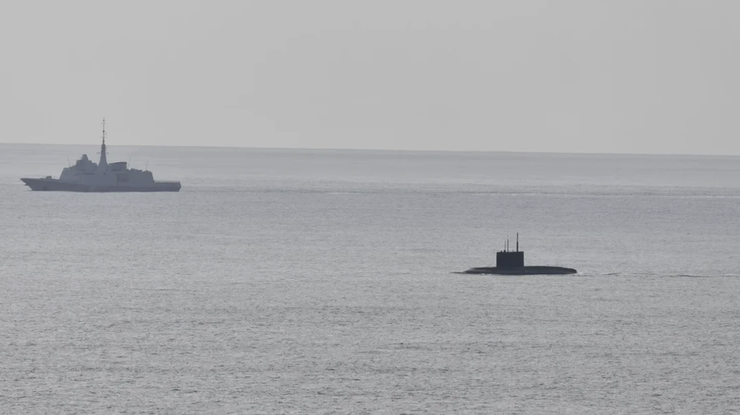
The second boat, Krasnodar, repeated her sisterʼs story. On 23 December 2024 the Russian defence ministry reported torpedo firings in the Baltic after repairs at Kronstadt. On 3 February 2025 the submarine passed the Great Belt into the Skagerrak together with the same tug Yevgeny Churov; on 11 February she was outside Portuguese territorial waters. She was shadowed by the Danish patrol vessel HDMS Triton, and in the German zone of the Baltic by the federal police boats Bamberg and Neustadt[17]. On 27 April Krasnodar left the Mediterranean with no replacement — an unusual situation for the Russian navy. That gives grounds to think the departure was not planned[12].
So without a repair base, and after losing that capability at Tartus, the Mediterranean group was doomed to fade away. And the absence of any prospect of building such a port raised the question of Russiaʼs ambitions in the region.[15].
Three possible replacements for Tartus are named. None of them closes the task fully.
| Address | What is there | Why it is not a replacement |
|---|---|---|
| Algeria | 13 commercial ports, ship repair, its own Kilo-class submarines, Russian instructors at five sites | Article 31 of the constitution directly forbids foreign military bases. Requests for a base at Mers El Kébir were refused in 1968 and 2001[12] |
| Port Sudan | An agreement on Russiaʼs first base in Africa, announced in 2025 | Designed capacity — four ships. In its present state the port cannot service a formation; years of dredging are needed. The Suez Canal is a chokepoint for passages meant to go unnoticed[11] |
| Tobruk | Existing quays, an airfield nearby, deliveries already running | No dry dock, few berths of the required size; the port was never the main base of the Libyan navy[11] |
The Algerian option has more than constitutional problems. The country buys enormous volumes of Russian weapons — estimates differ: RUSI writes of about 85 per cent of its military equipment and training, the Maritime Executive of about 70 per cent of its armaments[11][12]. But tension has crept into the relationship over Russian actions in neighbouring Mali that run against Algerian interests, and over Algeriaʼs need to avoid falling out with the United States and the UAE[11].
The most detailed analysis by researchers comes out in favour of Tobruk. It amounts to calling it the lesser evil. A position south of Crete brings ships closer to the central Mediterranean: closer to a potential adversaryʼs forces on the one hand, but with a Kalibr engagement zone that covers most of Europe. Tankers and Project 304 Amur repair ships could keep a formation combat-capable, as was done at Tartus. The fuel scheme can be repeated — export crude on civilian tankers and bring in aviation fuel[19].
Cargo does indeed already go there, and was going there before Assad fell. In early April 2024 between one thousand and fifteen hundred fighters, mostly former Wagner men, were moved to southern Libya, while ships delivered 6,000 tonnes of equipment to Tobruk — light and heavy pickups, trucks, anti-aircraft artillery. The Al-Jufra airfield became the headquarters[21]. In 2024 there was also a “Libyan express” — at least four transport runs[19].
- 01
Tobruk port
6,000 tonnes of equipment by sea in April 2024. The airfield 16 km to the south is Al-Adem, not Al-Khadim.
- 02
Al-Khadim airbase
The main node of the air bridge, a hundred kilometres east of Benghazi. On 18 May 2025 Maxar caught an An-124 here that had taken off from Khmeimim two days earlier.
- 03
Al-Jufra airbase · headquarters
A former Wagner stronghold, now a headquarters: 1,000–1,500 fighters were moved here in the spring of 2024.
- 04
Maaten al-Sarra airbase
Out of use since 2011. Imagery shows a restored runway and new storage; whether Russians are based there is unknown.
- 05
Ghardabiya airbase
Fifteen kilometres south of Sirte. It is called the new Khmeimim, but no one has confirmed a Russian presence.
- 06
Brak al-Shati airbase
Deep in Fezzan. An LNA base on the southern supply lines; Russian use is unconfirmed.
The network of sites in Libya has grown markedly in two years. Besides Al-Jufra, there is the Al-Khadim air base east of Benghazi, the Ghardabiya airfield that is called “the new Khmeimim”, Brak al-Shati and — most tellingly — Maaten al-Sarra in the south-east, near the borders with Chad and Sudan. The last of these had not been used since 2011, since Gaddafiʼs time; satellite imagery shows a restored runway, new storage buildings and reinforced logistics capability[20][22].
The point of that particular base is explained by the Middle East research platform Eekad: it “allows Moscow to control supply routes and eases the movement of equipment and personnel into the African Sahel while avoiding international attention to large ports and airports”[20].
Ukraineʼs HUR tracked at least ten flights from Khmeimim to eastern Libya from mid-December 2024[20]. Le Monde documented eight flights across December and January[31]. And CNN, which analysed tracking data itself, writes of more than one flight a day from mid-December — An-124s and Il-76s from Khmeimim to Al-Khadim[30].
One such flight was traced from beginning to end. On 16 May 2025 an An-124 with tail number RA-82030 — an aircraft of the 224th Flight Unit, a structure of the Russian defence ministry — took off near Khmeimim, disappeared from the trackers over the Mediterranean an hour later and reappeared north of Egypt. On 18 May a Maxar satellite image caught it on the runway at Al-Khadim, and between 20 and 26 May the aircraft showed up in Bamako and Ouagadougou[31]. An aviation engineer who spoke to RFI called the loss of signal “very much like a deliberate switch-off” — the same trick as the ships, only in the air.
Estimates of numbers kept rising, though they count different things: 1,000–1,500 fighters in southern Libya in early April 2024 — and 2,000–2,500 at military sites across the country by August of the same year[21][22].
But the political risk remains. Unlike Assad, Khalifa Haftar is not an international outcast and keeps working relations, including with France. The terms of access may turn out to be the kind Hafez al-Assad once set: the fleet was barred from keeping shore facilities and had to make do with floating workshops. And if Haftar decides other alliances pay better, being squeezed out is not impossible — as happened in Egypt under Sadat[11]
Ironically, history is repeating itself. Tartus itself was a consolation prize for the Soviet navy after the loss of the Egyptian ports in the 1970s: a small harbour, limited access, a poor replacement for Alexandria[11]. The Soviet Mediterranean squadron was reinforced by ships of three fleets — Northern, Baltic and Black Sea — precisely because it had no ports of its own. Repairs and supply were done from tankers and floating workshops at anchor in international waters — in the gulfs of Hammamet, Sidra and Alboran. Now the Russians are again working out how to live without Tartus[22].
The Russian side offered its own assessment of the problem — in December 2024, before it became clear how it would all end. The military channel Rybar wrote that after Syria the next logistics hub would be Libya. And it immediately named the limits: Russian aircraft can only reach Libya without refuelling when empty, so supplying operations in Africa through it “becomes very expensive and unstable”.[18].
The Russian bloggerʼs assessment matches that of the Institute for the Study of War: the loss of the bases would disrupt the logistics, supply and rotations of the Africa Corps, weakening operations in Libya and sub-Saharan Africa most of all.[18]. British defence intelligence put it in January 2025 as a Kremlin priority: to preserve the ability to sustain its military and private military companies in Africa — and at the same time to limit the reputational damage from the fall of the Assad regime[20].
§ 04 · RebuildThe expressʼs new routes
Map failed to load — check your connection
The version that did not hold
When two Russian ships with military cargo tied up in Guinean Conakry in January 2025, they were first tied to Tartus: the base was lost, so the equipment for the Africa Corps had to be whatever Russia had managed to pull out of Syria. The grey line is the route they were credited with at the time.
They sailed from Murmansk
An investigation by The Sentry, published in April 2026, contradicts that. Both ships — the ro-ro Adler and the dry cargo ship Siyanie Severa — left not Syria but Murmansk. There is no evidence that either called at Tartus in that period.
The dates matter more than the route
Assad fled on 8 December. The first ship left Murmansk six days later, the second after thirteen. Loading a dry cargo ship with armour, filing the voyage, planning the passage and putting to sea in that time is impossible — if the decision was taken only after the regime fell. Which means the new supply routes for the Africa Corps were being prepared before Syria stopped being the foothold.
The other voyages bear it out
Sabetta left Baltiysk in late February 2026. Mikhail Britnev sailed from Arkhangelsk via Baltiysk in June of the same year. The ro-ro Baltic Leader, according to the HUR dossier, worked between Baltiysk, Kaliningrad, Belokamenka and Murmansk — and Conakry, Algiers and Alexandria — up to 2025.
Two routes
The northern one runs from Murmansk and Baltiysk past Britain and Portugal to Conakry and Lomé — and never enters Gibraltar. The Mediterranean one runs from the same Baltic to Tartus and back. All they share is where they begin: off the Portuguese coast the paths part.
In February 2025 Rear Admiral Mike Mattis, director of strategic effects for US Naval Forces Europe and Africa, described what had happened to the old route from Novorossiysk.
In 2022 — no problems at all, routine passages. In 2023 — a sharp reduction. In 2024 — a gradual decline to a full stop. In the end the supply of Tartus went via the Baltic. Instead of a five to seven-day passage we now observe a twelve to fourteen-day one.
Mattis is talking about the Syrian route, not the African one. Cargo ships did not stop sailing to Tartus — the journey got longer: instead of five to seven days from Novorossiysk it is now twelve to fourteen from the Baltic. The cause is common to both directions: once the Black Sea exit stopped working, everything Russia sends south began leaving from the Baltic and the Arctic — Syrian cargo and African cargo alike[2].
§ 05 · The shipsHow the shipping actually works
What follows is a look at four ships whose stories are the most telling. They should be read not as a reference table but as a chronicle: the dates of each show how the Black Sea route was closing and where the ships were redirected afterwards.
They belong to a narrow circle of companies, and that circle is not hidden by the Russian state. Most are assets of Oboronlogistika, a shipping company that works within the military construction complex of the Russian defence ministry and is the ministryʼs sole supplier of transport services. The formal owner of the specific ships is its subsidiary SK-Yug. Oboronlogistika does not conceal its affiliation: the link to the defence ministry is stated outright on its website, which also mentions a licence for work involving state secrets. The technical manager of Sparta IV is listed as the subsidiary OBL-Shipping. As of 2023 its director was Timur Ivanov, at the time Russiaʼs deputy defence minister responsible for procurement and military construction[28][4].
Four ships around which most of the events revolve. Data from HUR sanctions dossiers.
IMO9268710 Ro-ro · Oboronlogistika / SK-YugSparta126.42 m · 8,831 GT · the workhorse of both routesIn service
The ship carried military cargo and personnel between Novorossiysk and Tartus. Former names — Scan Brasil, Hyundai Buffalo, Hc Paulina; she sailed under the flags of the Isle of Man, Germany, Antigua and Belize.
She left Baltiysk on 11 December 2024. On 5 January 2025 she was recorded in Syriaʼs exclusive economic zone — the ship was due to enter port that day, but as of the morning of 7 January she was still steaming along the coast, probably waiting for permission from the new authorities. She sailed together with the large landing ships Ivan Gren and Alexander Otrakovsky; on board the latter was the chief of staff of the 121st landing ship brigade, Captain 1st Rank Yuri Davityan[4].
18 April 2026 — cargo from Kaliningrad to Tartus, already after the fall of Assad. The link kept working[4].
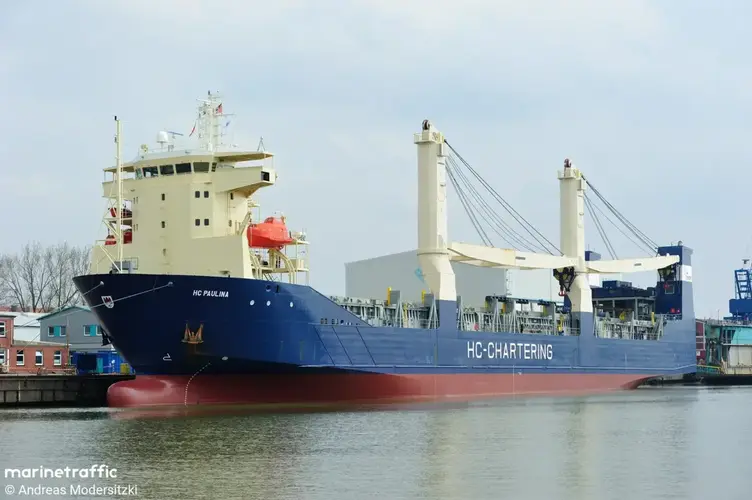
IMO9743033 Dry cargo · 2018, Jiangsu HongqiangSparta IV122.2 m · two 55-t cranes · six runs to Tartus in 2023In service
Her design, certification and lifting capacity make her convenient for heavy equipment such as T-90 tanks. She has been used in naval logistics since 2018.
In 2023 she made at least six runs between Tartus and Novorossiysk: 14–25 January, 1–6 March, 8–15 April, 16–25 May, 25 June — 15 July, 10 August. Each time she called exclusively at the naval base terminals[4].
On the night of Sunday 5 March 2023 she passed the Bosphorus with a draught of 6.2 m, which points to a heavy load; HUR assesses that she probably carried missiles for S-300 systems — the same ones used to shell Kharkiv. Loading took place at the base in Tartus, with military equipment on the quay and the holds open[4].
On 15 July 2023 artillery systems were loaded onto her in Novorossiysk — probably M-46, D-30 or 2B16 Nona. They were delivered to Tartus on 7 August. After returning, on 30 August, the ship entered Sevastopol empty for scheduled repairs[4].
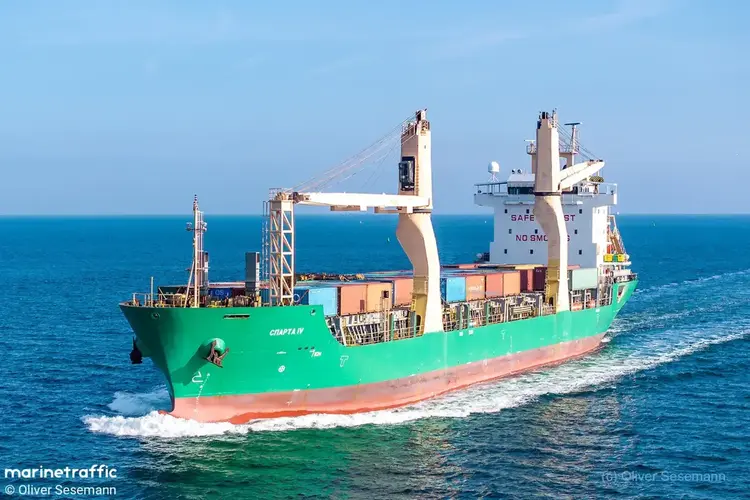
IMO9220639 Ro-ro · 2000, Peene-werft · MG-FlotBaltic LeaderSeized by France in 2022 · now runs to AfricaSanctioned in five jurisdictions
Owned by MG-Flot, formerly Transmorflot. The ship is linked to PSB Leasing, a structure of Promsvyazbank — the systemic state bank that finances Russiaʼs defence industry and services the state defence order.
In 2022 the ship was seized by French customs for breaching EU decision 2022/260. The seizure was a temporary measure, not a confiscation: the ship was released, and HUR notes separately that the Russian embassy in France pushed actively for that[4]. The owner changed too — in the HUR dossier MG-Flot is recorded as owner from 16 February 2022, that is a week before the EU decision for breaching which the ship was detained. The same dossier, however, writes that at the moment of the seizure the ship belonged to PSB Leasing. Those two statements in one document do not agree.
MG-Flot is linked to the Astrakhan businessman Dzhamaldin Pashayev, whose business was built around the port of Olya — the very one proposed as a key node of the North–South transport corridor for trade with Iran[4].
Up to 2025 the ship worked between Russian ports — Baltiysk, Kaliningrad, Belokamenka, Murmansk — and the ports of African countries: Conakry, Algiers, Alexandria. The full list of calls also includes Djibouti, Umm Qasr, Jeddah, Chennai and Kolkata[4].
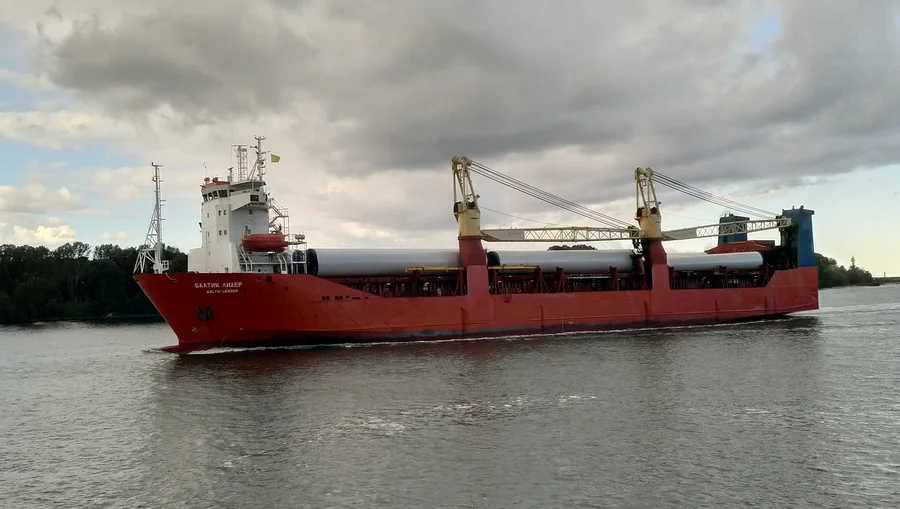
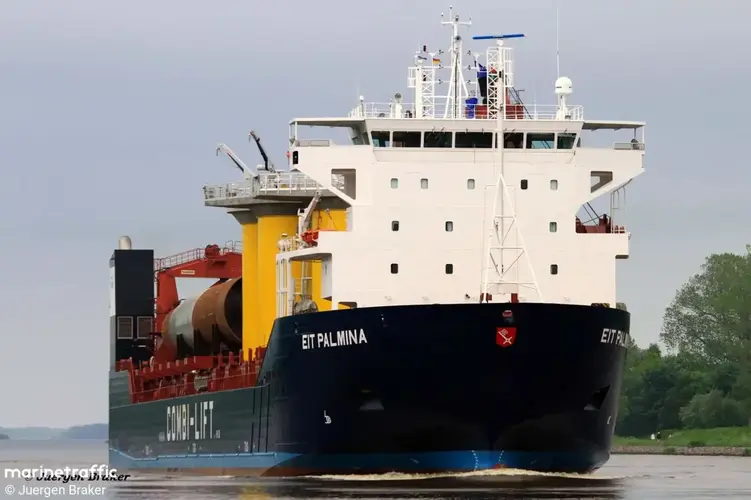
IMO9538892Dry cargo · 2009, Detlef Hegemann RolandwerftUrsa MajorFormerly Sparta III · sank on 24 December 2024Lost
Former names — Scan Britania, Hyundai Britania, Eit Palmina and Sparta III.
After long service on the Caspian between Russian and Iranian ports, in September 2023 she moved to the Azov–Black Sea basin with no AIS signal, and called at Tartus by the same method — with the transponder switched off.
Where they moved in 2024
The runs from Novorossiysk listed in the cards above are 2022, 2023 and early 2024. After that each shipʼs route changes, in favour of Russiaʼs northern ports.
| Ship | Black Sea route | Where she moved |
|---|---|---|
| Ursa Major | Novorossiysk — Tartus, 2022–2023 | from March 2024 — Baltiysk, Kronstadt, St Petersburg |
| Sparta IV | six runs in 2023, one more in February 2024 | June 2024 — the St Petersburg — Kaliningrad line, and at the end of the month a passage through the North Sea |
| Baltic Leader | first put on this route in February 2024 | up to 2025 — Baltiysk and Murmansk ↔ Conakry, Algiers, Alexandria |
| Sparta | the same route earlier | 11 December 2024 she leaves from Baltiysk |
This is exactly the transformation Rear Admiral Mattis described, and it can be followed freely in the ship dossiers[4]. Baltic Leader completes the whole arc within one year: in February 2024 she is put on the Novorossiysk — Tartus line for the first time, and by 2025 she is already sailing from the Baltic and the Arctic to Conakry and Algiers.
The sanctions chronology around these ships shows how unevenly the route out of the Black Sea closed. The United States listed Sparta as early as May 2022 — as property of SK-Yug. The EU did the same only in April 2026, Switzerland on 22 May 2026, Ukraine on 23 May, Canada on 12 June[4].
It is worth noting that these ships are not a shadow fleet: they do not hide what they are for and have to reckon with direct sanctions. In July 2025, when the corvette Boikiy led Sparta and the tanker General Skobelev through the English Channel, the ship was under the sanctions of the United States only, not of Britain and not of the EU, whose exclusive economic zones she had just passed. General Skobelev was under no sanctions at all and sailed openly under the Russian flag, so formally she did not belong to any “shadow fleet”[10].
The most natural question about this whole chronicle: if the ships are under sanctions and Turkey closed the straits, how did they sail through the Bosphorus with military cargo for years?
The answer lies in what exactly Turkey closed. The Montreux Convention governs the passage of both warships and merchant vessels, but the ban Ankara invoked on 28 February 2022 applies to warships of belligerent states — that is Article 19, and even it has exceptions for ships returning to their home bases[29]. A dry cargo ship under a merchant flag does not fall under that ban, whatever lies in her hold.
That is precisely what the scheme is built on. The US Naval Instituteʼs publication puts it plainly: Russia shifts its military logistics onto civilian hulls, and Turkey, having closed the straits to warships, could do more to restrict individual Russian ships and their cargoes that still sail the Black Sea — such as Sparta IV, Sparta II, Pizhma and Ursa Major. All of them are under sanctions, yet Turkey so far refrains from intercepting them[28].
More than that, Turkey knowingly grants preferences to the Russian military cargo fleet. Ursa Major passed the Bosphorus out of turn. Under established practice ships wait their turn for a certain time, and, as HUR notes, that is impossible without a prior arrangement with representatives of the Turkish maritime administration[4].
The main problem with sanctions is that a decision restricts access to the ports of the sanctioning party that adopted it, and the operations of its residents. It does not forbid sailing between Russian ports and West Africa. Baltic Leaderʼs route after 2024 — Baltiysk, Kaliningrad, Belokamenka, Murmansk and onward to Conakry, Algiers, Alexandria — includes not a single EU port[4].
§ 06 · The sinkingWhat happened aboard Ursa Major
One of the four cards above ends with the word “lost”. The loss of Ursa Major deserves its own section not for the event itself but for its consequence: it was after this that Oboronlogistika began escorting its dry cargo ships with warships.
The ship sank in international waters between Spain and Algeria on the night of 24 December 2024. Fourteen crew were rescued, two went missing[4]. She had left St Petersburg on 11 December; arrival in Vladivostok was planned for 22 January 2025.
From here the accounts diverge, and the divergence is telling — because it concerns one and the same hold.
| Version of the cargo | Who says so |
|---|---|
| Empty containers | the shipʼs master[4] |
| 380-tonne port cranes for the Vladivostok terminal and 45-tonne hatch covers for new icebreakers | Oboronlogistikaʼs press service, a few days before departure[4] |
| Civilian hatch covers, as stated in the manifest | WION[27] |
| Prohibited VM-4SG reactor units for submarines, destined for North Korea | “Spanish investigators”, as relayed by WION[27] |
The second and third versions most likely describe the same thing: the forty-five-tonne hatch covers for icebreakers later turned into civilian hatches. The fourth — the claim about reactor units for North Korea — looks entirely in the spirit of Russian logistics. There is no independent confirmation of it.
The cause of the sinking is disputed too. HUR writes of an explosion in the engine room[4]. Oboronlogistika claimed a terrorist attack — three explosions on the starboard side[10]. WION speaks of a probable external strike[27].
Whatever actually happened, the consequence is documented: after the shipʼs loss, Oboronlogistika dry cargo vessels carrying cargo out of Syria began sailing under the escort of Russian warships[10].
§ 07 · The cargoWhat exactly goes south
So far this has been about the Mediterranean direction. But a large part of the logistics concerns the African one. In the first five months of 2025 three large convoys reached Bamako; they give the fullest picture of what Russia actually ships to the Sahel.
The January one comprised about 50 vehicles of logistics, supply and transport — among them an armoured Linza ambulance. To these were added about 60 armoured fighting vehicles: APCs, VPK Urals, Tigrs and tracked equipment, apparently two tank platoons and two IFV platoons. Separately — two automatic anti-aircraft guns, two boats and three towed artillery systems[1].
The number of vehicles matches the size of a battalion tactical group, which in the Donbas numbers 600–800 men. But the purpose of the equipment is different. The Sentry notes that most of the vehicles are unsuited to combat in desert terrain: this is equipment for guarding bases. A senior European officer who previously served in the region adds that it is relatively new and not of the type foreign forces hand over to local armies[1]. Bamakoʼs official line — that the cargo was intended for Maliʼs armed forces — does not square with that.
The maker of most of the equipment is known. VPK Urals, Tigrs and several types of APC are produced by the Military Industrial Company, which is linked to Oleg Deripaska; together with its subsidiary, the Arzamas Machine-Building Plant, it is under US, British and EU sanctions. The company did not respond to The Sentryʼs query[1].
The convoyʼs route inside Mali makes sense too. From the main military base in Bamako the equipment was split: part went to Gao in the north, part to Banimanotié. That is a new base of Maliʼs armed forces 170 km from the capital; defence minister Sadio Camara opened it on 17 January 2025 — a day before the cargo arrived. The 82nd armoured regiment is stationed there, and the base itself is 100 km from the Yanfolila gold mine. A source in Maliʼs armed forces puts it plainly: the Russians want the Africa Corps sitting closer to Yanfolila[1].
Another source, in Mopti, lists the bases that received equipment from all three shipments: “Sokoro, Bafo, Nampala, Bandiagara, Sofara, Boni and Timbuktu”. A further part went to a new base at Diéma in the west of the country, three hoursʼ drive from the Mauritanian border. Notably, the equipment went mostly to new recruits of the Africa Corps rather than to former Wagner men stationed at the northern bases[1].
Least is known about the March 2025 shipment: missiles and several military and civilian vehicles. The May one is documented better — 152 mm artillery pieces, BTR-80s with electronic warfare equipment, armoured Spartak vehicles and other personnel carriers. And a Su-24: a frontline bomber, sorely needed in the north after the defeat Wagner and the Malian army suffered in 2024 for want of air power. Shortly after delivery the Su-24 crashed into the Niger river[1].
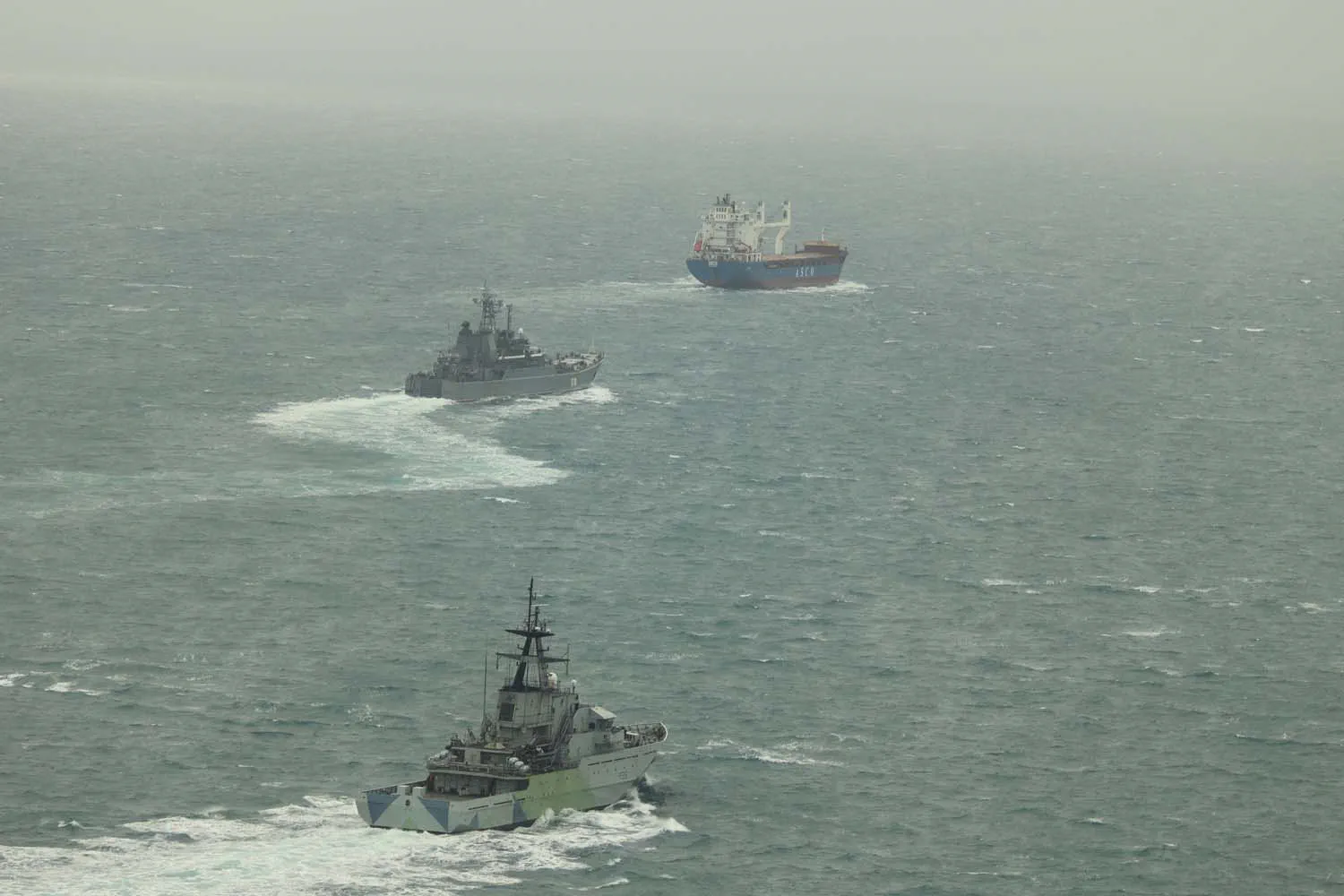
In 2026 the route repeats almost word for word, only with different ships. Sabetta left Baltiysk around 22 February escorted by the large landing ship Alexander Shabalin. On 5 March the Royal Navy said it had “intercepted” Russian vessels in the Channel: it shadowed them with boats and helicopters, and did not board. On 19 March Sabetta tied up in Conakry; an Airbus image from 21 March shows military equipment by the quay. From Conakry to Bamako is 995 kilometres overland, about seventeen hours. On 27 March the Malian newspaper LʼEssor described a convoy arriving in the capital on the night of the 24th, from where the equipment went on to Kati, the site of an armed forces base[7].
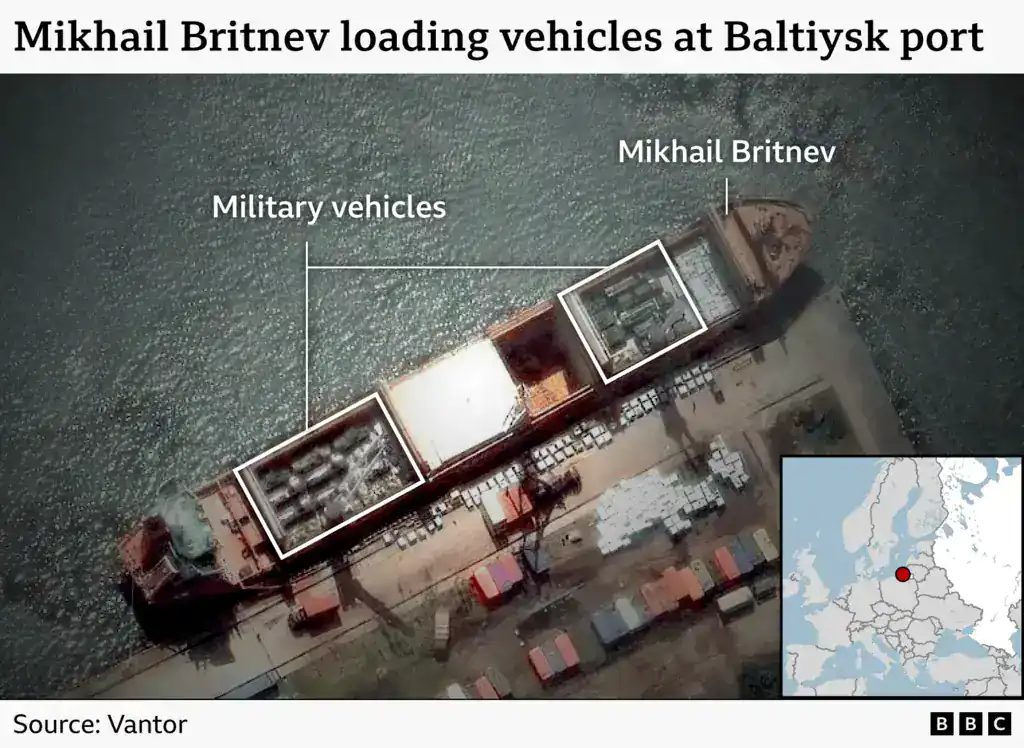
The June voyage of Mikhail Britnev is documented in more detail. A general cargo ship 136 m long, 12,700 tonnes deadweight, five holds, structurally reinforced for heavy cargo, ice class 1A; under US sanctions since 2024. The ship left Arkhangelsk on 3 June, called at Baltiysk on the 11th and lay there a week without unloading. Imagery from 16 June shows her loaded with armour and APCs. She sailed on 18 June; from the Fehmarn Belt she was led by Alexander Shabalin. On 25 June the ship was photographed west of Portugal — the escort was still in place[6].
On this passage Shabalin sailed with anti-drone netting covering part of her superstructure from the bow[6]. The same structural answer to drones that the Black Sea Fleet rigs over the sails of its submarines in Novorossiysk had reached a landing ship on an ocean voyage thousands of kilometres from the Black Sea.
After passing the Channel on 23 June, Mikhail Britnev switched off her AIS. A day before arrival she declared Dakar as her port of destination. She reappeared on 9 July in Lomé, Togo[6].
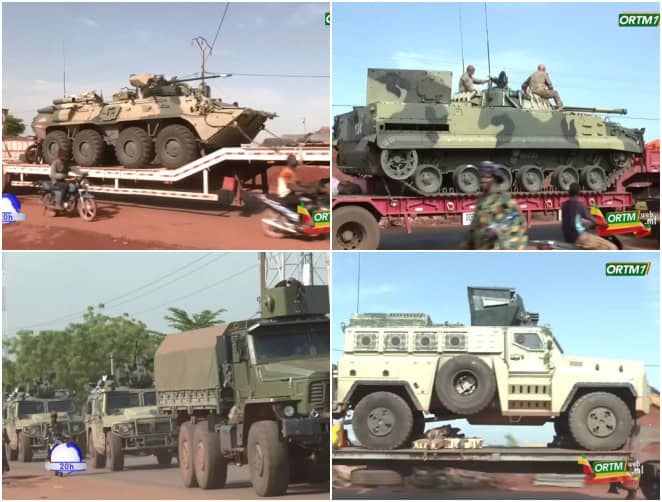
On 25 July Malian state television showed the column in Bamako: BMP-3s, BTR-82As, Tigrs and Chinese VP11s. BBC Verify assessed that the equipment in the satellite imagery of the ship matches what drove through the capital. The British defence ministry declined to comment on the passage[8].
One more ship, which never appeared in publicly available tracking data, was photographed loading military equipment at Baltiysk on 6 June[8]. How many such voyages went unnoticed cannot be established from open sources.
The Chinese vehicles in Russian shipments are not a recognition error. The March shipment included CS/VP14s, resistant to improvised explosive devices, and the CS/VN9 infantry fighting vehicle — both made by Norinco — as well as a Dongfeng Mengshi all-terrain vehicle, alongside Russian BMP-3s, Tigrs and VPK Urals[7].
It is entirely plausible that Russian supply is carrying Chinese equipment. Most likely Russia buys certain types of equipment from China, most probably from Norinco, especially where military vehicles are concerned. Given the scale of the deliveries Russia has been sending to Mali since the beginning of 2025, it is logical that some shipments may contain equipment from different manufacturers.
There is also a suggestion that the Africa Corps could have redirected some of the Chinese vehicles from earlier deliveries China made directly to the Malian army[7].
§ 08 · The portA railway built for bauxite
All three convoys of 2025 passed through one terminal of the Autonomous Port of Conakry. It is served by subsidiaries of Rusal — ACG-Fria and Compagnie des Bauxites de Kindia. The second is the companyʼs largest raw materials asset, about a quarter of its bauxite output. ACG-Fria holds the Friguia complex — bauxite plus an alumina refinery — in the town of Fria, built from scratch in the 1950s[1].
The port itself and its terminals are managed by Conakry Port S.A., a subsidiary of the Turkish conglomerate Albayrak Group, which won the terminal concession in 2018. Neither Albayrak nor the Autonomous Port of Conakry replied to The Sentryʼs queries. Rusal answered that it and its companies operate in Guinea “in full compliance with applicable laws and regulations”[1].
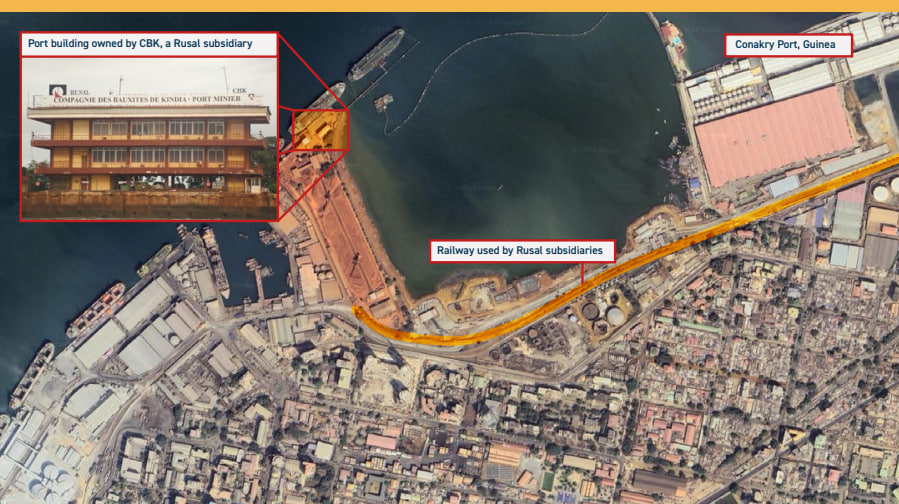
So infrastructure built to export bauxite is carrying armoured vehicles. A port worker describes the requirement simply:
For deliveries like this to work here you need a berth — either a ro-ro ramp or a mobile heavy crane — a secured yard and a clear road corridor out of the port. The railway here is for bauxite, not for weapons. That is what these companies can give to whoever is making military deliveries.
On 27 December 2024 a ship with several thousand tonnes of Russian wheat for Mali tied up in Conakry — reported by Maliʼs ambassador to Guinea, Mamadou Keïta. A port worker confirmed to The Sentry that this voyage “tested” the port: military deliveries cost more and were far more sensitive, and they needed to be sure the cargo would not only enter the port but cross Guinea without incident[1].
The ground was prepared diplomatically too: in June 2024 Sergei Lavrov visited Conakry and president Mamadi Doumbouya. Russiaʼs ambassador to Guinea, Alexei Popov, formally recognised the Guinean military leadership[1].
They knew it was harder to make friends with the other coastal states, and harder to carry cargo to their main ally in Mali through other countries. Conakry is certainty. They know they will not be refused access here, that they will be able to control the rail terminal.
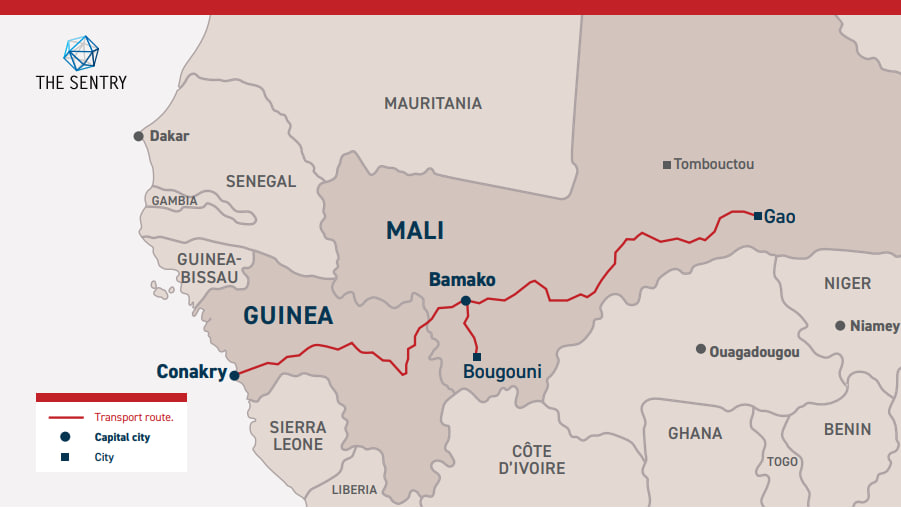
Analysts and journalists pointed out that Senegal, with better port infrastructure, would suit deliveries to Mali better. Russia chose Conakry for two reasons: friendly relations with the Guinean junta and ties to Rusal, which holds the cargo, rail and logistics apparatus around the port[1].
A telling detail: the ships did not hide. Adler, Siyanie Severa, Patria and Baltic Leader sailed under the Russian flag, without swapping it for someone elseʼs the way shadow fleet vessels do. The Sentry calls this a “non-shadow” delivery: the government in Conakry knew about the military cargo and welcomed it[1].
The May 2025 shipment — 25–28 May — was carried by exactly Baltic Leader and Patria. Radio France Internationale collected testimony about the column moving along National Road No. 1 on 28 May; it reached Bamako on the 31st[1].
What exactly travels on the new routes is not always known. Bellingcat followed Patria for six months, which was convenient thanks to her distinctive features: bridge forward, red deck, blue hull, two yellow cranes, a ramp aft. The ship began her voyage in the Sea of Japan, loading at the port of Olga on 21–23 January 2026, and from March shuttled between Owendo in Gabon and Douala in Cameroon[5].
The method proved more telling than the conclusion: the shipʼs draught increased every time after a call at Owendo and decreased every time after Douala — four loadings against five unloadings from March to July. While Patria lay at anchor off Lagos for more than thirty days, no other ro-ro or container ship waited more than ten days to enter the port[5].
Bellingcat does not say what was in the holds. Experts offer only versions. Charlie Brown, a former US Navy officer, calls the behaviour atypical for a merchant ship, but lists innocent explanations too: a breakdown, a commercial dispute, a lack of cargo, chartering delays, a long repair. David Soud of I.R Consilium adds that Douala is the main gateway for cargo into the Central African Republic, and that Gabon has recently grown closer to Moscow[5].
Bellingcat found no signs of position spoofing, though for part of the passage there was no satellite imagery, so it cannot rule it out entirely. The shipʼs owner and manager, the ports of Douala and Owendo and the Nigerian Ports Authority did not respond to queries[5].
§ 09 · LoméThe scheme shifts
By 2026 the scheme shifts. Mikhail Britnev sails not to Conakry but to Lomé — a deepwater port in Togo able to take large container ships and warships, linked by a transport corridor to Burkina Faso and through it to Mali[6].
The shift is confirmed on paper. On 22 July 2025 the Russian government approved a bill ratifying a military cooperation agreement with Togo — joint exercises and emergency medical assistance[1]. In October 2025 the agreement was ratified: joint exercises, training of Togolese troops, intelligence sharing. The cooperation has run since 2022, when Togo received Mi-35s and Mi-17s from Russia; there are also reports of Togolese soldiers being recruited for the war against Ukraine[6].
Togo is also a notable gold exporter — and, according to reports, serves as a transit point for gold mined in neighbouring countries[1].
Togo is not the only new address. In Niger, on 12 April 2024, a hundred Africa Corps fighters arrived in Niamey: with equipment and an agreement to install an air defence system. Through 2025 Russian aircraft regularly landed at Agadez airport[1].
In Equatorial Guinea, in the autumn of 2024, up to two hundred fighters appeared — to guard the president and train an elite guard in the two main cities, Malabo and Bata. The head of the Africa Corps, Averyanov, met president Teodoro Obiang Nguema Mbasogo to agree on joint training of personnel and on strengthening information security and critical infrastructure[1].
Both countries matter to Moscow for the same prosaic reason: they have large ports. Equatorial Guinea is also close to Cameroon — the key country for Russian logistics into the Central African Republic. Together with the deployments in Sudan and Libya this adds up to a picture The Sentry describes as a gradual encirclement of West Africa[1].
§ 10 · The recipientThe ultimate beneficiary
The Africa Corps was founded in December 2023 by deputy defence minister Colonel General Yunus-Bek Yevkurov[21]. In Mali the structure deployed at the end of 2024, and in June 2025 Wagner announced its exit from the country, handing over most of its operations to it[1].
Its strength in Mali is at least 1,500 people, about the same as Wagnerʼs, and a large share of them are former Wagner men. For Malian civilians there is no difference: in the list of victims The Sentry collected in Goundam, Léré, Mema, Taoudenni, Gao and Timbuktu for the second half of 2025, Africa Corps and Wagner are used as synonyms[1].
The chain of command looks like this:
- Yunus-Bek Yevkurov, Russian deputy defence minister — political oversight from Moscow;
- Major General Andrei Averyanov, GRU — military oversight of operations. At least until 2022 he headed Unit 29155, accused of sabotage and assassination attempts against Western countries;
- Andrei “Kep” Ivanov — overall commander in Mali, who personally oversaw the supply of equipment;
- Ivan “Miron” Maslov — commander in the north, in the Gao — Kidal area, where mostly former Wagner men are stationed.
For this story one thing matters: the cargo is received not by a private company looking for a way to pay for its own war, but by a structure of the defence ministry. That is why state ships of a state company carry its equipment — and why this route will not disappear along with any single contractor.
§ 11 · The expressThe Syrian Express survived
But Africa is not the whole of it: the Syrian route keeps working too — and it is there that Russia has shown the most elaborate concealment scheme in the history of its maritime shipping.
Map failed to load — check your connection
Three ports, three dates
In April 2026 three ships left three different ports: the products tanker General Skobelev from St Petersburg on 15 April, the ro-ro Sparta from Kaliningrad on the 18th, the replenishment tanker Akademik Pashin from Murmansk on the 23rd. The declared destination was Port Said in Egypt. NATO ships shadowed the convoy in the Baltic; in the Channel it was the Dutch Galatea and the British RFA Tideforce.
The escort tactics changed as well: a frigate appeared in the convoy. The practice of military escort for commercial traffic began earlier — at the end of June 2025 the corvette Boikiy led two shadow fleet tankers, Selva and Sierra, through the English Channel. The trigger was Estoniaʼs failed attempt to detain an unregistered tanker, which was thwarted by the appearance of a Russian fighter jet[10].
Boikiy herself masked her position by transmitting a generic MMSI number: tracking systems showed her as “objects” — for instance buoys that suddenly jump from the coast of China or from the Persian Gulf to the northern approaches of the Channel[10].
The upshot is that the loss of the naval base has not reduced Russiaʼs interest in Tartus, nor closed off the possibility of calling there.
Tartus has passed through three states. Until December 2024 — a base with rights, repairs and a permanent squadron. Through 2025 — empty quays and an undefined status while negotiations dragged on. From 2026 — ships do call, but by permission: the May convoy stayed eleven days, and Sparta brought cargo from Kaliningrad back in April.
So from a base of permanent presence Tartus has become a restricted logistics node. Long waits for entry permission and short stays indicate that Russia no longer holds its former rights — access is granted case by case, as it is to any foreign warship. Cargo ships get in more easily than combatants, which usually anchor in the roadstead[12].
Khmeimim, 35 miles to the north, Russia has held onto better: aircraft bound for Africa still refuel there and the logistics capacity has survived. But that position is shaky too — the base has come under drone attack recently, and the Russian military there has ended up between a local population of Assad loyalists and their old opponents[12].
In parallel the port is being prepared for transshipping Russian grain, coal, timber and steel: according to a Reuters report of 11 July 2026, this is being handled by the Syrian company Rus Line. Its chief executive, Jinan Mubadda, says one berth goes to commercial cargo while the second keeps its military purpose[10].
§ 12 · ConclusionWhat follows from this
The story of how Russia lost the Mediterranean has been told at least twice: in January 2025, when the last submarine left, and in July 2026, when the sea was left without Russian combatants. Both times it was true — and both times it overshadowed what was happening next door.
Yet the model of presence, and the military logistics Tartus was needed for, were changing gradually and pre-empted Assadʼs fall. Weapons for the Sahel travel from Murmansk and Baltiysk — by a route devised not after the loss of Tartus but before it.
The beneficiary of the cargo changed gradually too. Wagner took territory in exchange for resources and fought battles; the Africa Corps ships equipment for guarding bases, does geopolitics and runs a far more prosaic military policy. It is a more cautious, more expensive and slower presence — but it is a state one rather than private, and that is exactly why it will not vanish along with any one company.
As a result Russia has managed to head off the risks to its influence both in Africa and in the Middle East. It has cut its own logistical losses by diversifying routes and reformatting the delivery scheme. Russia has kept the ability to ship armour to Mali; the accessibility of its facilities has cost it time, but not its influence outright. The threat to its cargo fleet has forced it to use a navy that is hard to sustain in the region — and that has, in its own way, even strengthened its position there. So it is fair to say that the loss of a single node has not been enough to counter Russian influence, and far greater effort will be needed to undo it. There is a great deal of work ahead.
Sources
- The Sentry — “Doubling Down: Russiaʼs Military Network in West Africa”, April 2026. thesentry.org
- CSIS — “Maritime Domain Lessons from Russia-Ukraine”, panel transcript of 27.02.2025. csis.org
- Maritime Executive, Peter Berstling and Gianguiseppe Pili — “Russiaʼs ‘Syria Express’ Convoys May Be Combining Multiple AIS Tricks”. maritime-executive.com
- HUR MO Ukraine, the War&Sanctions database — dossiers on the ships SPARTA (IMO 9268710), SPARTA IV (9743033), URSA MAJOR (9538892) and BALTIC LEADER (9220639). war-sanctions.gur.gov.ua
- Bellingcat — “Tracking a Sanctioned Russian Vesselʼs West African Odyssey”, 25.08.2026. The route of the ro-ro Patria — from Lloydʼs List Intelligence AIS data and satellite imagery. bellingcat.com
- Eurasia.ro — the voyage of Mikhail Britnev from Arkhangelsk to Lomé, 16.07.2026. eurasia.ro
- France 24 Observers — the voyage of Sabetta from Baltiysk to Conakry, 14.04.2026. france24.com
- Militarnyi, on a BBC Verify investigation — the delivery of BMP-3s and other equipment to Mali by the ship Mikhail Britnev. militarnyi.com
- ItaMilRadar — “From a Powerful Mediterranean Squadron to Zero Warships”, 01.07.2026. itamilradar.com
- The Insider — “Russia left without warships in Mediterranean for first time in 13 years”, 16.07.2026, and a piece of 08.07.2025 on the escort by the corvette Boikiy. The “first time since 2013” assessment belongs to the OSINT project Russian Forces Spotter and is presented as its observation. theins.press
- RUSI, Edward Black and Sidharth Kaushal — “Russiaʼs Options for Naval Basing in the Mediterranean After Syriaʼs Tartus”, 14.01.2025. rusi.org
- Maritime Executive — “Russian Navyʼs Weakness in the Mediterranean Becomes Clear”. The piece calls Admiral Grigorovich a cruiser — she is a Project 11356 frigate. maritime-executive.com
- Forbes, Paul Iddon — “Russia Never Realized Full Potential Of Syriaʼs Tartus Naval Base—And Never Will”, 23.08.2026. forbes.com
- The Moscow Times — “Syria Terminates Russian Naval Base Deal – Reports”, 22.01.2025. The report was relayed citing the Syrian opposition outlet Shaam; the wording about the agreement being torn up later proved inaccurate. themoscowtimes.com
- English Wikipedia, the articles Tartus naval base and Mediterranean Sea Task Force — a consolidated chronology of the base with links to primary sources. en.wikipedia.org
- James Droxford — “Russia concludes conventional submarine operations in the Mediterranean Sea”. The author is a former Royal Navy signals intelligence officer. jamesdroxford.substack.com
- European Security & Defence, Hans-Uwe Mergener — “A Russian sub could be heading back to the Med”, 02.2025. euro-sd.com
- Newsweek — “Syriaʼs critical role in Russiaʼs Africa operations”, December 2024. Quotations from the Russian military channel Rybar are presented as claimed. newsweek.com
- russianfleetanalysis — “The Russian Navy and the fall of Tartus”, 12.2024. A niche analytical blog; the assessments are the authorʼs own. russianfleetanalysis.blogspot.com
- Foreign Policy — “After Assadʼs Fall, Russia Looks to Libya and Sudan”, 19.02.2025. foreignpolicy.com
- BISI — “The Expansion of Russiaʼs Africa Corps in Libya”, 13.06.2024. bisi.org.uk
- Alberto Priego — “Russian strategy in the Mediterranean: A second front”, Opinion Paper 08/2026, Spanish Institute for Strategic Studies (IEEE), 23.01.2026. An authored paper; it does not set out the position of Spainʼs defence ministry. It contains factual errors — among them the wrong project number for the submarines Krasnodar and Mozhaysk. defensa.gob.es
- TWZ — “Russian Withdrawal From Prized Syrian Naval Base Now Underway”: Maxar imagery of 25.01.2025 and Planet Labs imagery of 27.01.2025. twz.com
- Defense Mirror — “Russia Withdraws Last Submarine from Mediterranean Sea; No Naval Vessels Remain at Syriaʼs Tartus”. The submarineʼs hull number is given with a typo: “B-61” instead of B-261. defensemirror.com
- ItaMilRadar — “Russian Syrian Express Convoy Crosses Gibraltar Under Naval Escort”, 22.05.2026. itamilradar.com
- Zona Militar — on the withdrawal of troops and equipment from Tartus, 02.2025: Maxar and Planet Labs imagery. zona-militar.com
- WION — “From Sparta III to Ursa Major: the sanctioned history of the sunken Russian cargo ship”, 12.05.2026. The claim about reactor units for North Korea is attributed to unnamed Spanish investigators and has no independent confirmation. wionews.com
- U.S. Naval Institute, Proceedings — “Russia Is Violating the Montreux Convention with Civilian Ships”, 09.2023. usni.org
- JURIST — “The Implications of the Montreux Convention on the Transit of Russian Vessels”, 06.2022. jurist.org
- CNN — “Spike in Russian flights from Syria to Libyan desert base as Moscow eyes new Mediterranean hub”, 31.12.2024. The tracking data analysis is the outletʼs own. cnn.com
- RFI, the Info Vérif investigations desk — “Libyaʼs Al-Khadim airbase becomes a hub for Russian arms in the Sahel”, 23.06.2025. rfi.fr
- Asharq Al-Awsat — “From Haftar to Dbeibah: The Map of Control and Influence in Libya”, 05.06.2025. The boundary of the zones of control on the map of sites in Libya is drawn from the demarcation described in this piece. english.aawsat.com
This story is based on open sources. Data from Russian outlets and reference works is presented as claimed. The Russian side has published no official data on cargo composition or routes.