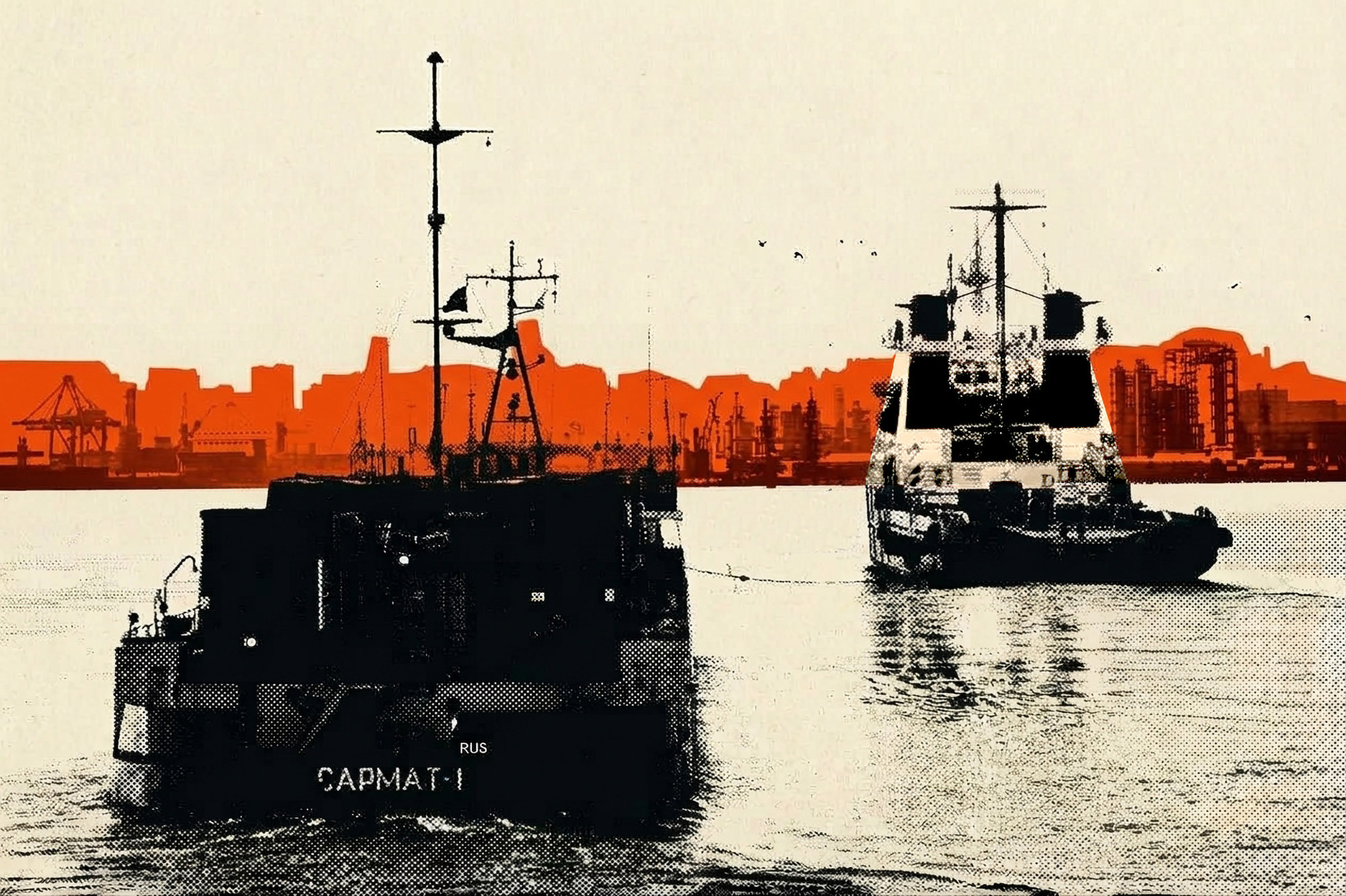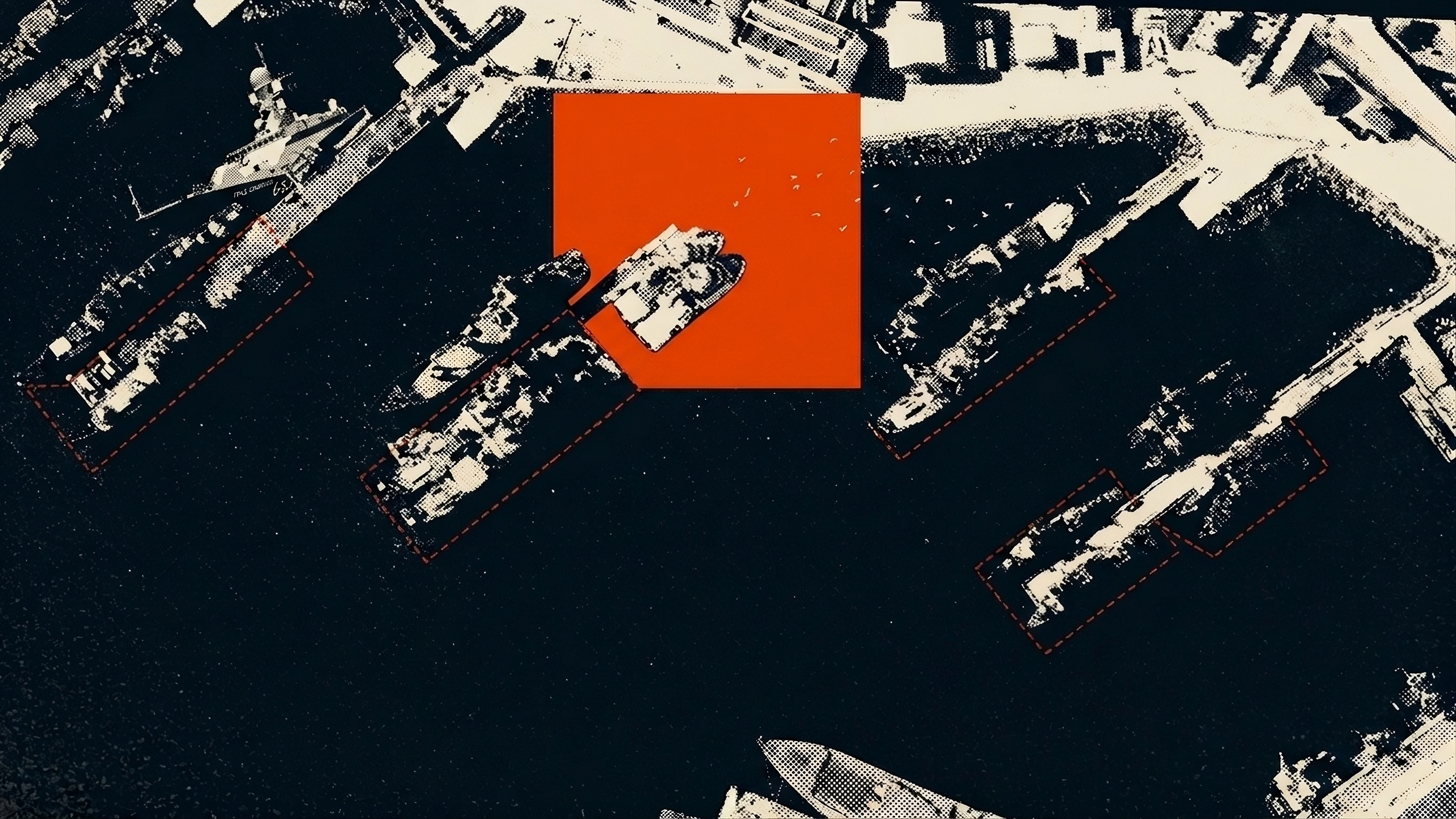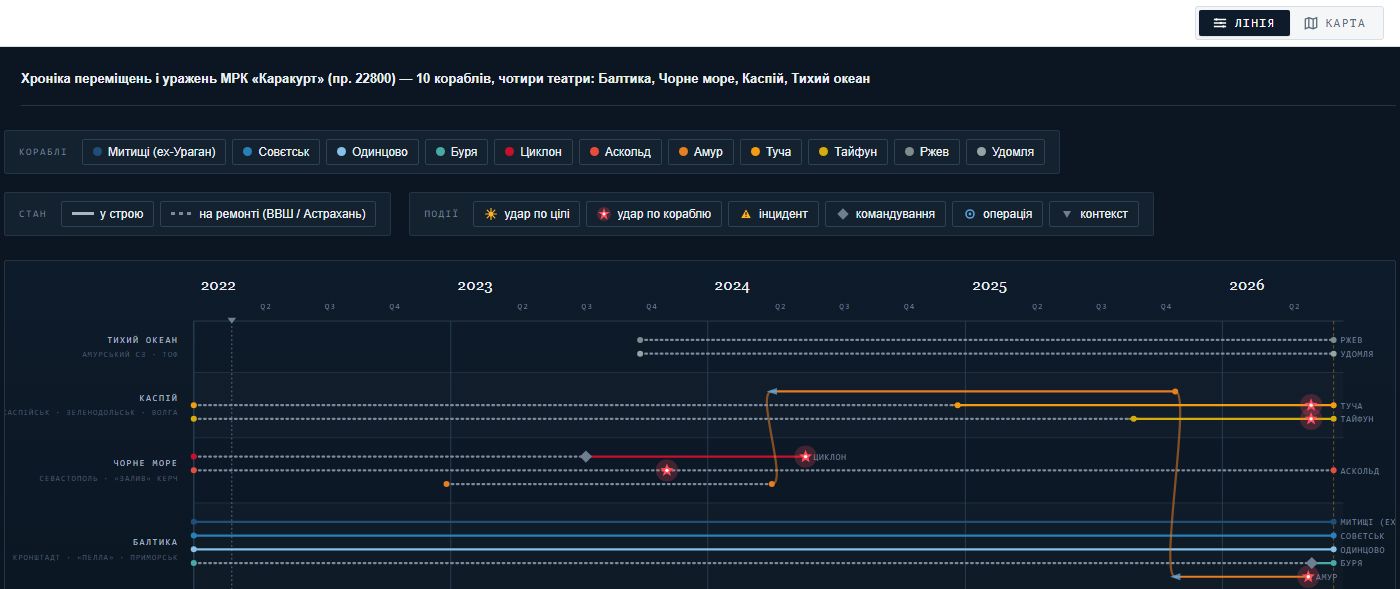
This article is about what Project 22800 was supposed to mean for the Russian fleet, and what it became under war conditions. The reconstruction draws on open sources: official statements from the Ukrainian General Staff and Naval Forces, UK MoD intelligence assessments, Russian MoD and shipyard publications, Defence Express and Crimea.Realities analysis, and satellite and drone imagery published by the parties.
IntroductionWhy Russia Needed the Karakurt
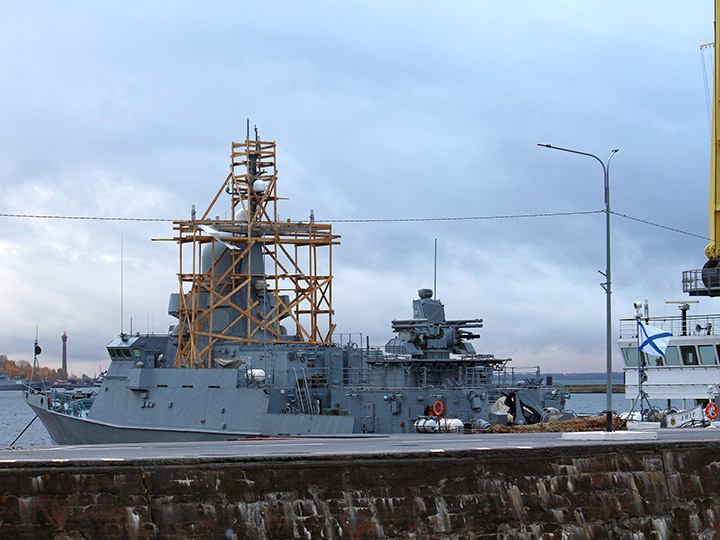
Project 22800 (designation "Karakurt") was developed by the Central Marine Design Bureau Almaz (St. Petersburg) in 2015, based on the Project 12300 Scorpion missile-artillery boat of the 1990s. These are third-rank near-sea small missile ships (MRKs) with a displacement of about 870 tonnes and a length of 67 metres.
The series was essentially a correction of the predecessor, the Buyan-M (21631). Buyan-Ms were deliberately designed with very shallow draught (about 2.6 metres) to classify them as river-sea ships: this allowed transferring them via inland waterways between fleets and, per analysts' assessments, helped circumvent restrictions on shore-based cruise missile deployment. The cost was poor seakeeping — in open waters the Buyan felt uncertain. The Karakurt retained the same strike logic but corrected two key deficiencies:
Two Key Differences from the Buyan-M
- Seakeeping. A draught of about 4 metres and seagoing hull lines allow operating in open sea, individually or in groups — where the Buyan-M is limited.
- Own air defence. Unlike the Buyan-M which is defenceless from the air, the Karakurt received the naval version of the Pantsir-M air defence complex.
The strike armament is common to both projects: eight universal UKSK 3S14 vertical launch cells for Caliber-NK cruise missiles, Oniks anti-ship missiles, and prospectively Tsirkon hypersonic missiles. Artillery — 76.2mm AK-176MA, rapid-fire AK-630M / Palash, heavy machine guns. Some ships carry Orlan-10 UAVs for reconnaissance and target designation.
Karakurts are built simultaneously at several sites: the Pella shipyard (Leningrad Oblast), Ak Bars Corporation enterprises — Zelenodolsk Plant (Tatarstan) and the Zaliv plant in Kerch — and the Amur Shipbuilding Plant (Komsomolsk-on-Amur) for the Pacific Fleet.
Of the planned 16 ships (earlier Western publications cited up to 18 contracted), about 14 have been launched. As of June 2026, seven are in service (including Burya, commissioned 8 May 2026), one is sunk (Tsyklon), one is under repair after a strike (Askold), the rest are under construction. Almost the entire series has already been launched — which makes the losses of the Black Sea group all the more notable.
Series 22800 · Full Roster by Yard and Fleet
Data cross-checked against RussianShips.info, Russian Wikipedia, and VPK.name; sources agree.[1]
| Name | Yard No. | Yard | Launched | Commissioned | Fleet / Status |
|---|---|---|---|---|---|
| Mytishchi (ex-Uragan) | 251 | Pella | 29.07.2017 | 17.12.2018 | Baltic, active — lead ship of series |
| Sovetsk | 252 | Pella | 24.11.2017 | 08.10.2019 | Baltic, active |
| Odintsovo | 253 | Pella | 05.05.2018 | 14.11.2020 | Baltic, active — first with Pantsir-M |
| Burya | 257 | Pella | 23.10.2018 | 08.05.2026 | Baltic, active |
| (names to be confirmed) | 254–256 | Pella | 2019 | — | Under construction (3 units) |
| Tsyklon | 801 | Zaliv (Kerch) | 24.07.2020 | 12.07.2023 | BSF → sunk 19.05.2024, Sevastopol (ATACMS) |
| Askold | 802 | Zaliv (Kerch) | 21.09.2021 | — | BSF → struck 04.11.2023, Kerch; under repair |
| Amur | 803 | Zaliv (Kerch) | 26.12.2022 | 26.08.2024 | BSF → transferred to Baltic (Oct. 2025) |
| Tucha | 804 | Zelenodolsk | 30.06.2023 | 21.12.2024 | Formally BSF; based on Caspian |
| Tayfun | 805 | Zelenodolsk | 07.05.2024 | 28.08.2025 | Formally BSF; based on Caspian |
| Rzhev | 201 | Amur SY | 27.09.2023 | Factory trials | Pacific Fleet (planned) |
| Udomlya | 202 | Amur SY | 27.09.2023 | — | Pacific Fleet (under construction) |
| Pavlovsk | 203 | Amur SY | — | — | Pacific Fleet (under construction) |
| Ussuriysk | 204 | Amur SY | — | — | Pacific Fleet (under construction) |
Methodology
This material is based exclusively on open sources without access to classified information. Every key fact was cross-checked against at least two independent sources from different "camps" — Ukrainian, Russian, and international — to minimise dependence on one side of the conflict. Four main data categories were used:
- Official Ukrainian statements — statements by the General Staff and Naval Forces of Ukraine on strikes against specific ships. This is the primary source for strike attribution, but enemy loss figures are marked accordingly since full independent verification is impossible.
- International intelligence and analysis data — primarily UK MoD intelligence briefings, which assess strike results with cautious phrasing ("almost certainly," "probably"); we preserve that level of certainty rather than elevating it.
- Russian official and industry sources — Russian MoD and yard statements on keel-laying, launching, and commissioning, plus roster databases (RussianShips.info, Russian Wikipedia, VPK.name). Ship yard and hull numbers, dates, and unit assignments are drawn from here. Propaganda-evaluative content is filtered out.
- Satellite and drone imagery — Planet Labs / Maxar imagery and frames from Ukrainian strike drones; used to confirm mooring location and damage extent through before/after comparison and geolocation.
Limitations. The precise damage extent for ships that did not ultimately sink (Askold, the Caspian-struck Karakurt) cannot be established from open data — Russia does not disclose such information. Names of ships under construction (yard nos. 254–256) are ambiguous. Hull numbers change, so identification in imagery requires date verification.
§ 01 · Black SeaThe Five That Didn't Fight
Five Karakurts were assigned to the Black Sea Fleet. By the project logic, they were to be the same long-range missile strike instrument as the Black Sea Buyan-Ms, but more seaworthy and better protected from the air. In practice, the southern group fell apart before it could prove itself: as of mid-2026, none of these five ships is performing combat missions in the Black Sea.
All five were built by the Ak Bars shipbuilding group: three at the Kerch Zaliv yard (Tsyklon, Askold, Amur), two more at the Zelenodolsk Plant in Tatarstan (Tucha, Tayfun). All were assigned to the 41st Missile Boat Brigade in Sevastopol — the same unit whose commander in March 2014, per the Ukrainian Prosecutor General's Office, led the armed seizure of the Ukrainian corvette Khmelnytsky.
None of the five Black Sea Karakurts carried out a confirmed Caliber launch against Ukraine.Based on available open data
Ukrainian Navy spokesperson Dmytro Pletenchuk stated that Tsyklon — the only then-commissioned ship of the series in the Black Sea — had not passed state trials and had not fired a single cruise missile. The only evidence to the contrary is a vague statement by Russian Defence Minister Sergei Shoigu (April 2024) that "Tsyklon… successfully carries out assigned tasks"; no specific missile strikes were named, and "tasks" could mean patrols or air defence duty. This is recorded as a statement, not proof.
Tsyklon: The World's First Warship Sunk by ATACMS
Tsyklon (yard no. 801) was laid down at Zaliv on 26 July 2016, launched 24 July 2020, and accepted into the Black Sea Fleet on 12 July 2023. Its first sea trial was 22 August 2023. It was the fleet's youngest ship and at that time the only fully commissioned Karakurt in the south — a carrier of up to eight Calibers or Oniks, with its own air defences.
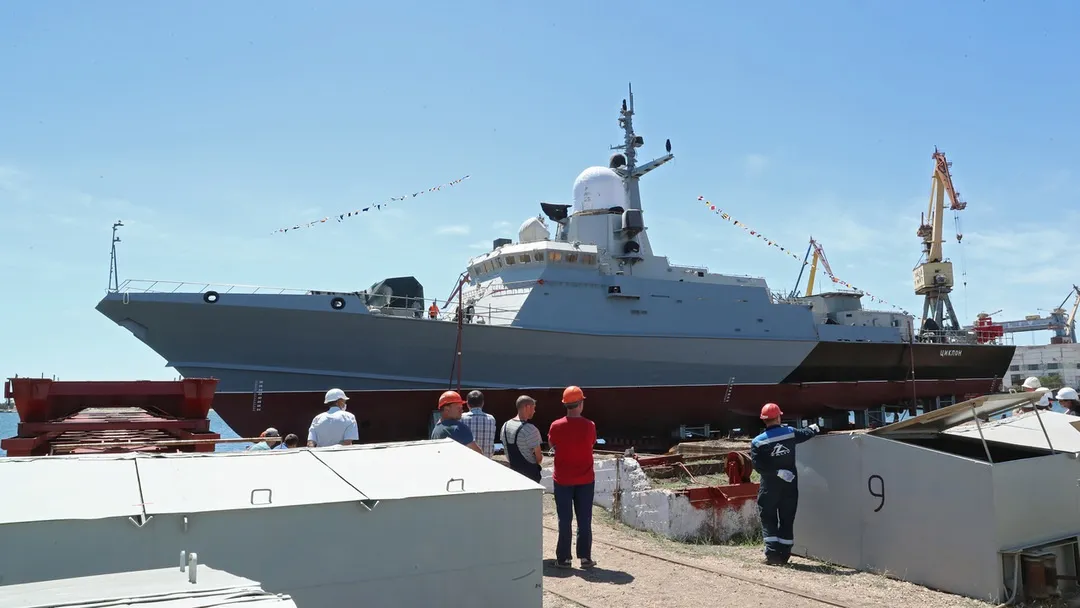
Tsyklon's combat value remained theoretical. Per Ukraine's Navy, the ship did not complete state trials and launched no missiles.[2] Against this backdrop, Shoigu's statement a month before the ship's destruction — that the lead Karakurt of the series "successfully carries out assigned tasks" — was particularly telling.
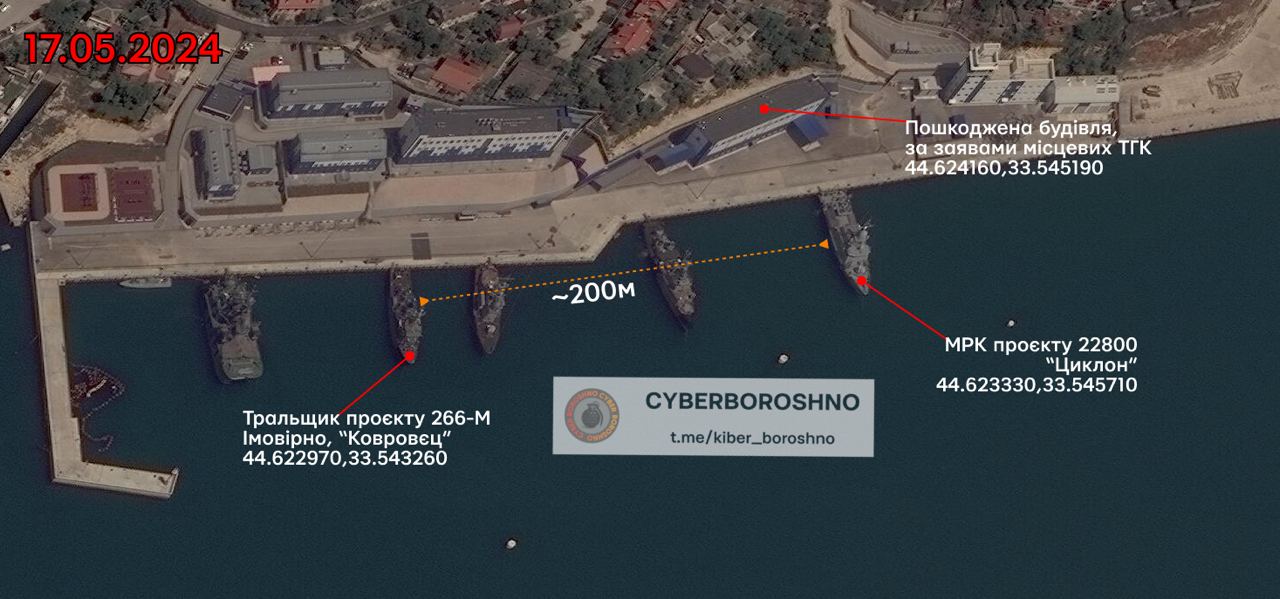
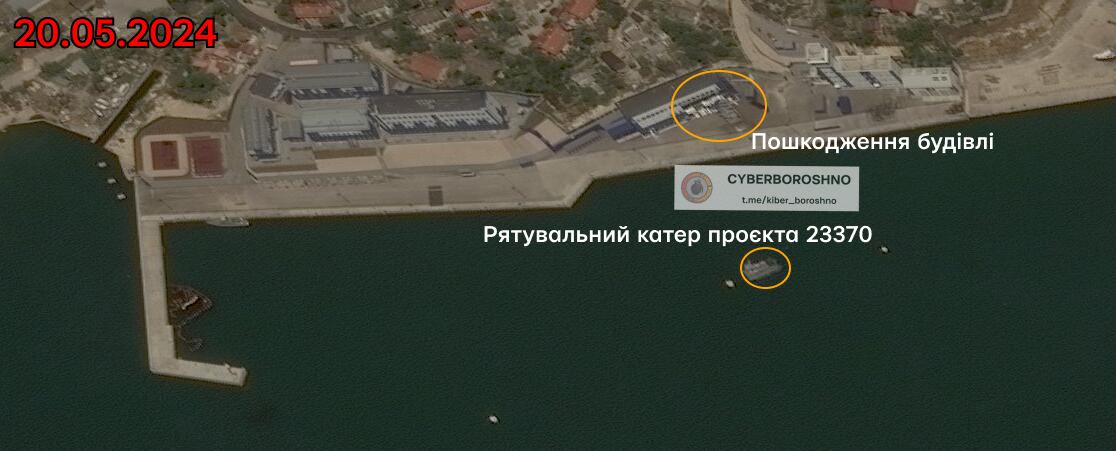
In the night of 19 May 2024, Ukraine's Defence Forces struck Sevastopol Bay. Per UK MoD intelligence assessment, the attack "almost certainly" combined strike drones and ATACMS operational-tactical missiles, sinking Tsyklon; the General Staff confirmed the strike on 21 May.[3] Per reports (not independently fully verified), six Russian sailors were killed and eleven wounded.
The episode's significance goes beyond a single loss: this is the first confirmed case of a warship sunk by ATACMS missiles. The ship that was supposed to protect Sevastopol Bay was not saved even by its own air defences. Per Pletenchuk, with Tsyklon's destruction Russia lost the last Caliber carrier capable of striking Ukraine at close range from the Crimean side.
Askold: Killed on the Slipway
The first Karakurt to make headlines never became a combat unit. Askold (yard no. 802) was laid down at Zaliv on 18 November 2016, launched 21 September 2021, but had not been commissioned at the time of the strike — it was likely close to completion.
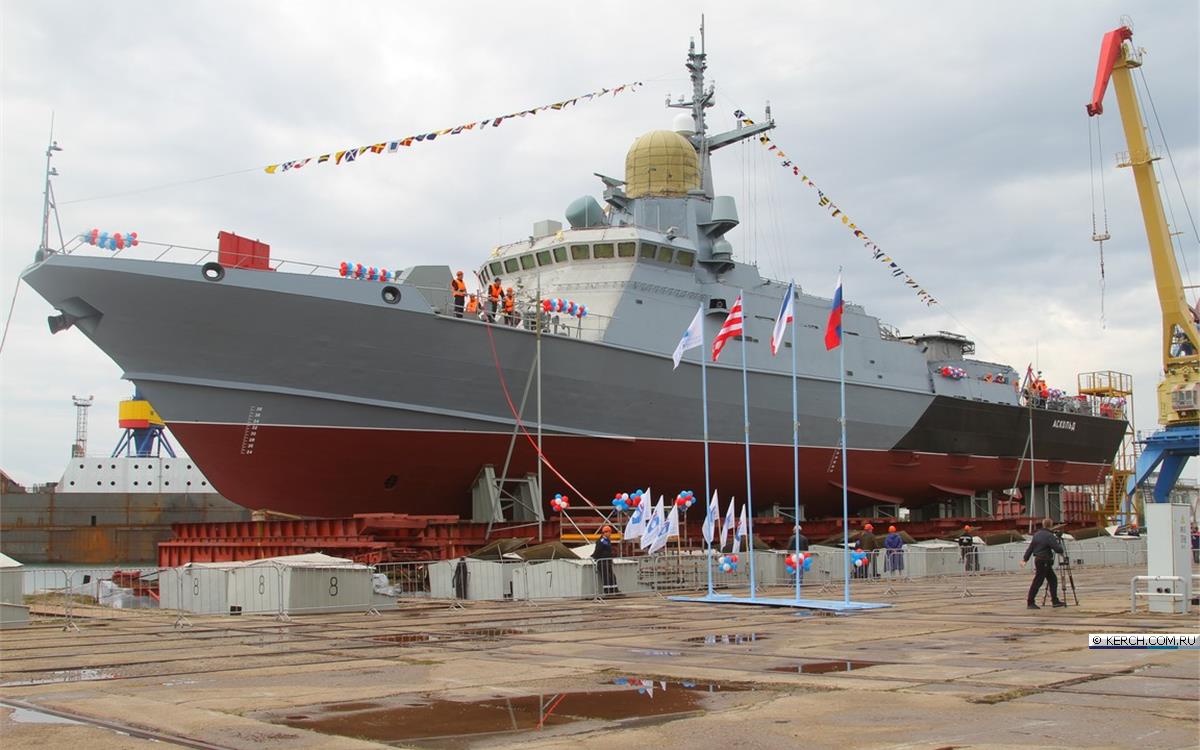
On 4 November 2023, Ukraine's Air Force struck the Zaliv shipbuilding plant in occupied Kerch, where Askold was moored. Per witness accounts and published footage, the ship was hit by at least three missiles; available data indicates these were SCALP-EG air-launched cruise missiles (the French version of Storm Shadow). UK MoD intelligence noted the strike occurred further east than most previously claimed long-range strikes.[6] Russia acknowledged the fact: Russia's MoD claimed 15 Ukrainian missiles, 13 allegedly shot down and two hitting; Air Force Commander Mykola Oleshchuk confirmed the strike.
Paradoxically, the ship was likely saved by its very incompleteness: without a combat load aboard there was nothing to detonate. Askold suffered heavy damage but did not sink. Southern Defence Forces spokesperson Natalia Humeniuk noted at the time that the ship would not return to combat duty soon, and some assessments concluded it would be simpler for Russia to write it off than to restore it.
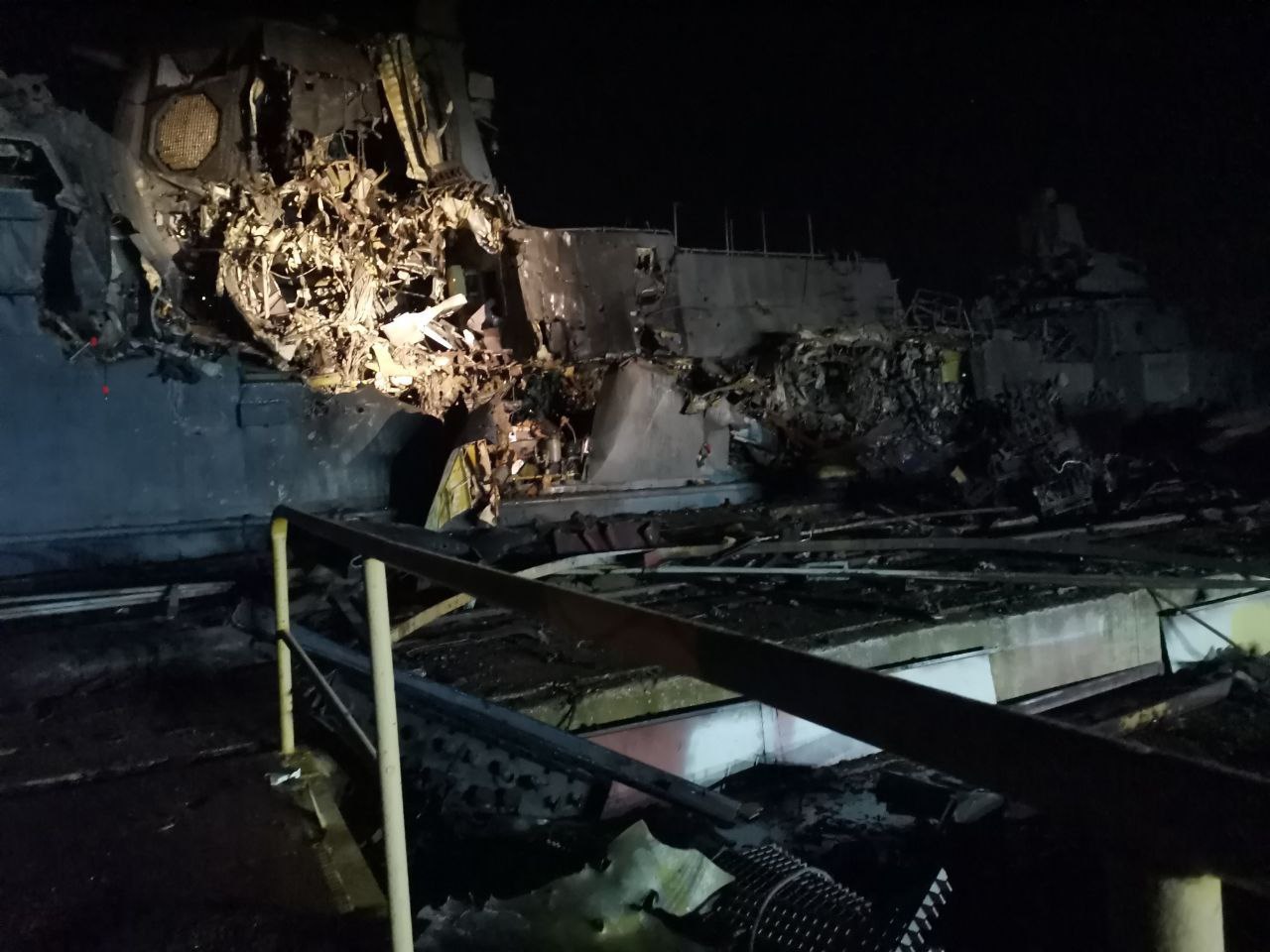
Per OSINT analyst MT_Anderson satellite analysis (Defence Express, December 2023), as of 2–3 December Askold was at Zaliv with the most damaged sections covered from above. Comparison of imagery from 2 December 2023 and 30 January 2024 showed no changes — the ship was not even moved. Pro-Russian Crimea resources later reported that Western satellites had captured a roof over the ship and scaffolding in a dry dock. In summer 2024, MT_Anderson estimated the ship had been prepared for transport for repair. Per Russian industry sources (VPK.name), as of 2026 the ship is still at Zaliv undergoing restoration repair, completion date unknown.[7]
Amur: Born in Kerch, Fled to the Caspian
The third Kerch Karakurt, Amur (yard no. 803), never participated in combat actions in the Black Sea — its fate became an illustration of the flight strategy. The ship was laid down at Zaliv on 30 July 2017, launched 26 December 2022, and was undergoing sea trials from December 2023. After the strikes on Askold and Tsyklon, Russia did not take risks: in April 2024 Amur was transferred from Novorossiysk via inland waterways to the Caspian — to complete trials outside the strike zone.
Formally, on 26 August 2024 Amur was accepted into fleet service — but physically the ship was in the Caspian at that time; some sources wrote about commissioning into the Caspian Flotilla, others into the Black Sea Fleet, reflecting the ambiguity of its assignment. Already in October 2025 the ship was transferred further: on 26 October 2025 Amur was spotted at Kronstadt, effectively joining the Baltic Fleet. Thus the only one of the Kerch trio to survive undamaged spent not a single day fighting at sea for which it was built, and ended its odyssey thousands of kilometres from it.
Tucha and Tayfun: Those That Didn't Make It
Two other ships of the Black Sea fivesome were physically built not in Crimea but at the Zelenodolsk Plant in Tatarstan — and never actually reached the Black Sea. Tucha (yard no. 804, launched 30 June 2023) was transferred south at the end of 2023 as a replacement for the stricken Askold — Defence Express reported this based on MT_Anderson satellite analysis — but was subsequently diverted to the Caspian, where it was commissioned on 21 December 2024. Tayfun (yard no. 805) was launched only 7 May 2024 and commissioned 28 August 2025 directly in the Caspian. Both ships moved along the Volga — the same route by which they were later diverted away from strikes.
Black Sea Section Summary
Of the five Karakurts assigned to the Black Sea Fleet, none has launched a confirmed cruise missile against Ukraine. One sunk in the water (Tsyklon), one destroyed at the yard slipway (Askold), three expelled from the theatre before full commissioning (Amur — to the Baltic; Tucha and Tayfun — to the Caspian). The project that was to fill the niche of a seaworthy missile carrier for Russia's southern grouping ended in the Black Sea before it effectively began.
§ 01 · The Black Sea Fleet Fivesome — Summary
| Ship | Yard | Episode | Status |
|---|---|---|---|
| Tsyklon | Zaliv, Kerch | Sunk by ATACMS, Sevastopol · 19.05.2024 | Destroyed |
| Askold | Zaliv, Kerch | Struck on slipway · 04.11.2023 | Under repair |
| Amur | Zaliv, Kerch | Flight to Caspian → Baltic (2025) | Active |
| Tucha | Zelenodolsk | Commissioned directly on Caspian | Active |
| Tayfun | Zelenodolsk | Commissioned directly on Caspian | Active |
§ 02 · CaspianThe Hideout That Didn't Work
The Caspian was never home for the Karakurts. No Project 22800 ship was built or planned for the Caspian Flotilla: all sixteen ships were assigned to the Baltic, Black Sea, and Pacific. Moreover, the very idea of the project was to give the fleet a seaworthy Caliber carrier — a complement to the river-sea Buyan-Ms of Project 21631, which were created for shallow inland basins like the Caspian. That is, Russia already had a dedicated Caliber carrier for the Caspian, and the Karakurt's seakeeping provides no advantage there.
Yet after the strikes on Kerch and Sevastopol, Russia transferred surviving Black Sea ships to the Caspian. The flight logic was simple: a landlocked interior sea over a thousand kilometres from the front, which Ukrainian weapons seemed unable to reach. This logic failed twice. First, the Caspian is not a quiet haven but an active theatre of missile strikes on Ukraine. Second, in May 2026 a Karakurt was struck there too.
Two Stranded Units: Tucha and Tayfun
As of May 2026, two Karakurts were based in the Caspian — Tucha and Tayfun; the third, Amur, had already gone to the Baltic in October 2025. Tucha (yard no. 804) was commissioned in the Caspian on 21 December 2024, Tayfun (yard no. 805) — 28 August 2025. Both are formally assigned to the Black Sea Fleet (some sources list them under the Caspian Flotilla) — that is, ships that never reached "their" sea and got stranded in a basin for which they were not designed.
Strike of 7 May: The Hideout Was Reached
In the night of 7 May 2026, Ukraine's Defence Forces struck a Project 22800 Karakurt multi-purpose small missile ship in the Kaspiisk base area. The General Staff of the Armed Forces of Ukraine reported this, noting the ship is a Caliber carrier and damage extent was being specified.[8] Which specific ship was struck — Tucha or Tayfun — was not officially named.
Ukraine's Navy spokesperson Dmytro Pletenchuk noted the bitter irony for Russia: the ship most likely struck was the same one that had left the Azov-Black Sea region specifically to avoid Ukrainian strikes. The distance to Kaspiisk is significant: about 930 kilometres straight-line to the occupied Kerch Peninsula, and approximately 1,000–1,500 kilometres from Ukrainian-controlled territory depending on the flight route. The General Staff did not specify the weapon used; assessments suggested a long-range strike drone type Liutyi (range about 1,400 km, warhead 40–50 kg) or FP-1 (up to 1,600 km, warhead about 120 kg).
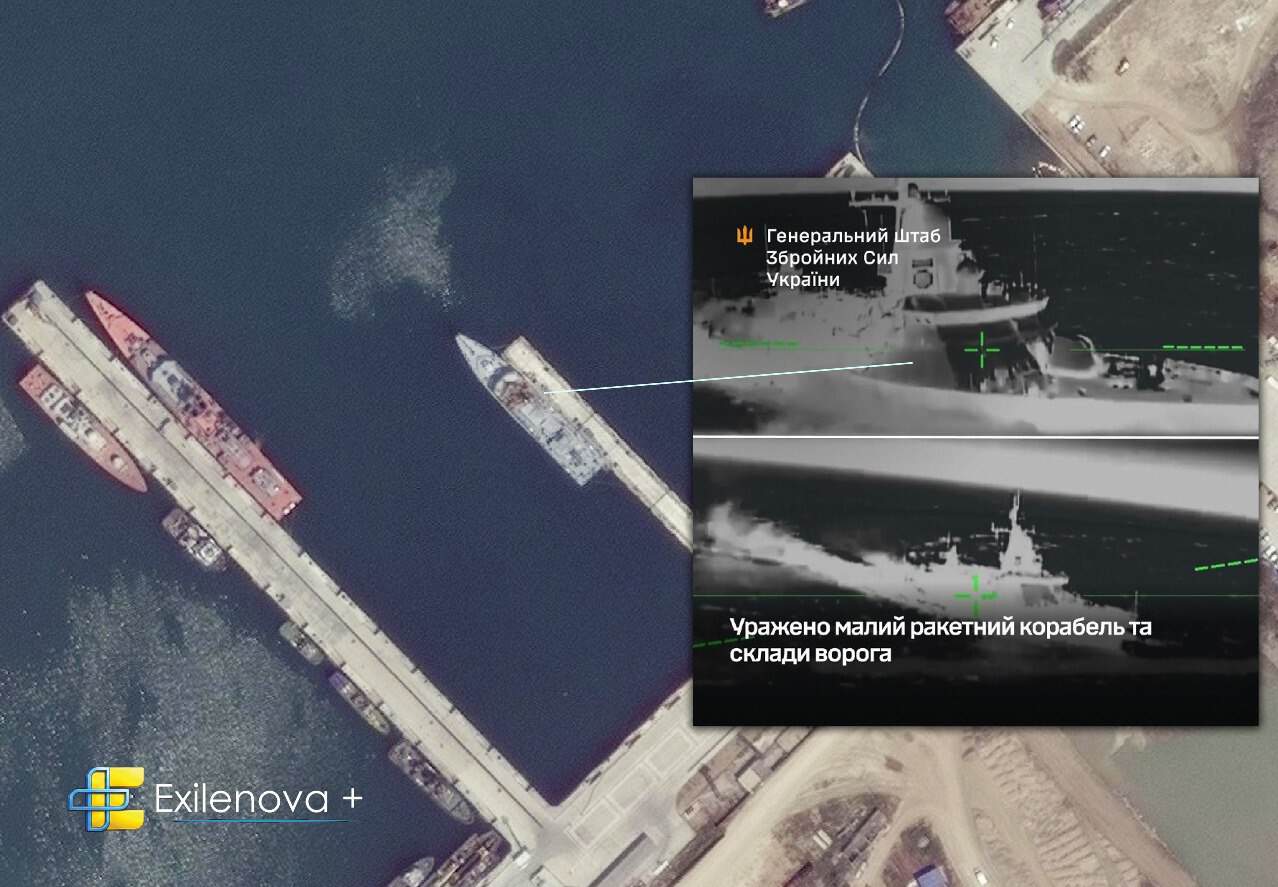
This strike was, per the General Staff's phrasing, the second Caliber carrier struck within a week: a few days earlier, on 3 May, the Karakurt Amur had been attacked at Primorsk in the Baltic (see § 03).
Strikes on Kaspiisk · 2024–2026
- 06.11.2024Drone attack on the flotilla base.
- 30.11.2024Repeat attack on Kaspiisk.
- 01.12.2025Strike on the naval base.
- 07.05.2026Karakurt struck — Caliber carrier (Ukrainian GS); damage extent being specified.
- ~15.05.2026Per unofficial data (Exilenova+ Telegram channel) — explosions again, possible strike on another ship and dozens wounded. Based on a single unofficial source, unconfirmed.
Caspian Section Summary
Flight to the Caspian saved Tucha and Tayfun from the fate of Tsyklon and Askold — but at a high price. Ships designed as seaworthy carriers specifically to reinforce the Black Sea Fleet found themselves locked in an inland sea where their main advantage is useless and Russia already had a dedicated Caliber carrier. The flight switched them off from the war for which they were built. And on 7 May 2026 it became clear that even this price does not guarantee safety: the strike reached them a thousand kilometres from the front.
§ 03 · BalticThe Only Theatre Where Ships Actually Serve
If in the Black Sea Karakurts died, and in the Caspian got stranded — and the Pacific branch is not yet ready — in the Baltic the series does what it was created for. Here the lead ship of the project serves along with the full range equipped with Pantsir-M; here Karakurts are based in their home fleet waters (Baltiysk in Kaliningrad Oblast and Kronstadt near St. Petersburg), with no need to flee. But even here Ukrainian strikes have reached — and even earlier, a Black Sea refugee arrived.
The Baltic foursome was all built by one yard — Pella in Otradnoye (Leningrad Oblast). On these ships the project's main technical evolution is most visible — the gradual emergence of dedicated air defences.
Baltic Foursome Registry: From Defenceless to Pantsir
| Ship | Yard No. | Commissioned | Hull | Air Defence |
|---|---|---|---|---|
| Mytishchi (ex-Uragan) | 251 | 17.12.2018 | 577 | AK-630M (no dedicated AD) — lead ship of series |
| Sovetsk (ex-Tayfun) | 252 | 08.10.2019 | 567 | AK-630M (no dedicated AD) |
| Odintsovo (ex-Shkval) | 253 | 14.11.2020 | 584 | Pantsir-M — first in series |
| Burya | 257 | 08.05.2026 | 578 | Pantsir-M — second standard unit |
Amur: The Black Sea Refugee on the Baltic
A special case in the Baltic grouping — Amur, a ship born in Kerch for the Black Sea Fleet, that fled strikes to the Caspian and in October 2025 ended up on the Baltic: on 26 October it was spotted at Kronstadt. Via inland waterways it had been routed all the way from the Caspian to St. Petersburg. Formally reinforcing the Baltic Fleet with another Caliber carrier, Amur had not fired a single combat shot throughout its entire odyssey. More on its Black Sea origins — in § 01.
The Primorsk Incident
War reached the Baltic coast. On 3 May 2026, Ukraine's Defence Forces struck the port of Primorsk — Russia's largest oil terminal port on the Baltic. President Volodymyr Zelenskyy announced the operation; per his data, the report was made by acting SBU head Major General Yevhen Khmara, and the operation itself was conducted by the SBU, Unmanned Systems Forces, SOF, HUR, and the State Border Service.[9] Among the struck targets: a small missile ship of the Karakurt project, a patrol boat, a shadow fleet tanker, and oil terminal infrastructure.
Which specific Karakurt was struck was not officially named by the Ukrainian side — reference was made only to a Project 22800 ship. Per Russian and network sources, this may have been Amur, but this identification is unconfirmed. If correct, the ship targeted was the same "refugee" that had travelled from Kerch via the Caspian to the Baltic — but at the level of open data this remains a version, not a fact. Damage extent was not detailed.
Baltic Section Summary
The Baltic is a mirror image of the Black Sea. Here Project 22800 exists in standard mode: lead ship, gradual appearance of Pantsir-M, series additions, home bases without need to flee. If the Black Sea group is a story of losses, the Baltic is a story of what the Karakurts were supposed to be everywhere. But even this most successful branch of the series no longer feels out of reach: the Primorsk strike showed that even a deep rear on the Baltic has ceased to be safe.
§ 04 · Pacific OceanThe Series That Hasn't Arrived Yet
For the Pacific Fleet, Karakurts are being built at the Amur Shipbuilding Plant in Komsomolsk-on-Amur — four ships: Rzhev (yard no. 201), Udomlya (no. 202), Pavlovsk (no. 203), and Ussuriysk (no. 204). All were laid down in 2019–2020.
Unlike the Black Sea and Baltic groups, the Pacific branch has suffered no losses and no forced redeployments — its problem is purely industrial: not one of these ships has been commissioned. Rzhev and Udomlya were launched on 27 September 2023; in October 2024 Rzhev was towed from Komsomolsk to Vladivostok, and factory sea trials began only at the end of 2025 to early 2026. The rest are at earlier stages.
This direction has almost no connection to the war against Ukraine: the ships are being built for another theatre. Their story illustrates only the chronic pace of Russian shipbuilding — units laid down before the full-scale invasion are still not in service six years later. The Pacific foursome is the case where Karakurts do not threaten Ukraine not because they were destroyed or expelled, but because they are still not ready to fight.
Project in NumbersBuild Rate vs. Loss Rate
The contract originally envisaged 18 units, then was reduced to 16 (two cancelled in September 2020 — Eastern Shipyard, Vladivostok). About 14 ships have been launched; seven are in service; one sunk (Tsyklon); one under repair (Askold); the rest under construction.
Four-Theatre Matrix
| Theatre | Series Fate | Ships | What Happened |
|---|---|---|---|
| Black Sea | Destroyed / expelled | Tsyklon, Askold, Amur, Tucha, Tayfun | No confirmed launches against Ukraine. 1 sunk, 1 destroyed on slipway, 3 expelled from theatre. |
| Caspian | Stranded | Tucha, Tayfun | Saved from BSF fate but locked in a basin where their advantage is useless. Strike 07.05.2026 reached here too. |
| Baltic | Active | Mytishchi, Sovetsk, Odintsovo, Burya (+Amur) | Series operating normally: home bases, gradual Pantsir-M deployment. Primorsk strike showed rear is unsafe. |
| Pacific Ocean | Not yet built | Rzhev, Udomlya, Pavlovsk, Ussuriysk | None commissioned. Do not threaten Ukraine due to chronic shipbuilding pace. |
ConclusionA Battered Series That Remains a Threat
Project 22800 was conceived as a correction of mistakes: a seaworthy Caliber carrier with its own air defences, to reinforce Russia's fleets where the river-sea Buyan-Ms were helpless. The series' fate split by geography into four different stories — and in none did the Karakurt become entirely what it was supposed to be.
In the Black Sea, where these ships were most needed by Russia, the series suffered its heaviest losses: of five ships assigned to the fleet, none fired a confirmed Caliber at Ukraine. Tsyklon became the world's first warship sunk by ATACMS; Askold was destroyed at the yard; three others were expelled from the theatre. Notably, the Black Sea group was struck not on the open sea for which these ships were built, but at berths and slipways. In the Caspian, Tucha and Tayfun escaped strikes at the cost of getting stranded in a basin for which they were not designed — and on 7 May 2026 it became clear that even a thousand kilometres from the front no longer guarantees safety. In the Baltic, the series operates as intended — lead ship, gradual Pantsir-M deployment, home bases — although the Primorsk strike showed that there is no unreachable rear there either. And in the Pacific Ocean, Karakurts do not threaten Ukraine only because six years after being laid down they are still not ready to fight.
Ukrainian strikes on Karakurts are noticeably thinning and containing this force — sinking, maiming, forcing ships to hide thousands of kilometres away — but have not eliminated the threat entirely.
Almost the entire series has already been launched — about fourteen of sixteen ships — and Russia continues commissioning new units: Burya joined the Baltic Fleet on 8 May 2026. Each Karakurt accepted into service is a full carrier of up to eight Calibers or Oniks. And the Caspian, to which the Black Sea ships fled, remains an active theatre of missile strikes on Ukraine: Caliber launches from there were recorded in the night of 2 June 2026. The hunt continues on all theatres simultaneously.
Sources
- Series 22800 roster cross-checked against RussianShips.info, Russian Wikipedia, and VPK.name.
- Statements by Ukrainian Navy spokesperson Dmytro Pletenchuk that Tsyklon had not passed state trials and carried out no missile launches.
- UK MoD intelligence briefing on the Sevastopol Bay strike of 18–19 May 2024 ("almost certainly" ATACMS + UAVs); Ukrainian General Staff confirmation, 21 May 2024.
- Radio Liberty / Crimea.Realities investigation into the "Ukrainian connection" in the Black Sea Fleet officer corps.
- NAZK sanctions registry; Ukrainian Presidential Decrees Nos. 82/2019 and 726/2022; Myrotvorets database.
- UK MoD intelligence and Ukrainian Air Force Commander Mykola Oleshchuk statements on the Zaliv strike, 04.11.2023 (SCALP-EG / Storm Shadow); Russian MoD acknowledgement.
- OSINT analyst MT_Anderson satellite analysis (Defence Express, December 2023); Crimea.Realities materials (summer 2024); VPK.name industry data (2026).
- Ukrainian General Staff statement on Karakurt — Caliber carrier — strike in Kaspiisk area, 07.05.2026; commentary by Dmytro Pletenchuk (Ukrainian Navy).
- President Volodymyr Zelenskyy statement on Primorsk port strike, 03.05.2026; report by acting SBU head Yevhen Khmara.