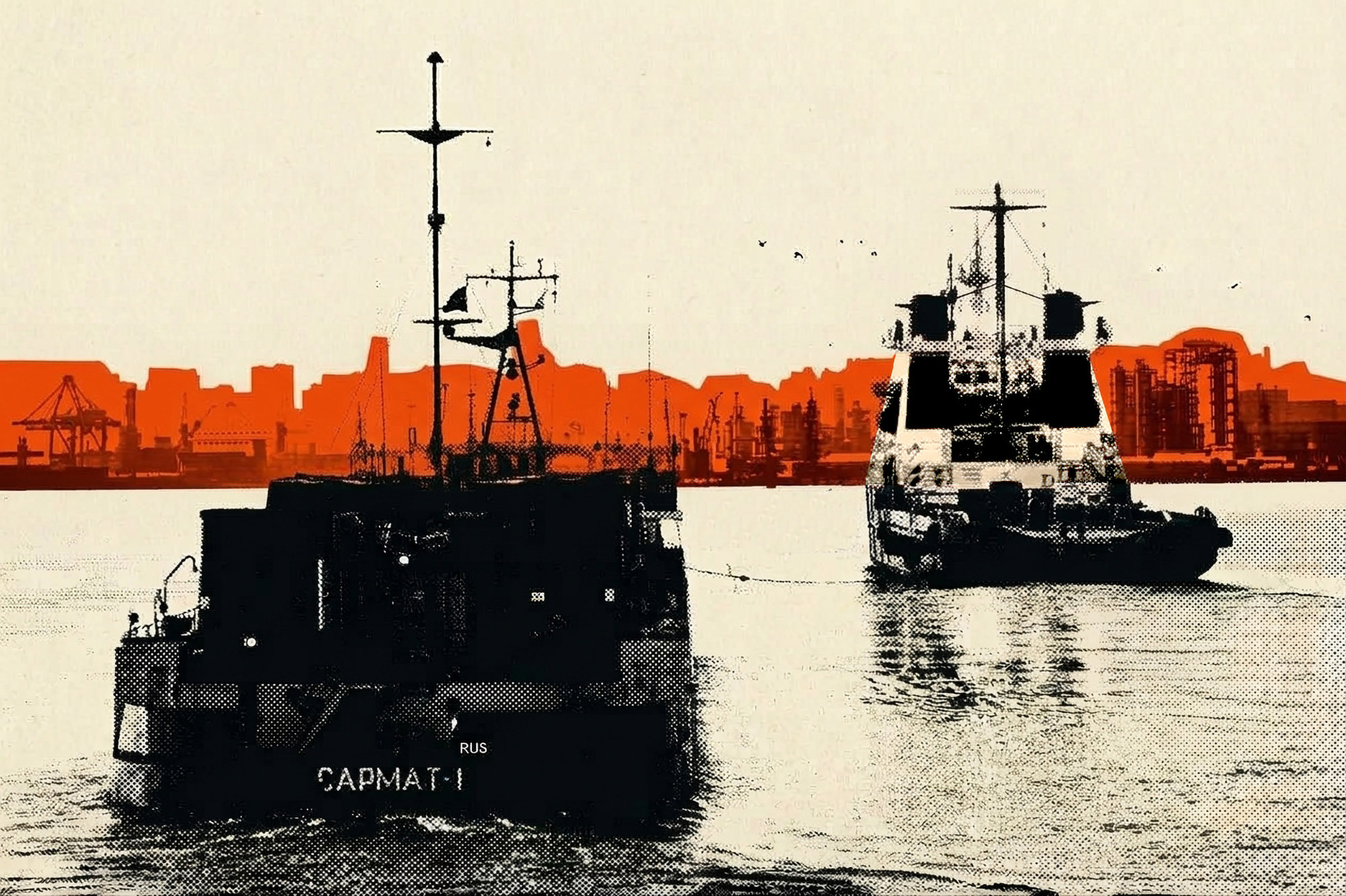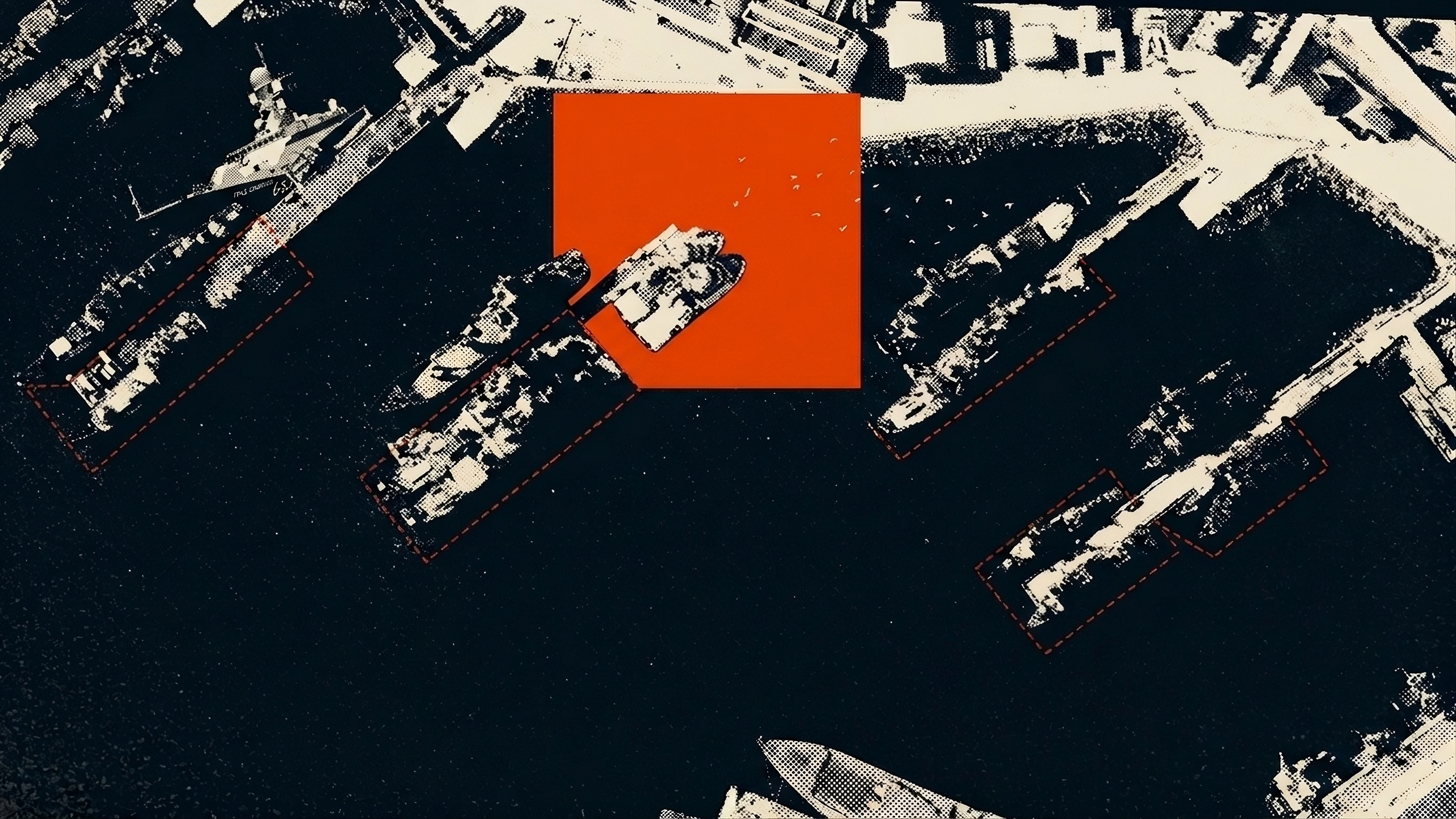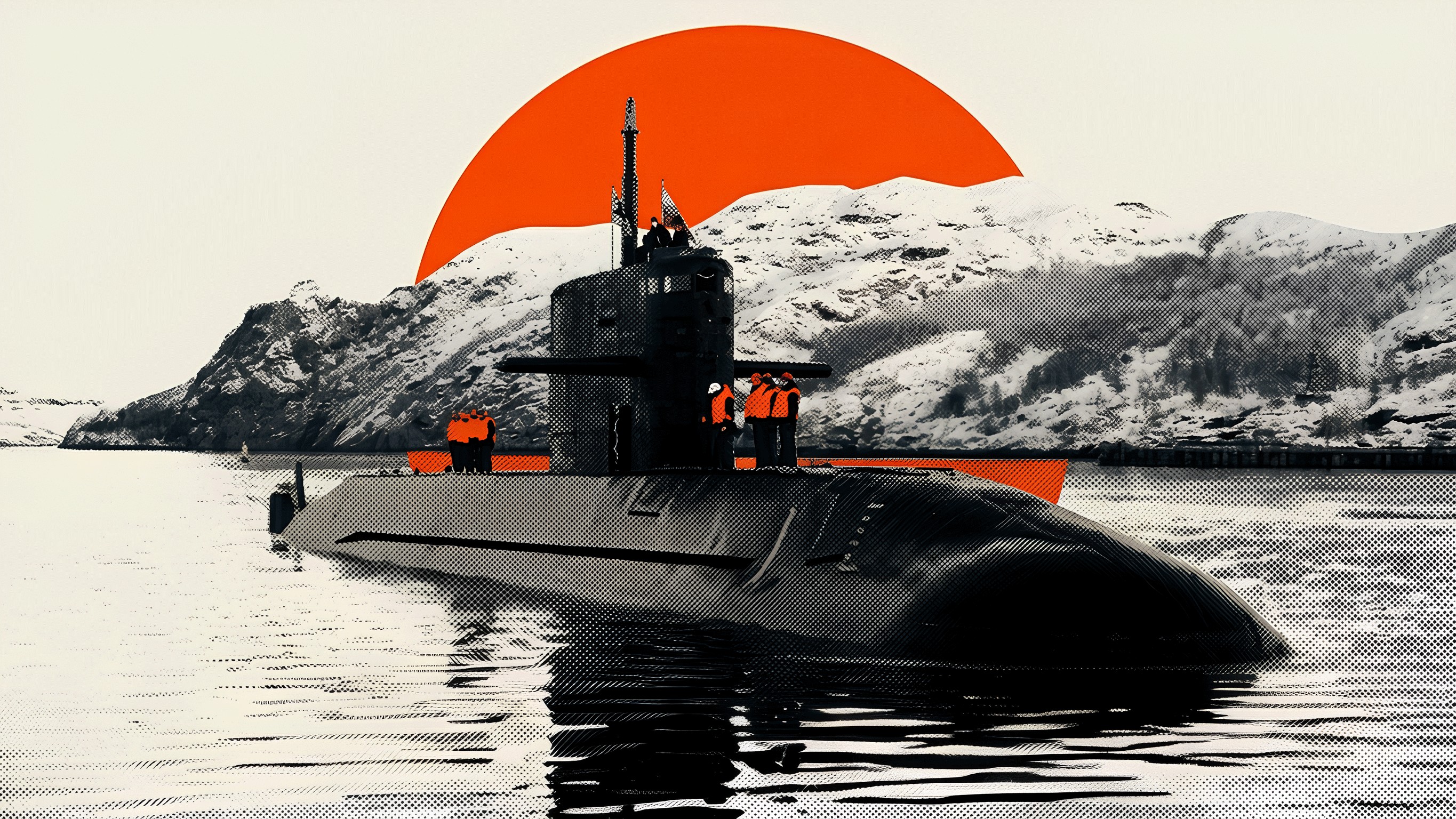
Project 677What Lada Is — and Why It Was Built
Project 677 was developed by the Saint Petersburg design bureau TsKB MT Rubin in the 1990s under chief designer Yuri Kormilitsin; every boat in the series has been built at Admiralty Shipyards (part of the United Shipbuilding Corporation)[1]. Lada was conceived as a universal replacement for the Project 877 Paltus-class Varshavyankas — with lower noise levels among the top requirements[1].
The project is considerably older than usually assumed: research and development on theme 677 began back in 1987, in the USSR[16] (Tekhnika Molodezhi dates it to 1989[20]). The technical design was approved in 1993 — and immediately sent back for revision; the second version was only signed off in 1997, and 180 separate development programmes were run in the course of creating the boat[16]. Kormilitsin led the effort from the start; from 2008 the project's chief designer was Alexander Arsentyev, under whom the serial boats were completed[15]. From the first research work to the flag-raising on the third boat in December 2025, 38 years passed.
The original plan was to build Ladas widely: at the Leningrad Admiralty Association, Sevmash in Severodvinsk, Krasnoye Sormovo in Gorky, and the Lenin Komsomol yard in Komsomolsk-on-Amur. Sevmash even managed to accumulate a construction backlog for the lead order — after the collapse of the USSR it was handed to Admiralty Shipyards, and the whole programme came down to a single yard[16].
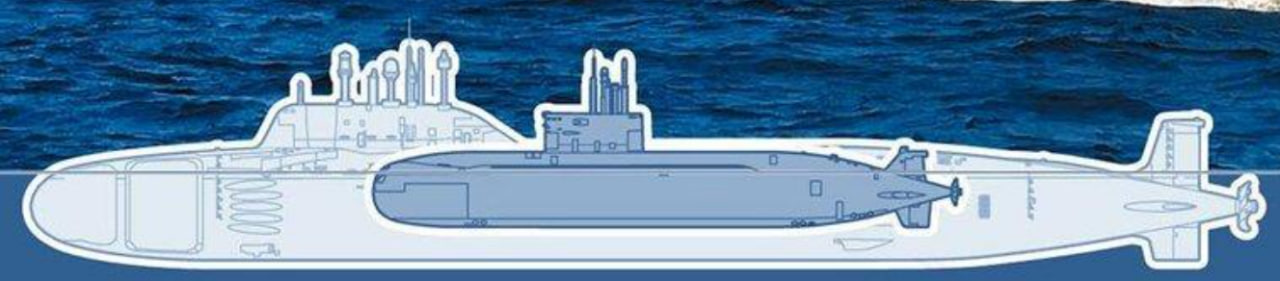
By design it's a multi-purpose boat: destroying enemy surface ships and vessels, patrol duty, reconnaissance, protecting sea lines of communication, laying minefields[1]. An important nuance that tends to get lost: Lada was designed first and foremost as an anti-submarine and patrol asset, not as a strike platform for cruise missiles — its role as a "Caliber carrier" became a deliberate talking point only later, riding the wave of enthusiasm for Calibers after 2015[11].
The submarine was conceived as a kind of underwater hunter, capable of destroying any target — surface combatants, transport vessels or submarines — by torpedo and missile strikes, by laying minefields, and also by means of combat divers.
Three Design Choices That Set Lada Apart
- A compact hull architecture — a configuration Russia hadn't used on attack submarines since the 1940s[14]. Exactly which configuration is disputed: the Apalkov reference work calls the boat single-hull[16], while N+1 describes it as one-and-a-half-hull[18]. Compared with Project 877, surface displacement is cut by roughly a factor of 1.3, noise is reduced, and submerged speed is higher[1].
- The automated combat system "Litiy" and a high degree of automation, which cut the crew down to 35[1][13].
- A permanent-magnet electric motor and a higher-capacity battery[14].
For the boat, "an entire line of new equipment — more than 130 items" was created, developed "on new principles."
That figure is presented as an achievement, but in the same interview Vilnit explained its price: no money was allocated for bench-testing the equipment, so the first units went straight onto the boat and had to be debugged on board[15]. More than a hundred and thirty systems never proven on a test bench, installed directly on the lead boat — that is the technical explanation for why Sankt-Peterburg took thirteen years to build and test.
SpecsTechnical Characteristics
Figures are given as claimed — they have not been independently verified and vary by provenance. Two lines of sources are set against each other below: Western reference digests[14] and the Russian reference tradition — the Shturm Glubiny compilation after Yu. V. Apalkov, which describes the baseline Project 677 as of the early 2000s and itself flags its data as "presumed"[16].
| Parameter | Western digests [14] | Russian sources [16] [17] |
|---|---|---|
| Project | 677 / 677M Lada; export — Amur-1650 (a.k.a. 677E) | |
| Designer / builder | TsKB MT Rubin / Admiralty Shipyards | |
| Hull architecture | one-and-a-half-hull[18] | single-hull, with minimal reserve buoyancy[16] |
| Displacement (surfaced) | ~1,793 t | 1,765 t |
| Displacement (submerged) | ~2,743 t | 2,700 t[17] · 2,650 t[20] |
| Draught | no data | 6.7 m[20] |
| Length overall | ~72 m (TWZ puts it at "roughly 200 feet" ≈ 61 m) | 67.0 m[16] · 66.8 m[20] |
| Beam | 7.1 m | |
| Diving depth | "over 300 m" | operating 250, maximum 300[17] (Apalkov allows 240) |
| Speed (surfaced / submerged) | 10 / 21 knots | |
| Range | ~7,500 km | 650 nm submerged at 3 knots; 6,000–6,500 nm snorkelling at 7 knots; 1,600 nm alternating 3.5-knot quiet running with snorkelling and battery charging until fuel is exhausted[20] |
| Endurance | 45 days on provisions | |
| Service life | no data | guaranteed 25 years; 10 years to first overhaul[20] |
| Noise | no data | per press claims — 50% of Project 877 levels, i.e. around 30 dB in calm seas[20] |
| Powerplant | diesel-electric; permanent-magnet motor, 1 shaft, ~2,700 hp | full electric propulsion; main motor SED-1, 1 × 4,100 hp; D-49 diesels; 28DG generators of 2,100 kW each[17] |
| Batteries | "higher-capacity battery" | 2 groups × 120 cells (forward and aft) |
| Propulsor | no data | 1 × low-noise fixed-pitch propeller |
| Auxiliary propulsion | no data | 2 retractable thrusters, 102 kW drive |
| Crew | 34 per the Russian MoD[17], 35 in digests, 36 per N+1[19] | |
| Torpedo tubes | 6 × 533 mm, bow; two upper-tier tubes adapted for wire-guided torpedoes[17] | |
| Load-out | 16–18 torpedoes/missiles or 44 mines; up to 10 Caliber/Klub; RPK-6 Vodopad (SS-N-16) | 18 torpedoes (SAET-60M, UGST, USET-80K), Shkval rocket-torpedoes, Biryuza (Club-S) anti-ship missiles or 22 DM-1 mines[20][16]; the MoD names Oniks and Alfa[17]; none of them mentions Caliber |
| Air defence | no data | Igla-1M MANPADS: 1 stowage container, 6 missiles |
| Electronics | combat system "Litiy" | Lira sonar suite with large-aperture bow passive array L-01; combat system Litiy; KRM-66 Kodak radar; Parus-98KP and Parus-98UP periscopes[17]; Murena torpedo fire-control[16]. Navigation suite: Appassionata[17] or Andoga[16] |
DesignInside the Boat: Five Compartments and No Margin
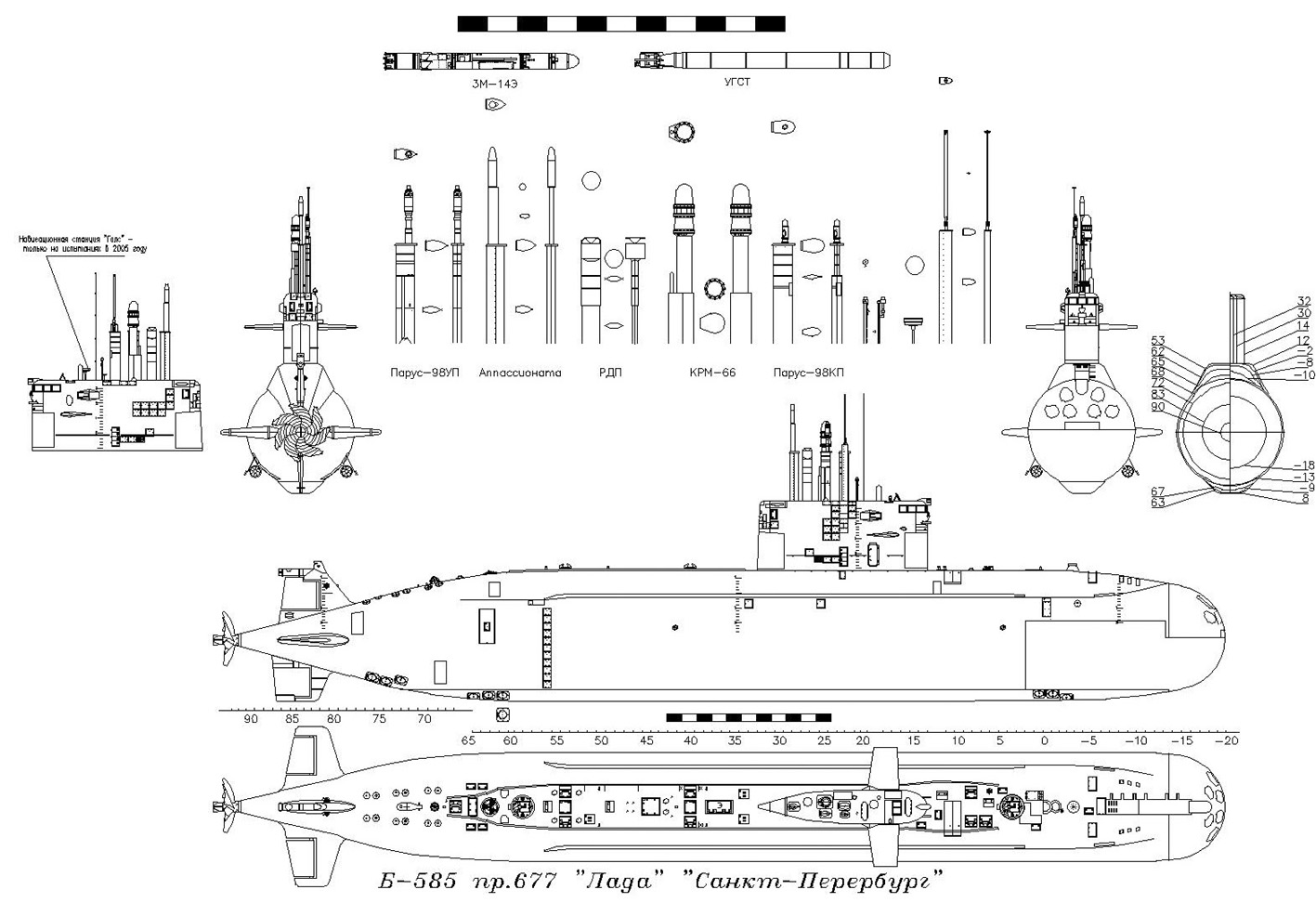
The longitudinal section of Lada has been published in Russian reference literature, and it shows a layout untypical of the Soviet school. The boat is divided into five compartments[16]:
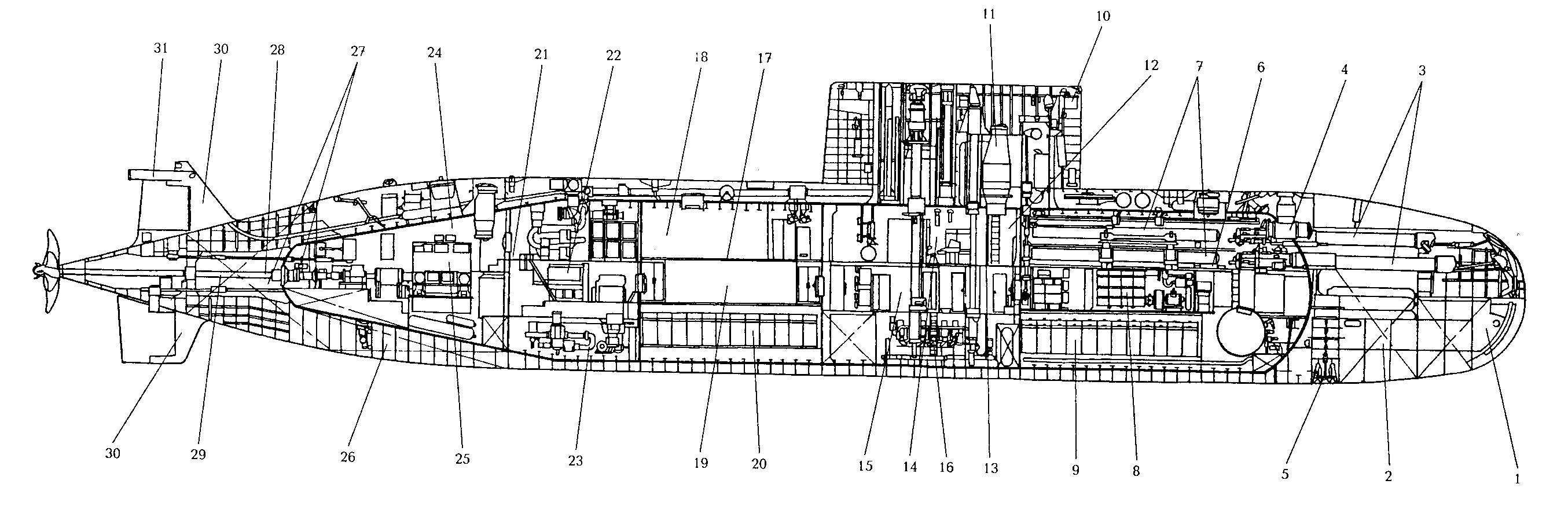
- 1compartment for the main sonar array
- 2forward main ballast tank
- 3533 mm torpedo tubes
- 4torpedo loading hatch
- 5anchor
- 6first (torpedo) compartment
- 7reload torpedoes with rapid-loading gear
- 8auxiliary machinery space
- 9forward battery
- 10navigation bridge
- 11pressure-tight conning tower
- 12second compartment (control room)
- 13control room
- 14main command post
- 15electronics equipment room
- 16auxiliary equipment and ship's systems: bilge pumps, hydraulic pumps, converters, air conditioning
- 17third (accommodation and battery) compartment
- 18wardroom and galley block
- 19living quarters and medical bay
- 20aft battery
- 21fourth (diesel-generator) compartment
- 22diesel generators
- 23auxiliary machinery space
- 24fifth (electric motor) compartment
- 25main propulsion motor
- 26fuel tank
- 27stern plane actuators
- 28shaft line
- 29aft main ballast tank
- 30aft vertical stabilisers
- 31fairing for the towed array deployment channel
The layout from bow to stern
- First, torpedo compartment. Right in the bow, a separate space houses the main sonar array; then six 533 mm tubes, the torpedo loading hatch, reload torpedoes with rapid-loading gear, the forward main ballast tank and the anchor.
- Second, control room. The pressure-tight conning tower, navigation bridge, control room and main command post, the electronics equipment room, bilge pumps and hydraulics.
- Third, accommodation and battery. The forward and aft battery groups, wardroom, galley, living quarters and medical bay — the crew lives directly above the batteries.
- Fourth, diesel-generator. The diesel generators and auxiliary machinery.
- Fifth, electric motor. The propulsion motor, fuel tank, shaft line and stern plane actuators; at the after edge, the vertical stabilisers and the fairing for the towed array channel.
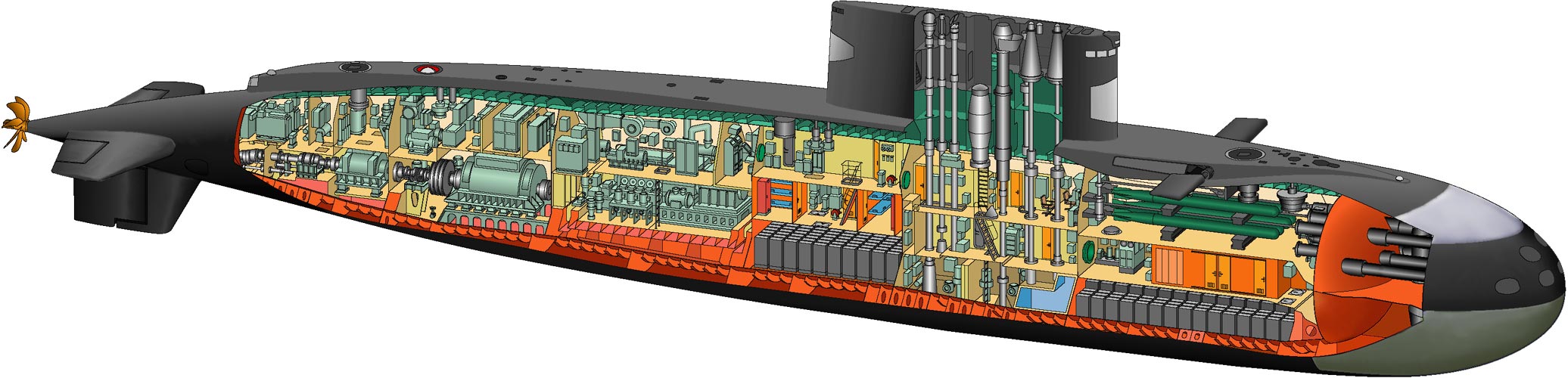
The defining structural feature sits in the definition of the type itself — and here two specialist sources disagree. The Apalkov reference work calls the boat single-hull, "with the minimum reserve buoyancy required to ensure surface unsinkability"[16]. Tekhnika Molodezhi says the same: a single-hull scheme, one that "our designers returned to for the first time in quite a while"[20]. N+1 describes the same Lada as one-and-a-half-hull: the pressure hull is only partly covered by a light hull[18].
The practical contradiction is smaller than it looks: both descriptions say that the outer hull on Lada shrank sharply compared with the double-hull Varshavyankas. They differ on whether any of it remains. The consequence is the same either way — a direct trade: a smaller hull means less noise, a smaller signature, better manoeuvrability and faster diving, but also less reserve buoyancy if the hull is breached[18]. Double-hull Varshavyankas are more survivable in that sense; the price of their survivability is volume and noise.
The powerplant was rewritten from scratch, and this is where most of the engineering novelty sits. Instead of DC diesel generators the boat has AC generators, and instead of two electric motors a single low-speed all-regime propulsion motor, which made a separate creep motor unnecessary[16]. Its full description is a multi-regime permanent-magnet main propulsion motor, quieter than conventional induction motors[18].
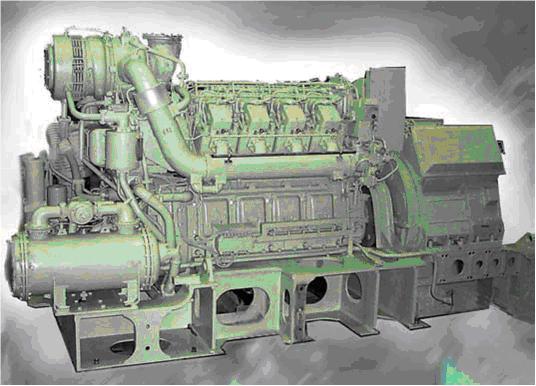
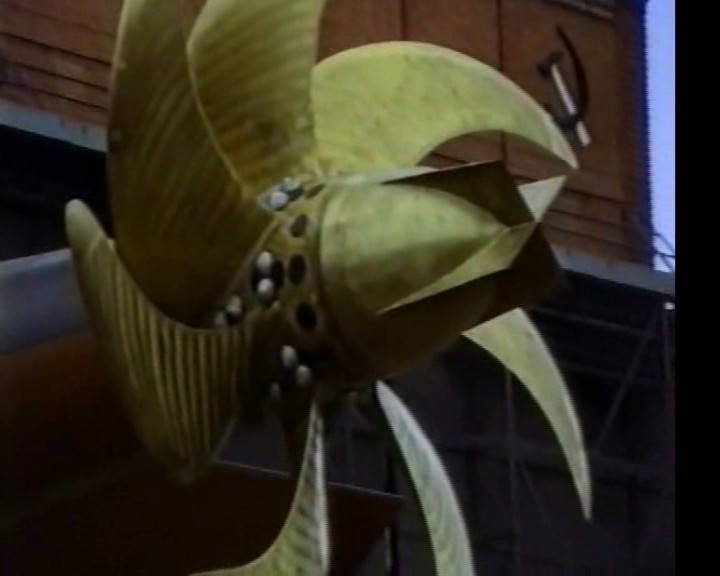
The diesel generator was created by the Kolomna plant. It has high specific power, works against high back-pressure, and is noticeably smaller and lighter than its predecessors. Its supercharging is adjustable and its built-in diagnostics catch faults at an early stage. Most importantly, a rapid battery-charging regime was developed around it, cutting the time the boat spends at periscope depth — its most vulnerable state[20]. The Russian MoD adds the designations: the SED-1 motor of 4,100 hp, D-49 diesels and 28DG generators of 2,100 kW each[17]. The D-49 itself is a medium-speed eight-cylinder V-type diesel with a 260 mm bore and 260 mm stroke, rated at a maximum 1,000 rpm. Power is supplied by two battery groups of 120 cells each; the propulsor is a single low-noise seven-bladed propeller with scimitar blades[20] (for comparison, the Project 877V Alrosa has a pump-jet). Two retractable thrusters with a 102 kW drive are fitted in case the main line fails.
Firsts for Russian submarine construction
- Forward diving planes on the sail — a layout used for the first time on a Russian diesel-electric boat[20].
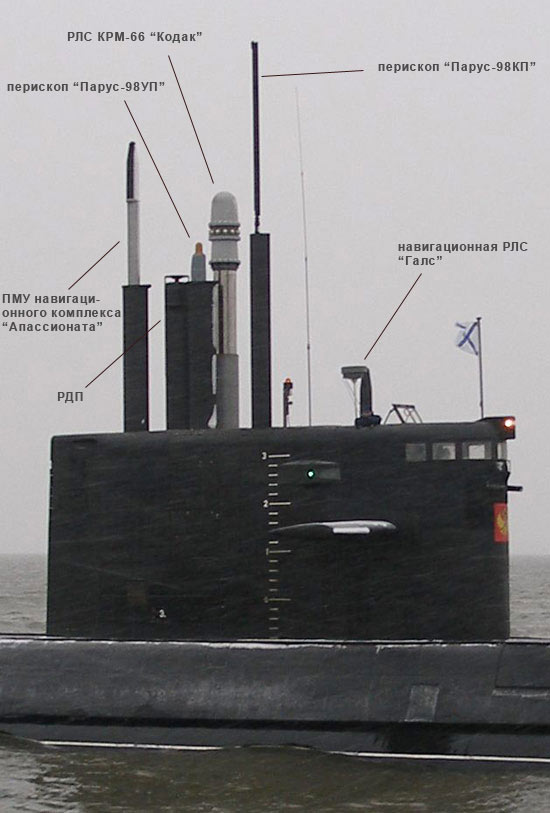
- Telescopic retractable masts that do not penetrate the pressure hull — with the exception of the commander's periscope. That removes a series of hull openings, each of them a potential leak and a noise source[20].
- The Parus periscope developed by TsNII Elektropribor — with optical and low-light television channels[20].
- A new-generation anti-sonar coating created at the Krylov institute; together with sound-absorbing elements and the mounting of all machinery on shock absorbers it is claimed to cut the acoustic signature several times over compared with Projects 877 and 636[20].
- Living conditions — the accommodation compartment as a "cabin-type hotel" with a personal bunk for every sailor and a wardroom seating half the crew at once[20].
Open reference works and Russian MoD releases give specific designations rather than a generic "electronic suite": the Lira sonar suite with its L-01 bow array. The combat information and control system is Litiy, the radar is KRM-66 Kodak, and there are two Parus-98 periscopes — the commander's KP and the universal UP[17]. Sources disagree about Murena: the reference work calls it a torpedo fire-control system[16], while Tekhnika Molodezhi describes it as the automatic rapid silent reloading gear for the torpedo tubes, which also have a pneumatic launch system[20]. The navigation suite differs between the two: Appassionata with an inertial system and GPS/GLONASS in the Kronshtadt release, against Andoga in the reference work for the baseline project; most likely this is the difference between the baseline 677 and the modernised 677M. Two of the six torpedo tubes are adapted for wire-guided torpedoes — controlled by an operator over a trailing wire after launch. And one thing rarely mentioned in accounts of Lada: the boat carries its own air defence — Igla-1M MANPADS with six missiles in a single stowage container.
SensorsBetting on Sonar
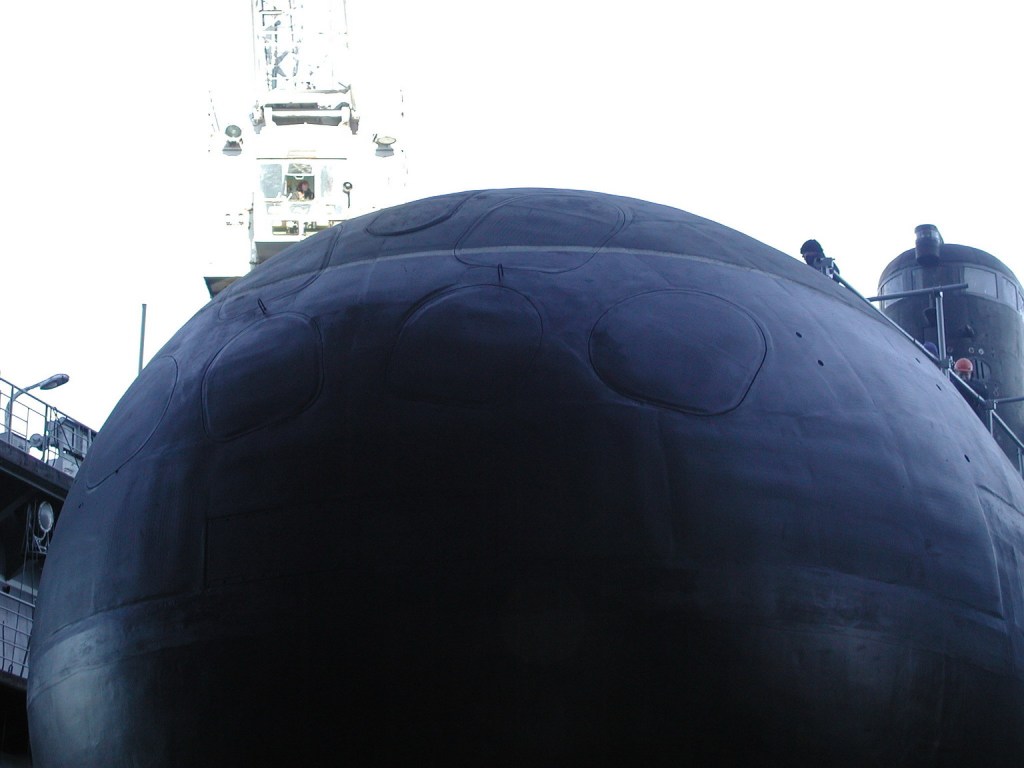
Lada's key claimed advantage isn't missiles — it's "ears." The suite is designated Lira, and its large-aperture bow passive array carries the index L-01[17]. The boat also carries a towed array and, by available accounts, a large conformal array in the bow[13]. Naval analyst H. I. Sutton has assessed that this bow conformal array may be the largest of its type on any non-nuclear submarine[13].
If the specifications hold up, it's the sensors — not the strike potential — that could give Lada an edge: detecting other submarines before it is detected itself.Consistent with the project's original anti-submarine mission[13]
Low noise, according to Rubin's CEO, rests on three things: purpose-built quiet machinery, an external anti-sonar coating and carefully designed hull lines[15]. One more measure belongs on that list, one Rubin did not mention: all equipment capable of vibrating in operation is mounted on shock absorbers — decoupled from the hull so the vibration does not reach the water[18]. The aft fairing for the towed array channel is visible on the longitudinal section: the flexible array is literally streamed behind the boat, away from its own noise[16].
In the same interview Vilnit explained why a powerful sonar is not just an antenna. The more sensitive the set, the more extraneous noise it picks up along with the useful signal, so everything depends on a "high-speed" data processing system. And detecting a target is only half the job: it then has to be classified, its speed, depth and course determined — while your own boat, the target and the medium itself are all moving[15].
If the Project 877 submarine was called the "Black Hole," then let us call this one the "Invisible." Nobody will really see or hear it.
According to Rubin, during trial service Sankt-Peterburg detected low-noise nuclear and non-nuclear submarines of other projects, as well as surface targets, and shadowed them covertly "for extended periods"[15]. There is no independent confirmation of this, and the lead boat itself was sent for scrapping four years after those words.
The real performance of Russia's newest sonar suites is not reliably known. But that, not the missile salvo, is where the design logic actually sits — a quiet diesel-electric "hunter" for confined coastal waters.
WeaponsCaliber from a Torpedo Tube: 10 vs. 4
Strike potential is what makes Lada interesting as a threat. The boat has six 533 mm torpedo tubes; the load-out is up to 16–18 torpedoes and missiles or up to 44 mines, and the claimed Caliber capacity is up to ten missiles[14][7]. The same tubes fire the anti-ship Klub and the anti-submarine RPK-6 Vodopad[13].
For comparison: the Project 636.3 Varshavyankas that have actually fired at Ukraine and Syria carry only four Calibers each[10]. On paper, then, one Lada equals roughly two or three Varshavyankas by missile salvo — and that is the whole substance of the "new generation of carriers" narrative.
The serial Lada has no vertical launch system — every missile goes out through a torpedo tube[13]. That limits the rate of fire and forces the load-out to be divided between missiles, torpedoes and mines. The paradox: it was precisely a VLS that Russia offered to foreign customers in the export version, while never giving it to its own boats.
Descriptions of Project 677's missile armament vary from source to source. The Apalkov reference work gives USET-80K torpedoes and Club-S anti-ship missiles for the baseline project — no Caliber[16]. The Russian MoD, on the day Kronshtadt was accepted in January 2024, named the supersonic anti-ship P-800 3M55 Oniks and P-900 3M51 Alfa plus torpedoes and mines — again without Caliber[17]. English-language digests say "up to ten Calibers"[10]. And finally the builder: in February 2021 Alexander Buzakov, CEO of Admiralty Shipyards, stated that the serial boats would be armed with launchers for Caliber cruise missiles[19].
Most of these discrepancies dissolve on two facts. First: Club-S (Russian designation Biryuza, NATO reporting name SS-N-27 Sizzler), developed by the Novator design bureau, is not an alternative to Caliber but the same missile family under its export name. The complex comprises the anti-ship 3M-54E and 3M-54E1, the anti-submarine 91RE1 and 91RE2, and the land-attack 3M-14E — the export variant of the very 3M-14 the Varshavyankas fire at Ukraine[20]. Second: the serial boats are built to a modernised design, and it is Kronshtadt and Velikie Luki that received Caliber, a more powerful and quieter propulsion motor and updated onboard systems, none of which the lead boat Sankt-Peterburg had[19].
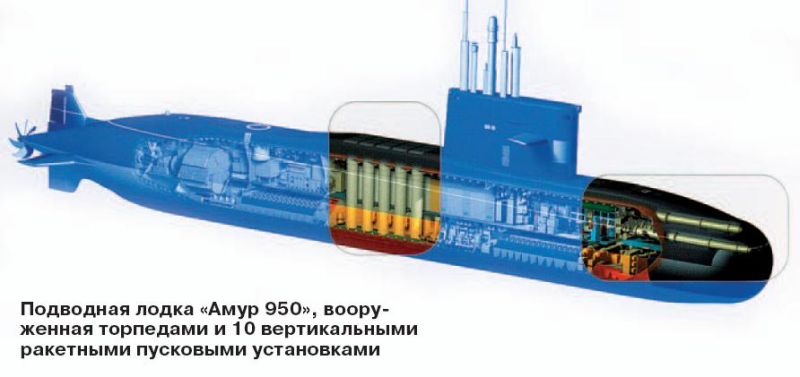
The number ten needs a separate explanation. It appears in English-language digests and on Wikipedia, but no specialist reference work confirms it. The promotional cutaway of the export Amur-950, on the other hand, carries the manufacturer's caption: a boat "armed with torpedoes and 10 vertical missile launchers" (see above). Ten is a parameter of the export design with vertical launchers that was never built, not of the boats in Russian naval service.
The MoD's own list does not add up either. Oniks is a large missile roughly 670 mm in diameter, normally launched from vertical or inclined launchers; it will not physically fit a 533 mm torpedo tube, and the serial Lada has no vertical launchers. The 3M51 Alfa, by contrast, was developed for torpedo-tube launch in the first place. So the claimed missile fit for Lada does not match its own claimed launchers, and the likeliest explanation is the same one — the export Amur-950's characteristics transplanted onto a serial boat.
AIPThe Air-Independent Propulsion That Isn't There
The technology the whole project was started for was air-independent propulsion (AIP) — it was meant to sharply increase submerged endurance and make the boat harder to detect. The irony is that the USSR and Russia had groundwork in this field going back to the 1950s (the experimental Project 617)[13].
On Sankt-Peterburg, which served as the prototype, the installation never worked, and AIP for the series was effectively abandoned — in 2019 Rubin stated outright that the boats of the series would not be fitted with it[13][14]. A parallel line of work was under way, however, and it had entirely specific executors. In early 2018 it was reported that the Central Research Institute of Marine Electrical Engineering and Technology, together with the Krylov State Research Centre, would complete development of an anaerobic power plant for submarines by 2020 — and that the first such installation would be fitted to the lead Lada, Sankt-Peterburg. The claimed effect: submerged endurance of up to 45 days[18]. In that same year, 2019, development resumed on an electrochemical generator — extracting hydrogen from diesel fuel and oxygen — with completion "in the mid-2020s." Lithium-ion batteries were also discussed as an alternative that would in theory give a diesel boat very long submerged endurance[13][14].
As of 2026, no AIP has been installed on any of the boats built[5][11]. Without it Lada remains noisier and easier to detect — the new generation's headline advantage is still on the drawing board. Western analysts consistently describe the programme as a "disappointment"[5].
In a lengthy interview given ahead of Kronshtadt's acceptance in January 2024, Rubin's CEO does not mention air-independent propulsion once[15]. He speaks of "greater submerged endurance" as a designer's goal — but does not explain how it is achieved on a boat that covers 650 miles submerged at three knots. The technology the project was begun for was passed over in silence at the moment of its principal triumph.
TimelineSix Keels, Two Combat-Capable Boats, 28 Years
Six boats have been laid down — three are afloat or in service, three are under construction. The number in brackets after the name is the yard number.
| Name (yard no.) | Project | Laid down | Launched | Status |
|---|---|---|---|---|
| B-585 Sankt-Peterburg (01570) | 677 | 26.12.1997 | 28.10.2004 | Stricken, scrapped (2024) — served as a test platform |
| B-586 Kronshtadt (01571) | 677 | 28.07.2005 | 20.09.2018 | In service since 31.01.2024, Northern Fleet |
| B-587 Velikie Luki (01572) | 677M | 10.11.2006* | 23.12.2022 | In service since 16.12.2025, Baltic Fleet** |
| Vologda (01573) | 677M | 12.06.2022 | — | Under construction |
| Yaroslavl (01574) | 677M | 12.06.2022 | — | Under construction |
| Maloyaroslavets (01575) | 677M | 27.08.2026 | — | Under construction |
- Laid down as Sevastopol, construction halted in 2009, re-laid and renamed Velikie Luki on 19.03.2015.
** Fleet assignment is Baltic per TASS and GlobalMilitary; some outlets wrote Northern — the assignment remains unsettled.
Stated plans for the number of boats changed as sharply as the decision to build the series at all. At the lead boat's launch in 2004, navy representatives promised a run of up to forty submarines, and the Baltic Fleet was to have two brigades of six non-nuclear boats each by 2020[20]. In March 2009 Vice Admiral Oleg Burtsev, deputy chief of the Navy Main Staff, spoke of a series of eight; in November 2018 Navy Commander-in-Chief Admiral Vladimir Korolyov spoke of twelve[16]. Between those two statements came the 2009 pause, when construction of the second and third boats was halted by Defence Ministry decision, and — most importantly — on 19 January 2016 RIA Novosti reported that Project 677 boats would not be built at all, with funding redirected to the prospective Kalina project[16]. The decision was then reversed and the two boats already laid down were completed. In January 2024, accepting Kronshtadt, the MoD was speaking of six boats in the series[17]. Deadlines slipped independently of numbers: in February 2021 Admiralty Shipyards CEO Alexander Buzakov promised to hand both serial boats to the fleet in 2022[19] — Kronshtadt was delivered in 2024 and Velikie Luki in 2025.
The latest figure came from Putin himself. On 24 July 2025, at a meeting on the development of the submarine forces held in Severodvinsk, Arkhangelsk Oblast, he said: "Construction of Project 677 non-nuclear submarines is under way. The lead submarine Kronshtadt was accepted into the Navy back in 2024. A total of no fewer than nine such submarines are planned"[22]. Two separate claims sit in those two sentences, and both are worth noting.
The first is yet another change to the target figure: no fewer than nine, against the six the Defence Ministry had been citing eighteen months earlier. The second is subtler: the lead boat of the project is now said to be Kronshtadt. The lead boat was and remains B-585 Sankt-Peterburg — the one that took thirteen years to build and that had been struck off for scrap eighteen months before this speech, its sonar and propulsion beyond repair. Reassigning the title of "lead boat" to the first serial hull removes the project's most awkward episode from its official history.
The actual position at the end of August 2026: six boats laid down over 28 years of the programme, of which two are combat-capable — Kronshtadt and Velikie Luki, each of which took between ten and nineteen years. Three more sit on the slipways. To deliver on "no fewer than nine," Russia would have to contract and lay down at least three or four more submarines — and that is without counting the scrapped Sankt-Peterburg.
Below is a dossier on each boat: the full construction history and key dates.
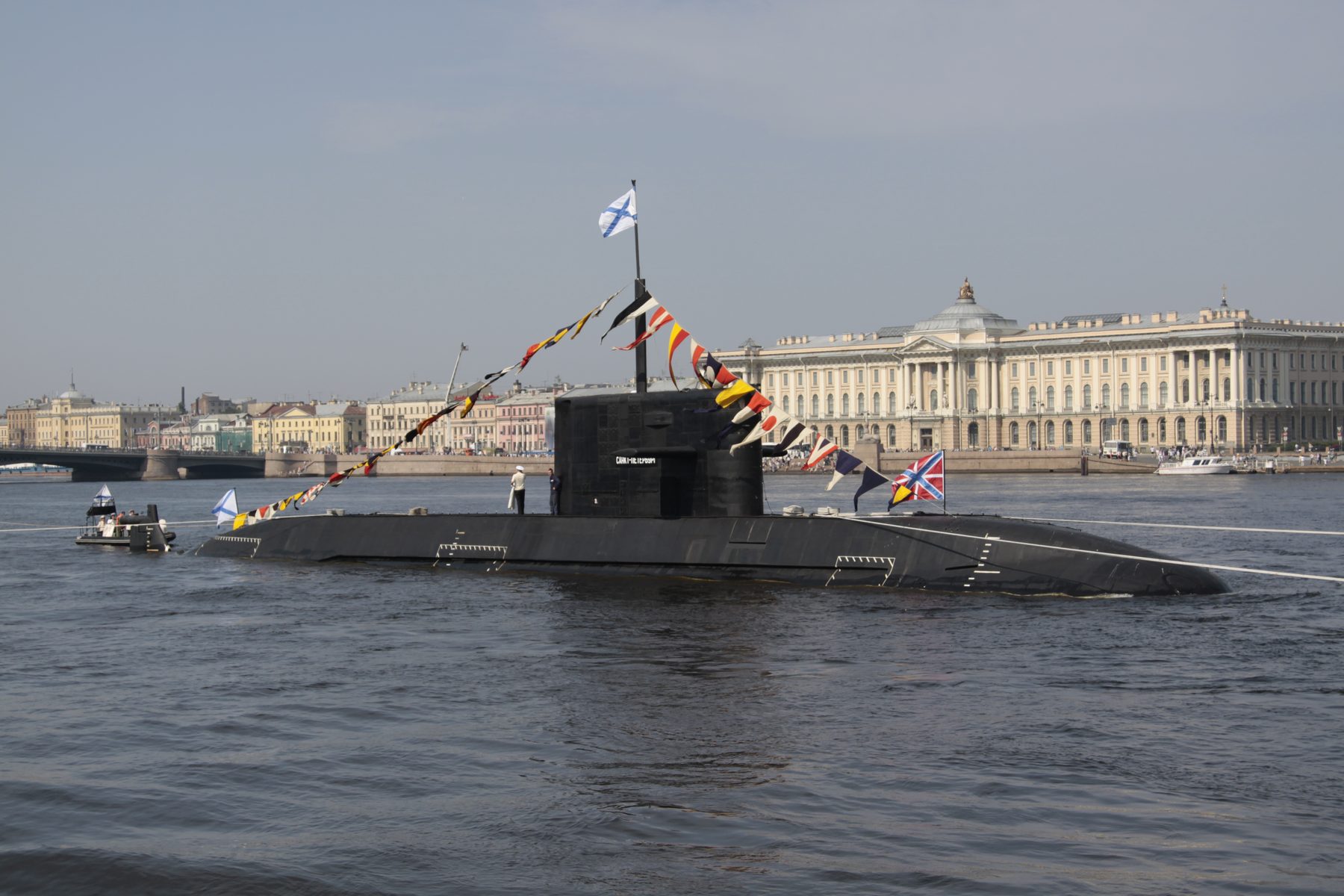
B-58501570Project 677 · lead boatSankt-Peterburg13 years to build → test platform → scrapScrapped · 2024
The lead boat was laid down on 26 December 1997 and launched on 28 October 2004[1]. The Defence Ministry had signed the contract with Admiralty Shipyards back in August 1997, and construction was expected to finish by 2002[20].
The first stage of trials in the Gulf of Finland in 2005 showed otherwise. Errors in the compartment layout — the space around the motor turned out to be extremely cramped, making adjustment and diagnostics difficult. The main powerplant could not develop even half its rated power. And hardest of all, the sonar suite did not work: once submerged, the boat was effectively blind[20]. For several months the defects were addressed on the move, without success; in December 2005 the first stage of trials was wound up and the boat sat at the wall for a long time.
Acceptance into service was postponed three times — from 2006 to December 2007, then to May 2010. And when the act was finally signed on 22 April 2010, the boat was taken into trial service with an undeveloped main propulsion motor delivering 60 per cent of design power, and with shortcomings in a number of other systems[20]. Hence the later reports that the sonar and propulsion on the boat were not working properly[11].
In November 2011 a decision was made to rework the lead boat and build the rest of the series to a revised design (control systems, electric propulsion, navigation)[1]. In effect, Sankt-Peterburg was kept on as a test platform for evaluating those systems[14].
On 7 April 2020 the boat left its base on the Kola Peninsula for Kronshtadt — a surface transit escorted by the rescue tug Pamir, for maintenance and modernisation[18]. The content of the work was not disclosed. The timing is telling: 2020 was exactly when the anaerobic plant was due to be completed, and Sankt-Peterburg was named as the boat that would receive it first[18]. Whether it was actually installed is not stated anywhere in open sources — not then, not since.
Sankt-Peterburg conducted its trial service, unlike most boats, across two fundamentally different theatres: first in the Baltic — a shallow sea with distinctive acoustic conditions, particular hydrology and heavy civilian traffic — and then in the north, with cold deep water, the ice edge and an entirely different level of acoustic interference[15]. According to Rubin, the boat confirmed its design characteristics, and in 2020 the Navy Commander-in-Chief approved the final act on the successful completion of the trial service programme[15]. Four years after that "successful completion," the boat was sent for scrapping.
On 5 February 2024 it was announced that the boat was being withdrawn from the fleet and sent for scrap: in the words of a TASS source, "its modernisation is very expensive — for the same money a new boat could be built"[1]. The lead boat of the project never became a full combat unit — thirteen years of construction ended in scrap[11].
Key dates
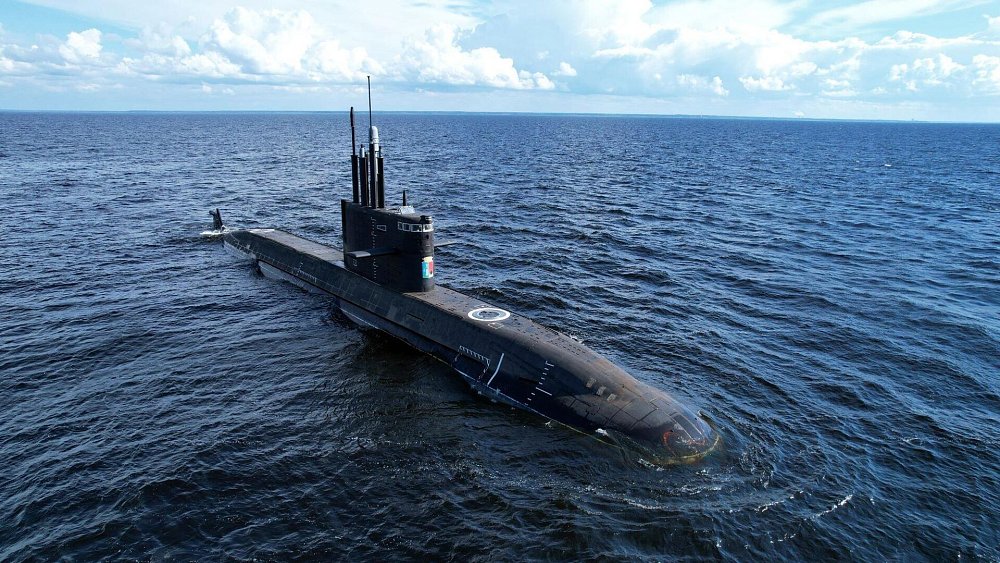
B-58601571Project 677 · first serial boatKronshtadt19 years from keel to deliveryIn service · Northern Fleet
The second boat of the series was laid down on 28 July 2005, but in 2009 construction was halted by the global financial crisis that hit shipbuilding across the board[1][11]. Work resumed on 9 July 2013 — by then taking account of the findings from the lead boat's trials[1]. It was launched on 20 September 2018 and handed to the fleet only on 31 January 2024[1]. In the press it was described as "the first serial ship of Project 677, concentrating more than 130 of the newest technical developments"[20].
The flag-raising ceremony was held at the Admiralty Shipyards in St Petersburg[23]: the Navy Commander-in-Chief's order enrolling the boat in the 161st submarine brigade of the Kola Flotilla of the Northern Fleet was read out[13]. By dimensions it is roughly 61 m long with a submerged displacement of about 2,700 t[13]. For all the ceremony, the boat was regarded as troubled from the outset[2].
Being enrolled in a formation and joining it are different events, and here two years and five months separate the two. Kronshtadt left the Baltic only on 27 June 2026, when Danish observers photographed a northbound Russian group under the Great Belt bridge — the landing ship Kondopoga, a Project 677 boat and a Project 636.3 boat[24]. The Russian military commentator Dmitry Boltenkov named them: Kronshtadt, bound for the North, and Yakutsk, headed onwards to the Pacific Fleet[25]. Open sources record no earlier passage. The boat ceremonially enrolled in the Northern Fleet in January 2024 thus sat in the Baltic until the summer of 2026.
Nor was any completion of the state trials firing programme reported after the boat reached the North: open sources record no torpedo or missile firing by Kronshtadt. Kalibr launches in the Northern Fleet were publicised over the same period — on 22 May 2025 the Yasen-M nuclear submarine Arkhangelsk fired one across the Barents Sea[26].
Key dates
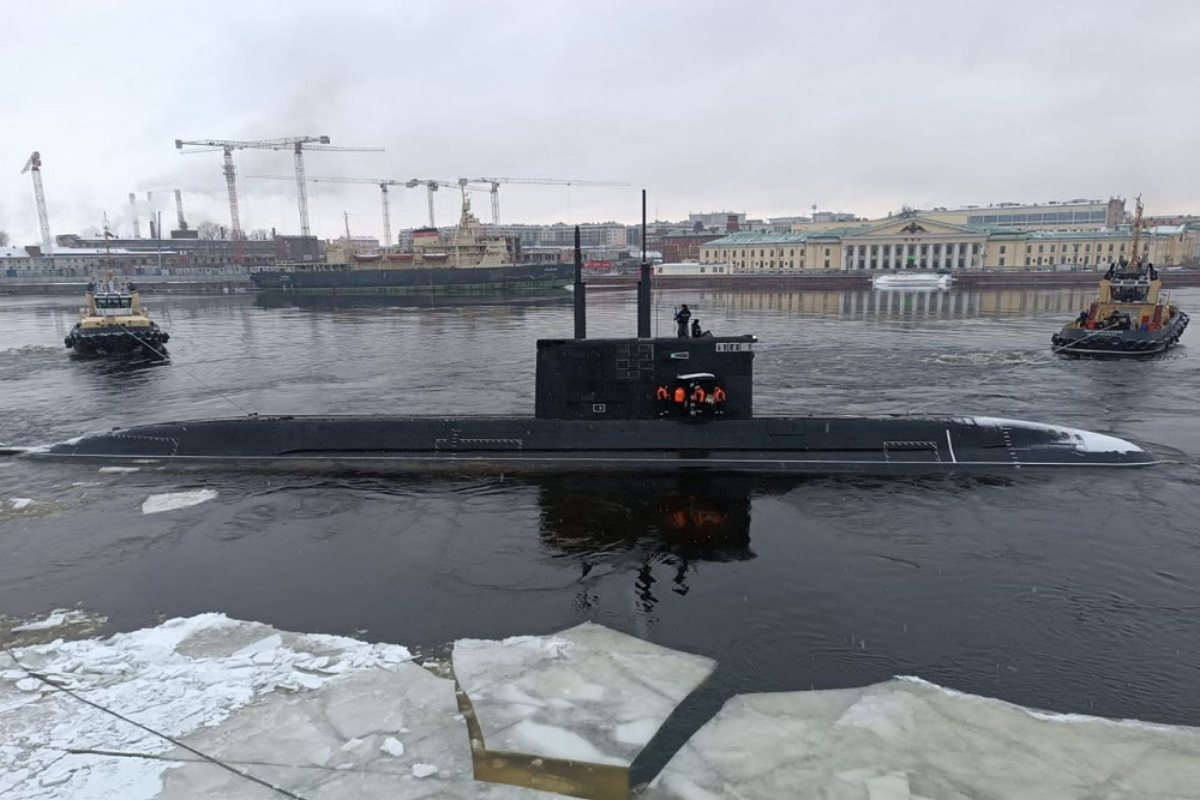
B-58701572Project 677M · ex-SevastopolVelikie LukiAcceptance postponed at least six timesIn service · assignment disputed
The third boat (yard number 01572) was laid down on 10 November 2006 as Sevastopol, construction was halted in 2009, and on 19 March 2015 it was re-laid and renamed Velikie Luki[1]. The name was no accident: the boat was being built for the Black Sea Fleet, with delivery planned for 2010[20]. At the time of the keel-laying, in other words, a Lada for the Black Sea was still entirely expected — and four years later Rubin's CEO said publicly that the sea was too small for the project. The 2015 renaming closed the Black Sea chapter for good.
It was floated out on 23 December 2022 and the ensign was raised only on 16 December 2025[1][12]. According to trade publications, acceptance was postponed at least six times[6].
On the same day the Russian Navy command announced the laying down of two more boats in early 2026[4][8]. Fleet assignment is Baltic (per TASS and GlobalMilitary), though some outlets wrote Northern, so it remains unsettled[1][3][14].
Key dates
0157301574Project 677M · laid down the same dayVologda · Yaroslavl"Continuation of the series" — a declaration so farUnder construction
Both boats (01573 and 01574) were laid down on the same day — 12 June 2022[1]. These are the boats meant by announcements about "continuing the series"; in total Russia claims plans for at least nine hulls, a figure stated by Putin himself[22][4] — to be read as a statement of intent rather than a schedule.
The keel-laying ceremony was a less momentous event than it was presented to be: the contract for both boats was signed back in June 2019, metal cutting began in February 2022, and the official ceremony was held on 12 June 2022 — on work already under way[16]. Beyond these, at least two more boats are under contract — one of them from August 2020 — with keel-laying planned for around 2026[16].
Status
B-???01575Project 677M · sixth orderMaloyaroslavetsLaid down 27 August 2026Under construction
The sixth Project 677 submarine overall — and the fifth to the modernised 677M design — was laid down at Admiralty Shipyards in Saint Petersburg on 27 August 2026. It is named after a town in Kaluga Oblast associated with the campaigns of 1812 and 1941[21].
The ceremony was attended by presidential aide and chairman of the Maritime Board Nikolai Patrushev, Navy Commander-in-Chief Admiral Alexander Moiseyev and USC CEO Andrei Puchkov[21]. Patrushev expressed confidence that the yard's workforce would "cope worthily with the task set," while Moiseyev dwelt on the name itself, drawing parallels with the war of 1812 and the Second World War. Nobody mentioned a delivery date.
The keel-laying came a year after Putin's Severodvinsk statement about building "no fewer than nine" Project 677 boats, in which Kronshtadt was declared the lead ship of the series in place of the scrapped Sankt-Peterburg[22].
Status
ExportAmur-1650 and Amur-950: The VLS Denied to Russia's Own Navy
Russia tried to recoup its costs by selling the design abroad. The export versions were designated Amur-1650 and Amur-950[1]. Notably, the Amur-950 was offered with a vertical launch system for cruise missiles (BrahMos among them) — that is, foreign buyers were offered a better-armed configuration than the one Russia's own fleet ended up with[11].
The main prospective customer was India, which was offered joint production. India chose the French design, and the Amur export programme effectively died — no other buyers were found[11]. That hits both the economics of the programme and its reputation.
The Amur exists as more than a paper design. The export boat was laid down at Admiralty Shipyards on the very same day as Sankt-Peterburg, 26 December 1997[16]. According to ITAR-TASS, by 2005 it was 47 per cent complete, and by 2009 construction had stopped altogether[16]. The export Lada has therefore stood unfinished for almost thirty years — and for thirty years buyers have been offered something that does not physically exist in completed form. Besides the Amur-1650, a whole family of Amur variants differing in displacement and propulsion was developed for export; not one was ever built[16].
OutlookThe Program's Future — Staying the Conventional Course
For all Lada's problems, the Kremlin's general line is to stay with conventional submarines (unlike, say, the United States, which builds only nuclear boats)[13]. Russia's Defence Ministry claims the fleet has received 24 submarines of various projects over ten years — eight times more than in the preceding decade[13]. Yet it is precisely Lada's delays that force Russia to keep building the less capable Project 636.3 Varshavyankas that Lada was meant to replace[13].
- A series of no fewer than nine boats — stated by Putin himself in July 2025[22].
- One Lada is claimed to carry up to ten Calibers — two to three times a Varshavyanka[7].
- Caliber's range — roughly 1,500–2,500 km by CSIS estimates[9]: a boat in the Baltic theoretically holds much of Europe at risk.
- Serial production is "under way": keel-layings continue.
- Afloat and combat-capable — two: Kronshtadt and Velikie Luki. Each took between ten and nineteen years.
- On the slipways — three unfinished: Vologda, Yaroslavl, Maloyaroslavets.
- Reaching nine would need three or four more boats that are not yet even under contract.
- Not one boat has received either air-independent propulsion or vertical launchers for Caliber.
Lada and the Black Sea
The question of whether Lada threatens Ukraine was answered by the designer itself — back in December 2010. Andrei Dyachkov, then CEO of TsKB MT Rubin, stated in an interview that the Black Sea is too small for Project 677 boats, and that Ladas would therefore not join the Black Sea Fleet[16]. This is the position of the design bureau that created the boat. Lada was designed for the deep water of the north and the specifics of the Baltic; the enclosed shallow sea where the Varshavyankas operate was considered an unsuitable theatre for it long before any of the current events.
On top of that, the Baltic and the North Atlantic are areas of dense NATO surveillance, where a small diesel submarine finds it harder to manoeuvre unnoticed than in the enclosed Black Sea.
Lada is indeed becoming a new diesel-electric Caliber carrier — but far more slowly, in far smaller numbers and with worse characteristics than Moscow declares.Less a "new generation of threats" than a protracted build with high paper potential and minimal delivery
The central question is not the boat's specification-sheet capability but the capacity of Russian industry to build such boats in series, and to a decent standard, under war and sanctions[13]. If Russia ever gets AIP (or the lithium-ion variant) working and reaches series production, the picture will need revisiting; for now Lada's real contribution to the fleet's strike potential is minimal.
Sources
- TASS — FACTBOX: Project 677 Lada-class submarines, 16.12.2025. tass.com/defense/2059523
- Naval News — Russia Commissions First Serial Lada-class Submarine (Kronshtadt), 02.2024. navalnews.com
- Zona Militar — The Russian Navy has finally commissioned the third Lada-class submarine, 16.12.2025. zona-militar.com
- Army Recognition — Russia Expands Lada-Class Submarine Program with Two New Boats in 2026. armyrecognition.com
- National Security Journal — Russia's Lada-Class Submarine Looks Like a 'Major Disappointment' With No Fix. nationalsecurityjournal.org
- United24 Media — After Six Missed Deadlines, Russia Pushes to Accept Long-Delayed Lada-Class Submarine. united24media.com
- 19FortyFive — Russia's 'New' Lada Diesel Submarine Will Carry Lethal Kalibr Cruise Missile, 2023. 19fortyfive.com
- RIA Novosti — Two more Project 677 submarines to be laid down in 2026, 16.12.2025. ria.ru
- CSIS Missile Threat — 3M-14 Kalibr (SS-N-30A). missilethreat.csis.org
- Wikipedia — Lada-class / Kilo-class submarine. en.wikipedia.org — Lada-class
- Brent M. Eastwood, 19FortyFive — Russia's 'New' Lada-Class Submarines Are So Bad the First Boat Took 13 Years to Build and Was Scrapped, 14.07.2026. 19fortyfive.com
- Naval News — Admiralty Shipyard Launches 3rd Lada-Class Submarine Velikie Luki, 12.2022. navalnews.com
- Thomas Newdick, TWZ (The War Zone) — First Of Russia's New Diesel-Electric Submarines Enters Service, 31.01.2024. twz.com
- GlobalMilitary.net — Lada-class (Project 677): Specs & History. globalmilitary.net
- Igor Vilnit (CEO, TsKB MT Rubin) and Alexander Arsentyev (chief designer of Project 677 since 2008), interview to Rossiyskaya Gazeta ahead of Kronshtadt's acceptance, 01.2024. morpolit.ru
- Shturm Glubiny (deepstorm.ru) — Projects 677, 677M Lada and 677E Amur-1650. Specifications and the longitudinal section after Yu. V. Apalkov (Podvodnye lodki, vol. 1, pt. 2, Galeya Print, 2003) and A. N. Gusev (Podvodnye lodki s krylatymi raketami, Galeya Print, 2000). deepstorm.ru
- Focus — "Russia's Northern Fleet takes delivery of a new Project 677 Lada submarine," 31.01.2024: an account of the Russian MoD press service release on the day of the ceremony. focus.ua
- Vasily Sychev, N+1 — "The lead Lada submarine has gone in for modernisation," 08.04.2020. nplus1.ru
- Vasily Sychev, N+1 — "The first serial Lada submarines will reach the fleet in 2022," 09.02.2021: Alexander Buzakov on Caliber aboard the serial boats. nplus1.ru
- "Sankt-Peterburg: the long road to the pier" — Tekhnika Molodezhi, no. 9, 2010 (reprinted at lemur59.ru). lemur59.ru
- Militarnyi — "Russia lays down the new submarine Maloyaroslavets of Project 677 Lada," 27.08.2026. militarnyi.com
- Vladimir Putin, meeting on the development of the Navy's submarine forces at Severodvinsk, Arkhangelsk Oblast · 24.07.2025 — transcript on the Kremlin website kremlin.ru; report by Interfax interfax.ru.
- PortNews — "The flag-raising ceremony for the second Project 677 Lada diesel-electric submarine was held at the Admiralty Shipyards," 31.01.2024. portnews.ru
- WarshipCam (photo by Kurt Pedersen / Under Broen) — a Russian Navy group northbound under the Great Belt bridge, 27.06.2026. x.com
- Dmitry Boltenkov, Izvestia — "The Ladas of the Arctic," 30.08.2026. iz.ru
- The Barents Observer — "Kalibr missile across Barents Sea," 23.05.2025: a Kalibr cruise missile launch by the Project 885M nuclear submarine Arkhangelsk in the Barents Sea on 22.05.2025. thebarentsobserver.com
Based on open sources. Specifications drawn from Russian and reference publications have not been independently verified and are presented as claimed.