The measureWhat exactly went up over the sails
Not long ago the British Ministry of Defence put out two releases four days apart. The first, with imagery dated 9 June 2026, recorded submarines lying alongside the quay wall, with counter-drone cages clearly visible over their sails. The second release, with imagery dated 13 June, showed a different posture: the same boats submerged in the water in mid-basin[1]. The summary assessment, published on 4 August, reduces it to a figure: three of the four boats at Novorossiysk now have cages over their sails[2].
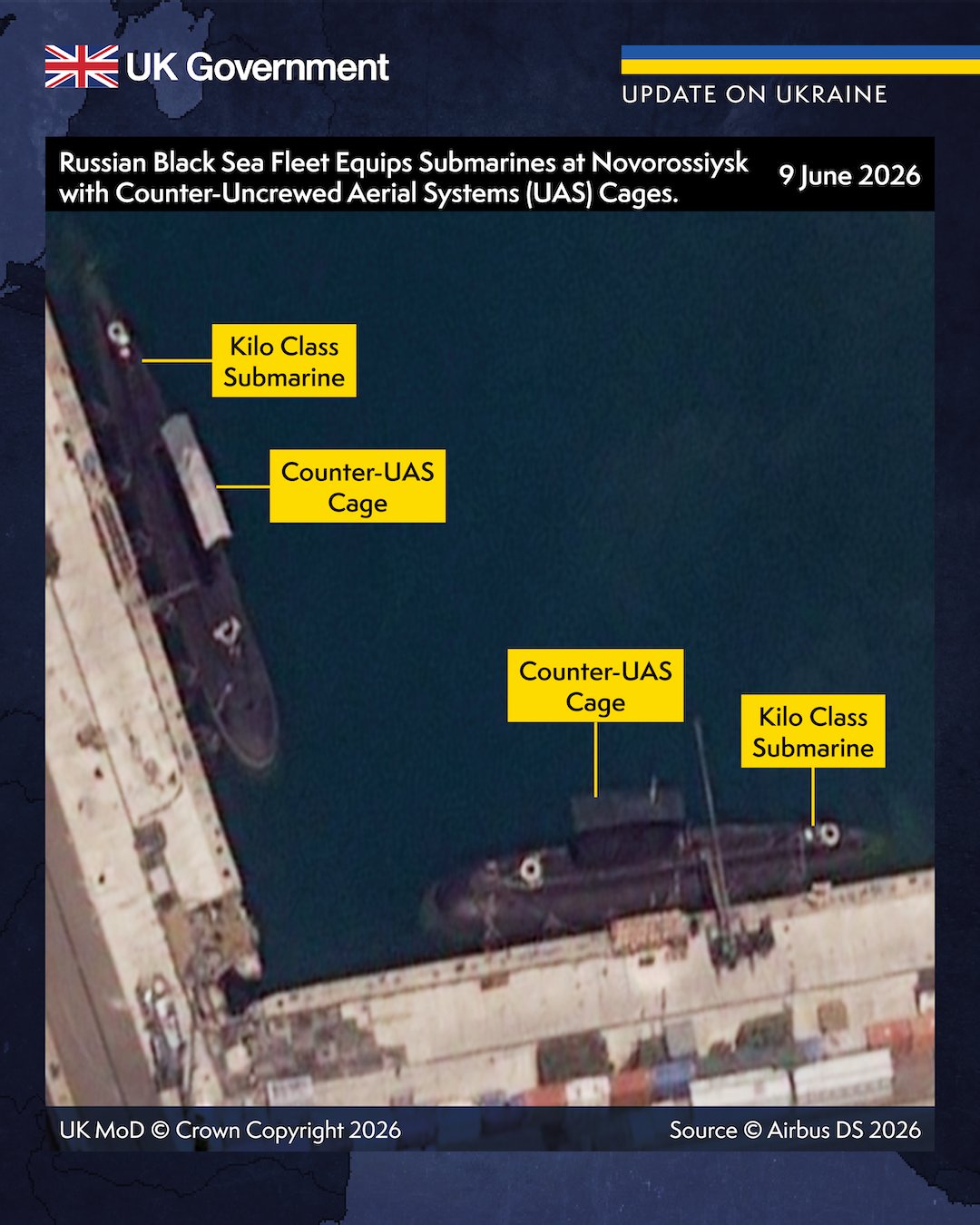
The cage here is exactly what it looks like: a metal frame or mesh structure wrapping the sail from above. No radar, no electronic warfare — a purely physical barrier, meant to make a drone break up or detonate on it before reaching the structure itself[2].
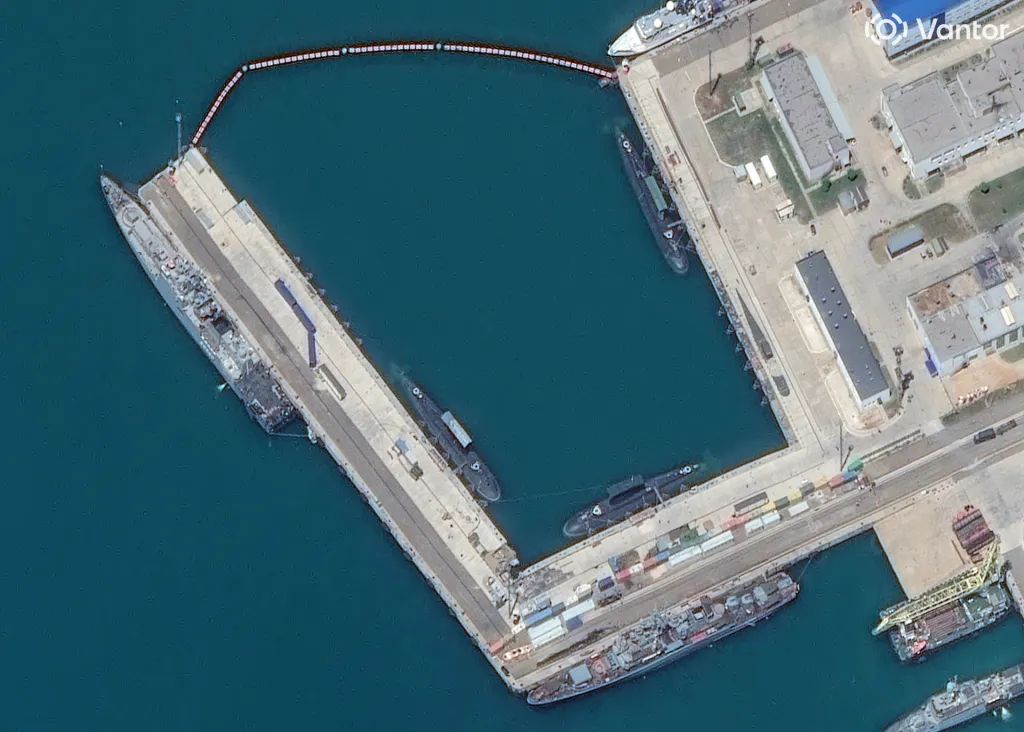
The other solution is not new. In the 13 June imagery three boats are submerging into the water right inside the harbour on slackened mooring lines: most of the hull went under, leaving only the sails above the surface[1]. The fleet has been doing this since at least the spring of 2024: in a frame of Novorossiysk dated 17 March 2024 two boats are already lying in the water — but there are no cages over them yet.
But submersion is not a permanent state either. By 17 June, four days after the British frame, the boats are back alongside the quay wall and afloat. This is neither a one-off nor a regime the fleet is stuck in: the boats settle into the water and come back up, and each such cycle is a trade-off between safety and readiness to put to sea.
Three layers of protection at the quay
- A cage over the sail — against what comes from above.
- Semi-submersion — reduces the visible target area and takes the hull out of the line of fire.
- A boom across the entrance — against what comes across the water.
KiloWhich boats we are actually looking at
The British assessment speaks of "three of its four Kilo class submarines" — and that wording contains a nuance. Kilo is a NATO designation covering two different projects at once: the older 877 and the improved 636.3. Novorossiysk holds both, so "four Kilos" is not "four Project 636.3 Varshavyankas." The British do not name the boats precisely in the update: the text specifically cautions that names should not be assigned without additional imagery or movement data[2].
The names, though, come from another source — Defense Express, which lists all four boats then present at Novorossiysk[4]. The list matches exactly what we set out in our submarine chronicle as of June 2026.
The four boats at Novorossiysk · summer 2026
So the "four" Kilos are three Project 636.3 Varshavyankas plus Alrosa, a Project 877V boat. The rest of the Black Sea-assigned submarines fall outside this arithmetic: Rostov-na-Donu has been destroyed, while Novorossiysk and Krasnodar are at Kronstadt and are not returning to the Black Sea.
The sailWhy that is what gets covered
The choice of location is not arbitrary. The sail is not a submarine's fighting compartment and holds no launcher; the torpedo tubes sit in the bow, under water, where a drone has a rather harder time reaching them. What the sail does hold is everything without which the boat is blind and mute: the periscope, communications antennas, the snorkel induction mast and the other retractable equipment[2].
This is equipment a crew cannot replace and that cannot be restored anywhere in the Black Sea. The fleet's repair base stayed in Sevastopol and under the constant threat of another strike, and the nearest yard able to service a Varshavyanka is at Kronstadt, reachable only through the straits. So a damaged sail means not a week of repairs but a boat out of service indefinitely.
How well this works is a separate question. Western analysis calls these structures cope cages, by analogy with the improvised grilles on Russian tanks. The name is mocking and judgemental. H. I. Sutton of Covert Shores, who specialises in submarines, rates the effect soberly: nets and cages give some protection against the smallest and slowest FPV quadcopters, but not against what has already been sinking ships in this sea[5].
KolpinoThe boat that got no cage
The most interesting thing here is not the three boats with cages but the fourth without one. Defense Express noticed the asymmetry and offered an explanation: if the unprotected boat is B-271 Kolpino, the reason may be simple. There is no point shielding it, because it is no longer operational[4].
Our own chronicle reached the same conclusion. In our summary table Kolpino carries the note "probably damaged" — following operation Sub Sea Baby on 15 December 2025, when an underwater drone attacked the boat inside its base.
LayersBooms, paint and false silhouettes
Cages are only one of the methods of protection. Satellite imagery of the harbour published by MizarVision on 6 July 2026 shows two further measures. The first is a boom, strung in an arc across the entrance to the inner harbour: protection against the drone boats that have been working over ships in the port[6].
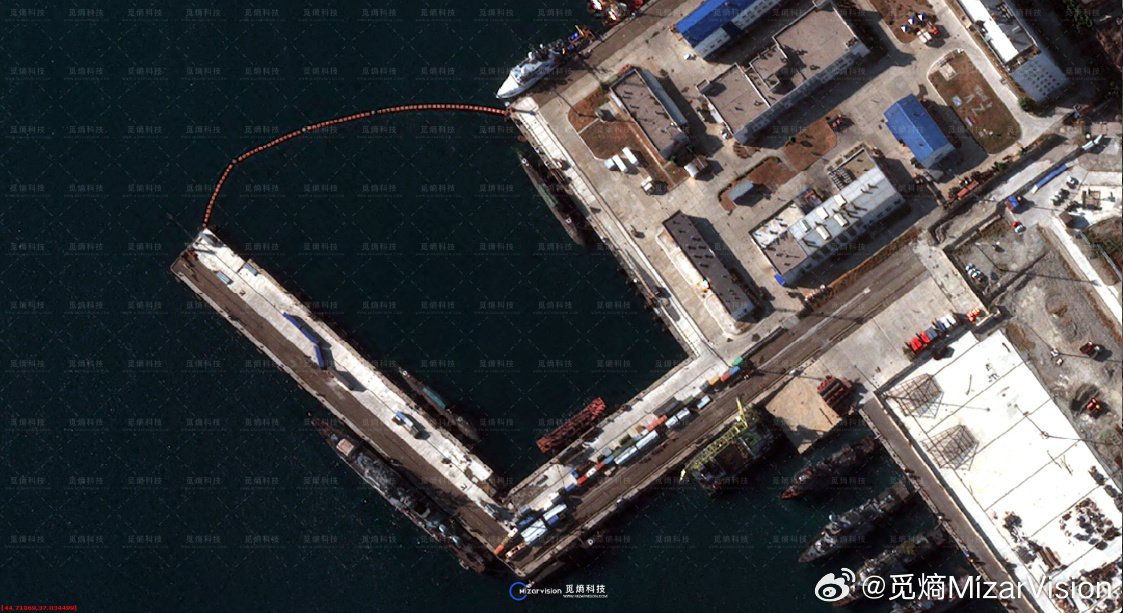
The other measure is repainting. Analysis of the same imagery indicates that some ships in the harbour have been repainted, and that painted silhouettes have appeared on the quays and the water, intended to confuse a drone operator or an automated classifier working on satellite imagery[6]. The trick is not new: deceptive camouflage on Black Sea Fleet ships was recorded as far back as 2023, and it did not prevent the strikes then either.
Why MizarVision has to be handled with care
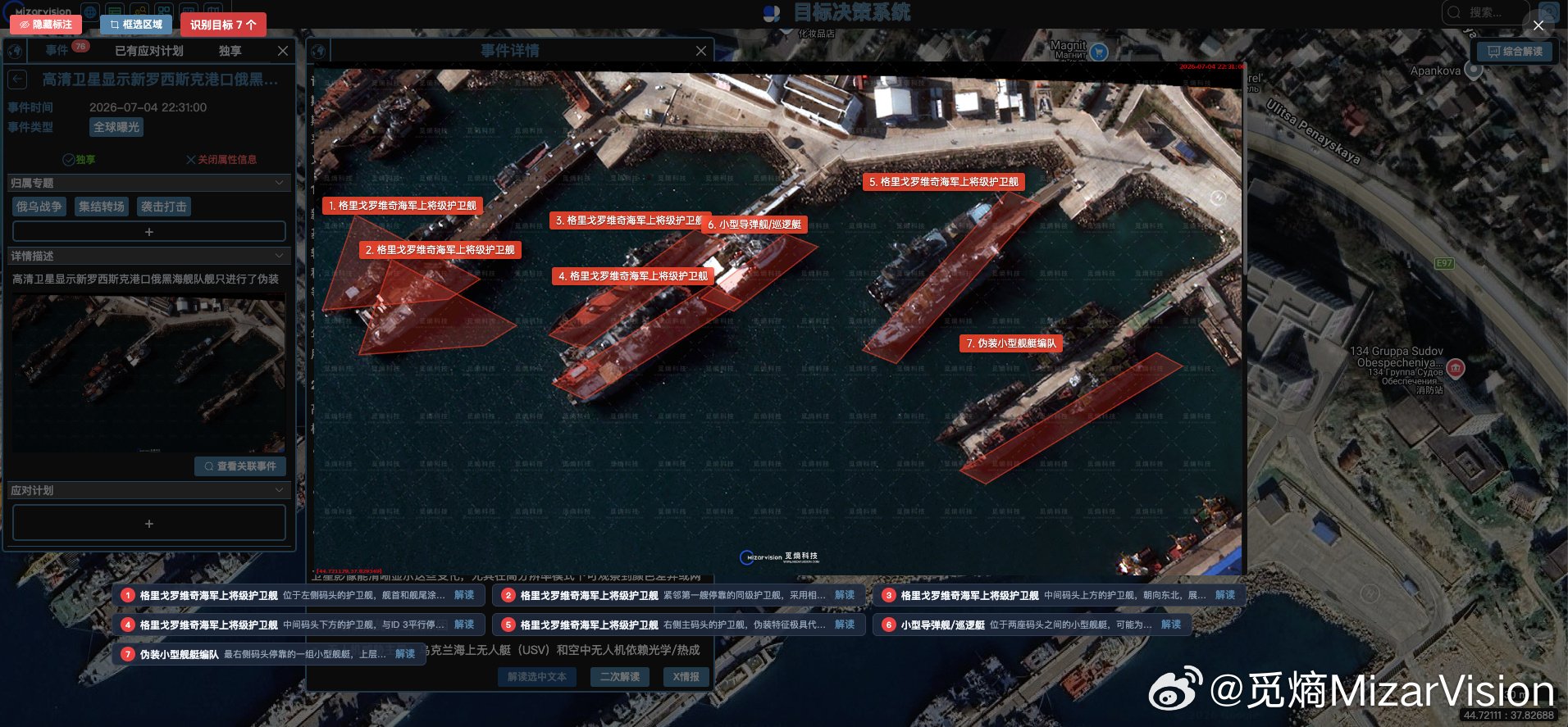
The MizarVision imagery comes from a platform where objects are marked up automatically and the accompanying text is labelled as model-generated. In one frame the system tagged five objects as "Admiral Grigorovich-class frigates." There are two Project 11356R frigates at Novorossiysk, and both are documented at a different pier.
So this piece uses the MizarVision imagery as imagery, not as identification: the boom and the concealment measures are visible in the frame itself and corroborated by other analyses, while the names of the boats come from Defense Express.
7,400 kmThe same thing on Kamchatka
If this were only about Novorossiysk it would be a story about one front-line base. But the netting has also appeared where Ukrainian drones do not reach. At any rate, not yet.
In May 2026 satellite imagery of the Rybachiy base on the Kamchatka Peninsula showed two ballistic missile submarines of Projects 955 and 955A Borei entirely covered in fine netting. That is 7,400 kilometres from Ukraine[5]. And the scale differs: at Novorossiysk the cage covers the sail alone, whereas at Rybachiy the netting is drawn over the entire hull. By August the method was being applied more widely: imagery from 4 August 2026 shows boats under netting on a large scale, erected by crane barges since May, with floating booms strung around the piers[7].
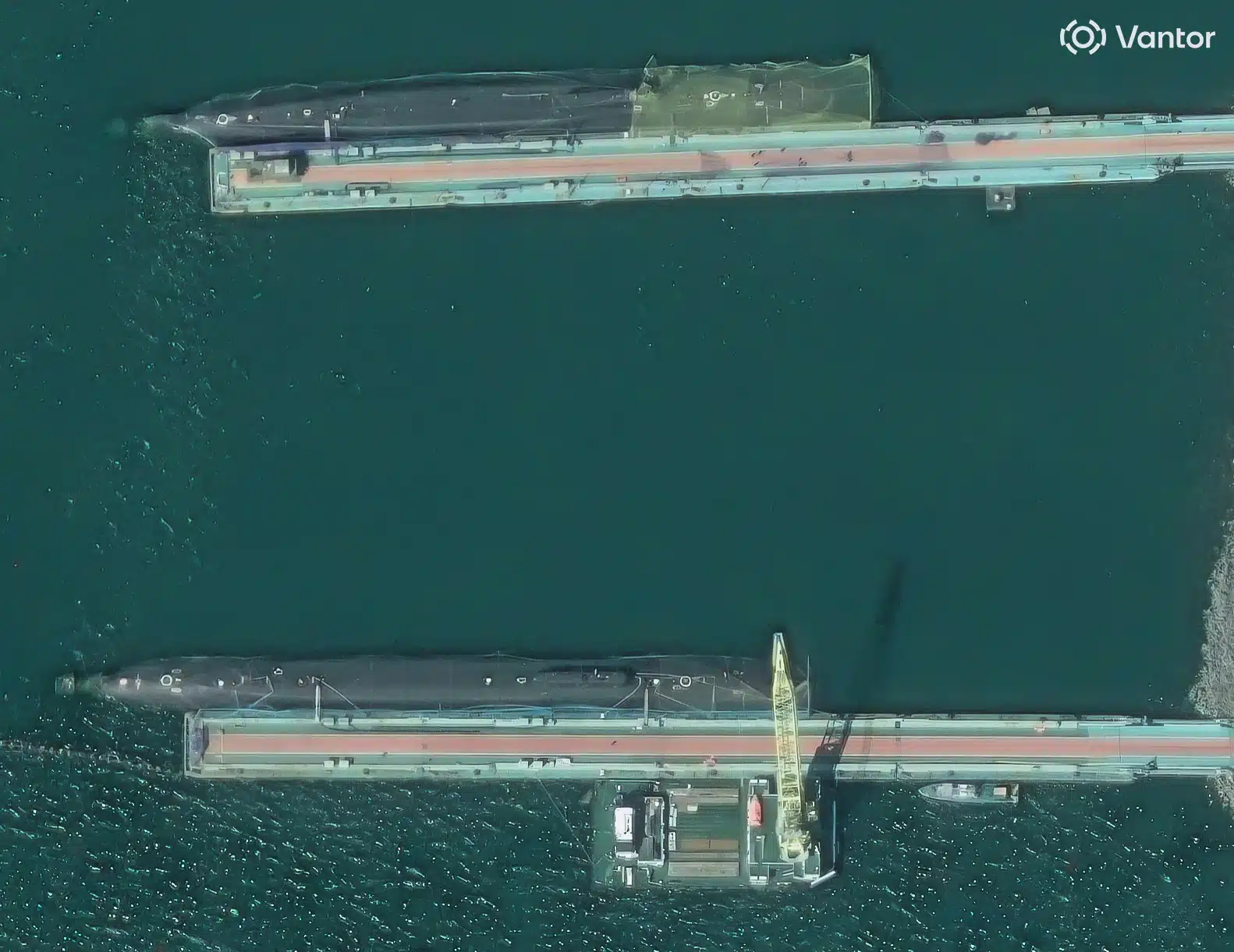
There is an explanation for the measure, and it is plain fear. After operation Spiderweb, when drones were launched from lorries beside the airfields themselves, a surprise attack from right under a base's nose stopped being hypothetical at any distance[5]. Whether covering an entire boat in netting is practical, especially in Kamchatka weather, is an open question that Russian sailors will have to work out in practice.
How the measure spread
- May 2026 — the first Boreis under netting at Rybachiy, erected by crane barges.
- 13 June 2026 — the frame from which British intelligence counts three cages among four boats at Novorossiysk.
- 6 July 2026 — MizarVision imagery: the boom at the harbour entrance, camouflage paint.
- 4 August 2026 — the British assessment is published; the same day's imagery of Rybachiy shows boats under netting on a large scale.
Bottom lineProtection in name
Whether these measures give even the slightest protection is the question. Against a few-hundred-dollar quadcopter they may well count for something. But against the weapons that have actually been putting ships out of action in this sea — cruise missiles, long-range jet drones, uncrewed surface vessels and underwater craft — a metal frame over the sail may be of little use. Kolpino was taken out by an underwater drone, and no netting overhead would have changed that.
The price of the measure is readiness. A boat with a cage over its sail, lying in the harbour on slackened moorings, is not a combat unit at readiness but a suitcase without a handle. To move to a firing position and launch Calibers it has to surface, have the structure removed and then spend time preparing. Passive protection and reaction time are in direct conflict here.
But it is worth noting that this is no longer a local improvisation. When the same netting appears over strategic missile submarines on Kamchatka, what is changing is the basing norm for the entire fleet: a ship in its own base is no longer treated as safe. Sutton put it more precisely than the official summaries — the protective moles of Novorossiysk are themselves becoming a cage.
Sources
- UK Defence Intelligence / UK MoD, Update on Ukraine series. Two releases on Black Sea Fleet submarines at Novorossiysk — one with imagery dated 09.06.2026 (© Airbus DS 2026) and one with imagery dated 13.06.2026 (© Vantor / European Space Imaging 2026). UK MoD © Crown Copyright 2026.
- ArmyRecognition — Russia Fits 3 Black Sea Kilo Submarines With Drone Cages to Sustain Ukraine Strike Capability, 08.2026. The outlet cautions that the boats cannot be named from the data available. armyrecognition.com
- Vantor. Satellite imagery of the inner harbour at Novorossiysk dated 13.06.2026 and 17.06.2026, and of the Rybachiy base dated 04.08.2026.
- Defense Express — New Satellite Images Show russia Protecting Kalibr Submarines With Cope Cages, Revealing an Interesting Clue, 06.07.2026. en.defence-ua.com
- H. I. Sutton (Covert Shores) — Russian Nuclear Submarines, Thousands of Miles From Ukraine, Get Anti-Drone Defenses, Naval News, 05.2026: assessment of how effective the netting is, and imagery of the Rybachiy base on Kamchatka dated 12.05.2026 — Project 955 and 955A Borei boats under netting. navalnews.com
- MizarVision. Satellite imagery of the Novorossiysk naval harbour published 06.07.2026 (collected 04–05.07.2026): the boom at the entrance, camouflage paint. The platform's captions and object mark-up are generated automatically and are not used here as identification.
- TWZ (The War Zone) — Russian Nuclear Ballistic Missile Submarines Are Now Cocooned In Nets, 08.2026: imagery of Rybachiy dated 04.08.2026. twz.com
Based on open sources. Assessments drawn from satellite imagery are interpretations of visible indicators; Russia has published nothing about these measures.