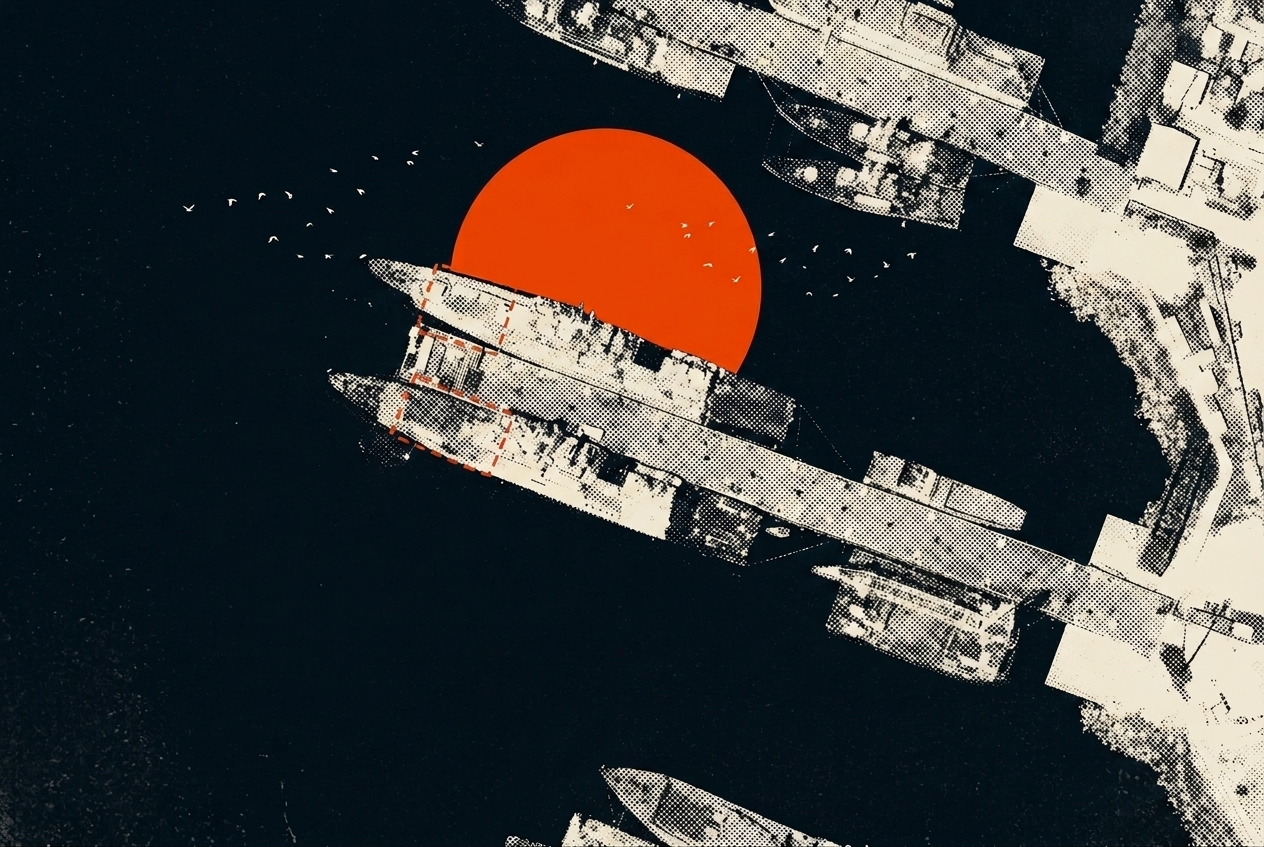
In the autumn of 2023 Russia's Black Sea Fleet left Sevastopol because cruise missiles could reach it there. Novorossiysk was presented as a safe rear area: more than 300 km from the front line, a fortified naval harbour, dense air defences. In the first half of 2026 that harbour took four strikes. A satellite image from 19 August shows both Project 11356R frigates at the same pier — with burn marks around the Caliber launchers. This is no longer "a damaged ship." It is the loss of the very function these ships were built for.
The moveWhy the fleet went to Novorossiysk, and what it changed
By the autumn of 2023 Sevastopol had stopped being a base. On 13 September Storm Shadow cruise missiles hit the Sevmorzavod yard — the landing ship Minsk and the submarine Rostov-na-Donu burned out along with the dock; nine days later the next strike fell on Black Sea Fleet headquarters. By the first days of October satellite imagery showed the main surface missile carriers sitting in Novorossiysk[1].
The logic of the move was simple: put the ships beyond reach. Novorossiysk offers over 300 km of separation from the front line, a naval base of its own in the Geoport area, and cover from coastal air defences. The problem is that the geography works against that calculation. Sevastopol Bay is narrow, with a throat that can be closed off with booms. Tsemes Bay is wider, and both the naval harbour and the berths of the Sheskharis oil terminal sit inside the envelope of air- and sea-launched weapons.
After Admiral Grigorovich left the Black Sea, Novorossiysk was left with a pair of Project 11356R frigates — Admiral Essen and Admiral Makarov. They are two of the few Black Sea Fleet surface combatants able to fire Calibers from an eight-cell universal vertical launcher. This piece is about what was done to them in Novorossiysk.
ChronicleFour strikes in half a year
Novorossiysk naval base · 2026
- 02.03.2026First combined strike. The fire aboard Admiral Essen burned for about 18 hours.
- 06.04.2026Night raid on the Sheskharis terminal. Hits on Essen's bow section and around Makarov's launchers.
- 23.05.2026Raid by the 1st Separate Centre of the Unmanned Systems Forces. Drones came in on Essen's side at the waterline.
- 12.08.2026Joint operation by HUR, the SBU, the Navy and the Border Guard. Four ships hit, plus an S-300 radar and two oil targets.
Eighteen hours of fire
On the night of 2 March 2026 a mass raid worked over Novorossiysk — up to two hundred drones combined with missile weapons. Admiral Essen took a hit on its midships superstructure; the fire aboard burned for roughly eighteen hours[2].
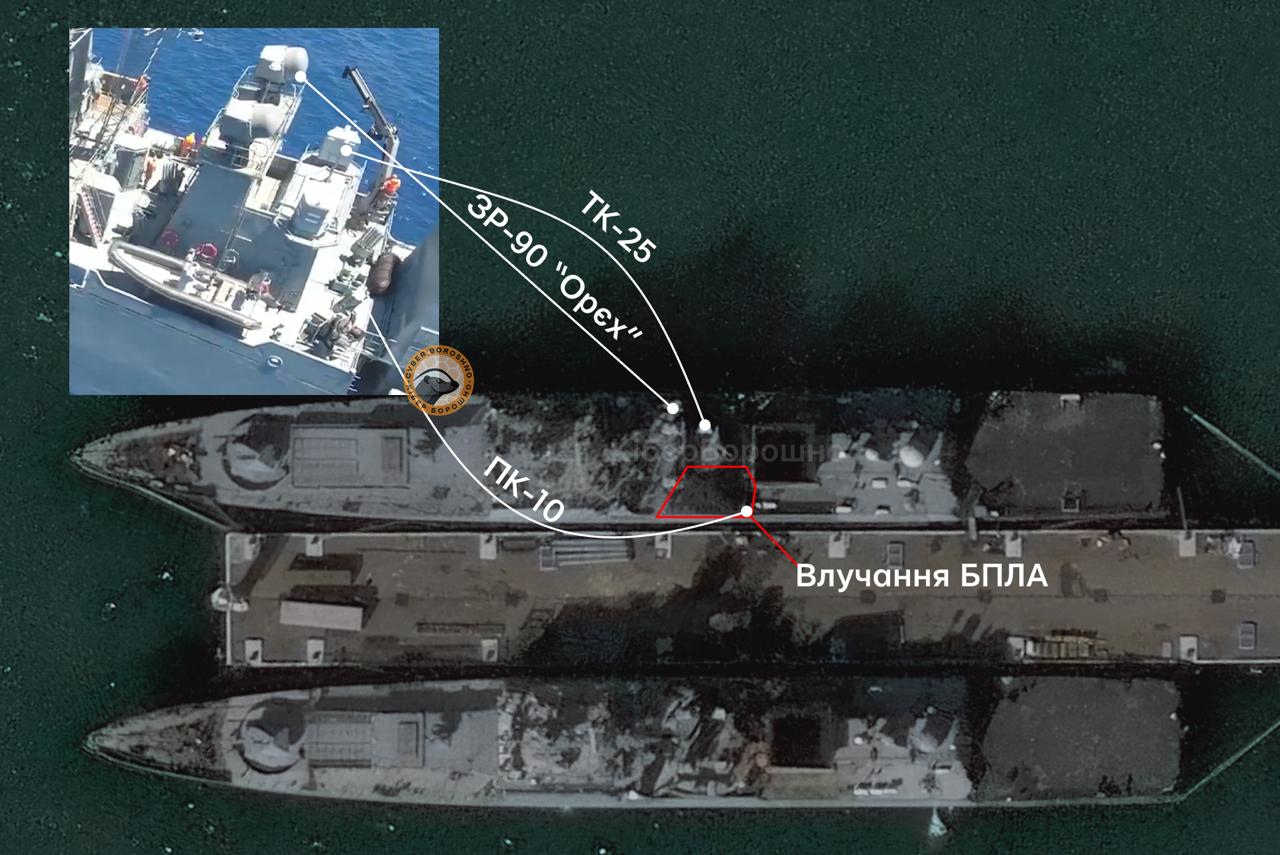
Satellite analysis of the damage showed that what burned was precisely the section where the ship's self-defence and detection systems are concentrated. The casualties were the PK-10 decoy launchers, the TK-25 electronic warfare suite, the Fregat-M2M search radar and the MR-90 Orekh illumination posts. Without the last of these the Shtil-1 surface-to-air system cannot guide its missiles[3]. On 6 March the General Staff of the Armed Forces of Ukraine officially confirmed damage to both frigates[4].
The bow section, and the white radomes
On the night of 6 April strike drones of the 1st Separate Centre of the Unmanned Systems Forces worked the Sheskharis oil terminal with support from deep-strike units. The ships in the harbour came under the same attack.
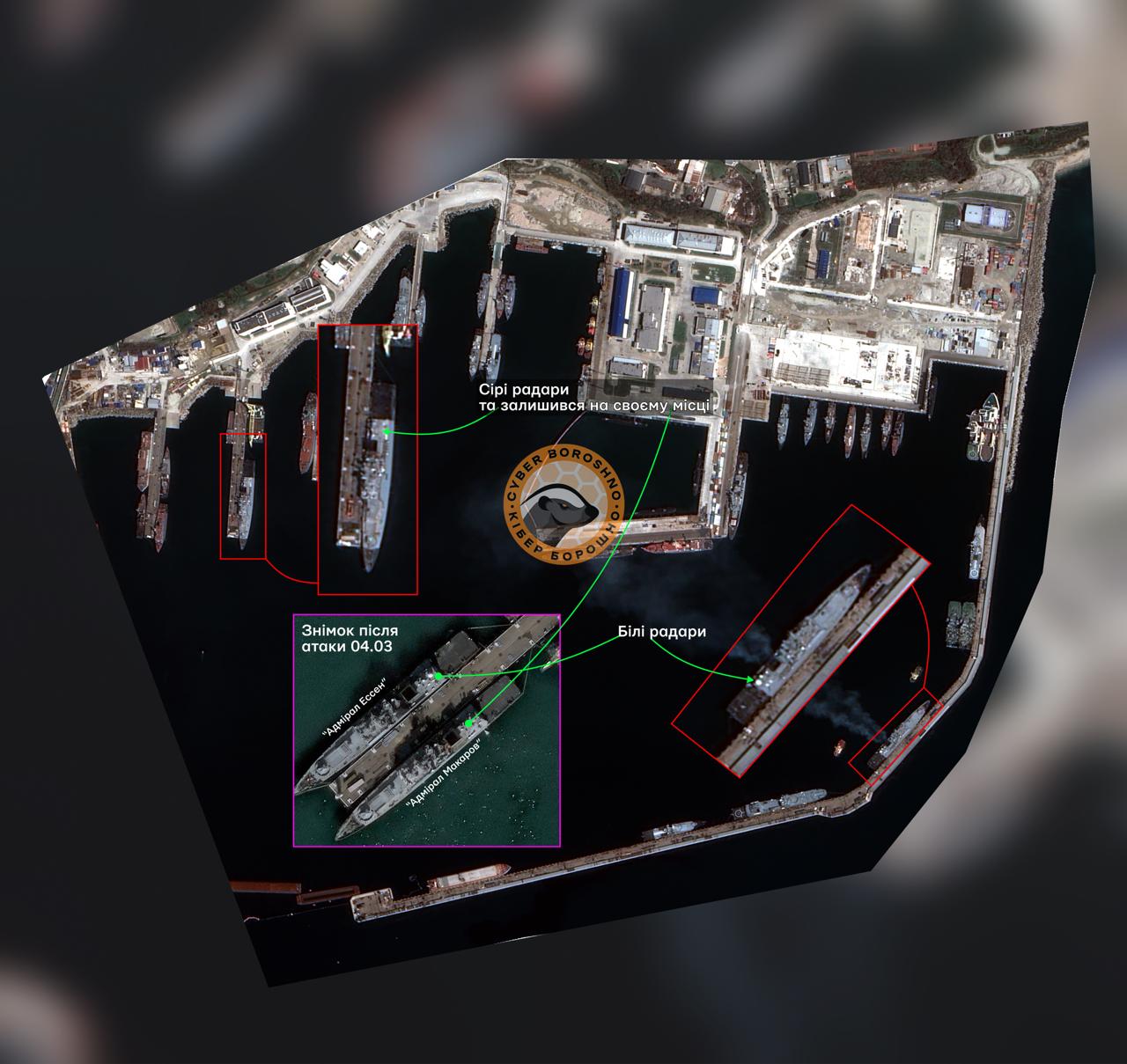
According to CyberBoroshno's satellite analysis, Essen this time was hit in the bow section — in the area of the 100 mm A-190 gun mount, directly above the MGK-335M Platina hull-mounted sonar[3]. The ship was identified on the imagery by its distinctive white radomes; Makarov's are grey. Makarov itself registered arrivals around its pier and its vertical launchers — despite the ship firing its Shtil-1 surface-to-air system.
In on the side, at the waterline
In late May the 1st Separate Centre of the Unmanned Systems Forces, commanded by Robert "Madyar" Brovdi, ran a two-day raid on Novorossiysk. This time Essen was not attacked from above: the drones came in on the ship's side, right at the waterline, despite fire from its air-defence weapons[5].
Four ships in one night
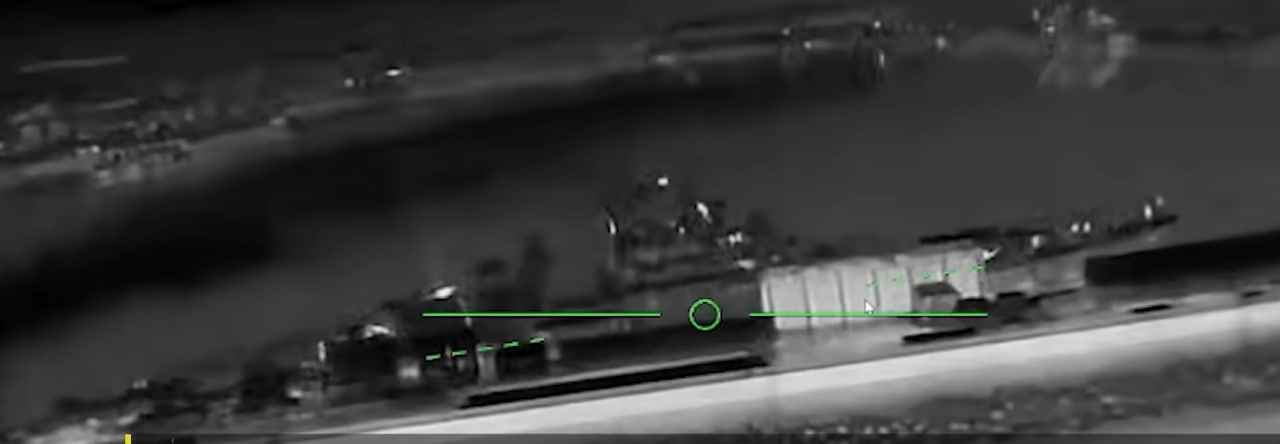
The operation on the night of 12 August was run jointly: the Active Operations Department and the Unmanned Systems Department of HUR (Defence Intelligence of Ukraine), the SBU, the Navy and the State Border Guard Service, in coordination with the General Staff. The weapons were Palianytsia jet-powered long-range drones, Neptune cruise missiles and uncrewed surface vessels[6].
The night's confirmed results were hits on four ships: both Project 11356R frigates, a Project 21631 Buyan-M small missile ship and a Project 22160 patrol ship of the Vasily Bykov type. Separately, a 30N6E radar belonging to an S-300 surface-to-air battery, the Grushovaya oil depot and the Sheskharis terminal were struck[6][7].
19.08What the high-resolution image showed
On 19 August 2026 an image of the Novorossiysk harbour appeared online at far better quality than anything before it. Both frigates are lying along opposite sides of the same pier, parallel, bows the same way — and both show burn marks across the forward half, where the Caliber launcher sits[8][9]. The damage, however, is of two different classes.
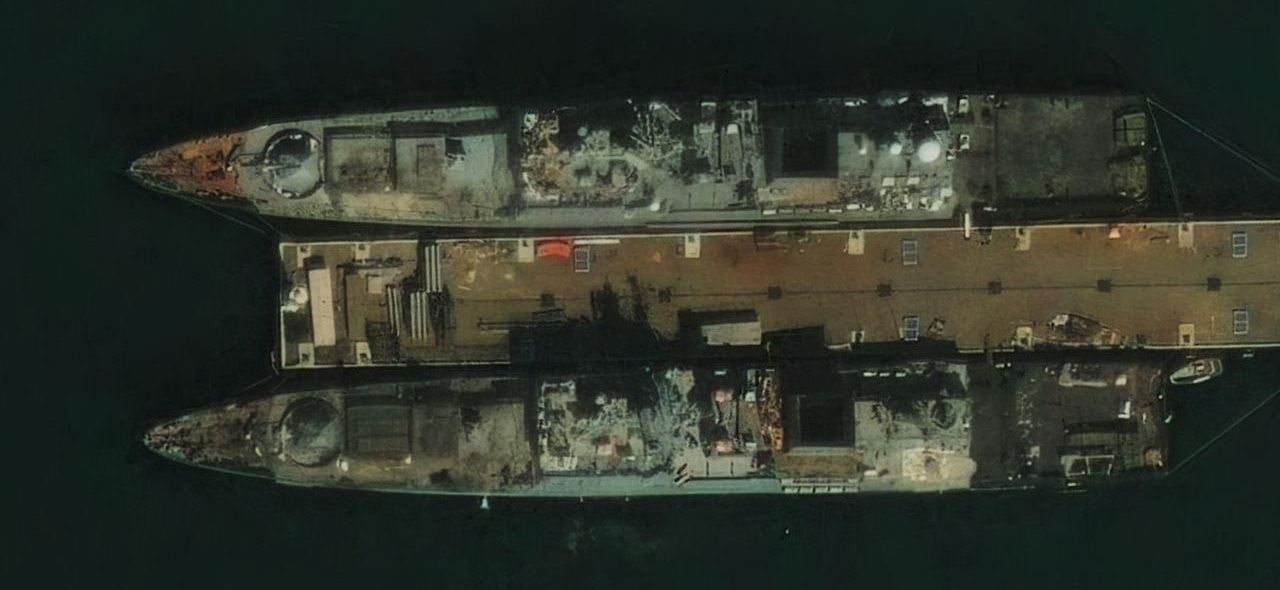
Admiral Makarov · pr. 11356R
Admiral Essen · pr. 11356R
On Makarov the imagery reads as a penetrating hole directly in the mounting area of the eight-cell 3S14 universal vertical launcher. Missile rounds are not routinely kept aboard while in base, so there was no detonation — but the silo itself is wrecked. On the after superstructure, the radome of the Kentavr-NM1 protected satellite communications station has been destroyed, and the antenna post of the three-coordinate Pozitiv-M1.2 radar next to it damaged[9][10].
Essen's damage is of a different character: the deck around the missile silos is covered in soot from repeated fires, and the PK-10 decoy launchers and the TK-25 electronic warfare station are out of action. The ship is afloat and its main strike system is most likely intact — but its close-in defence and detection systems have degraded across four consecutive strikes[10].
3S14Why a breached silo means the loss of Calibers
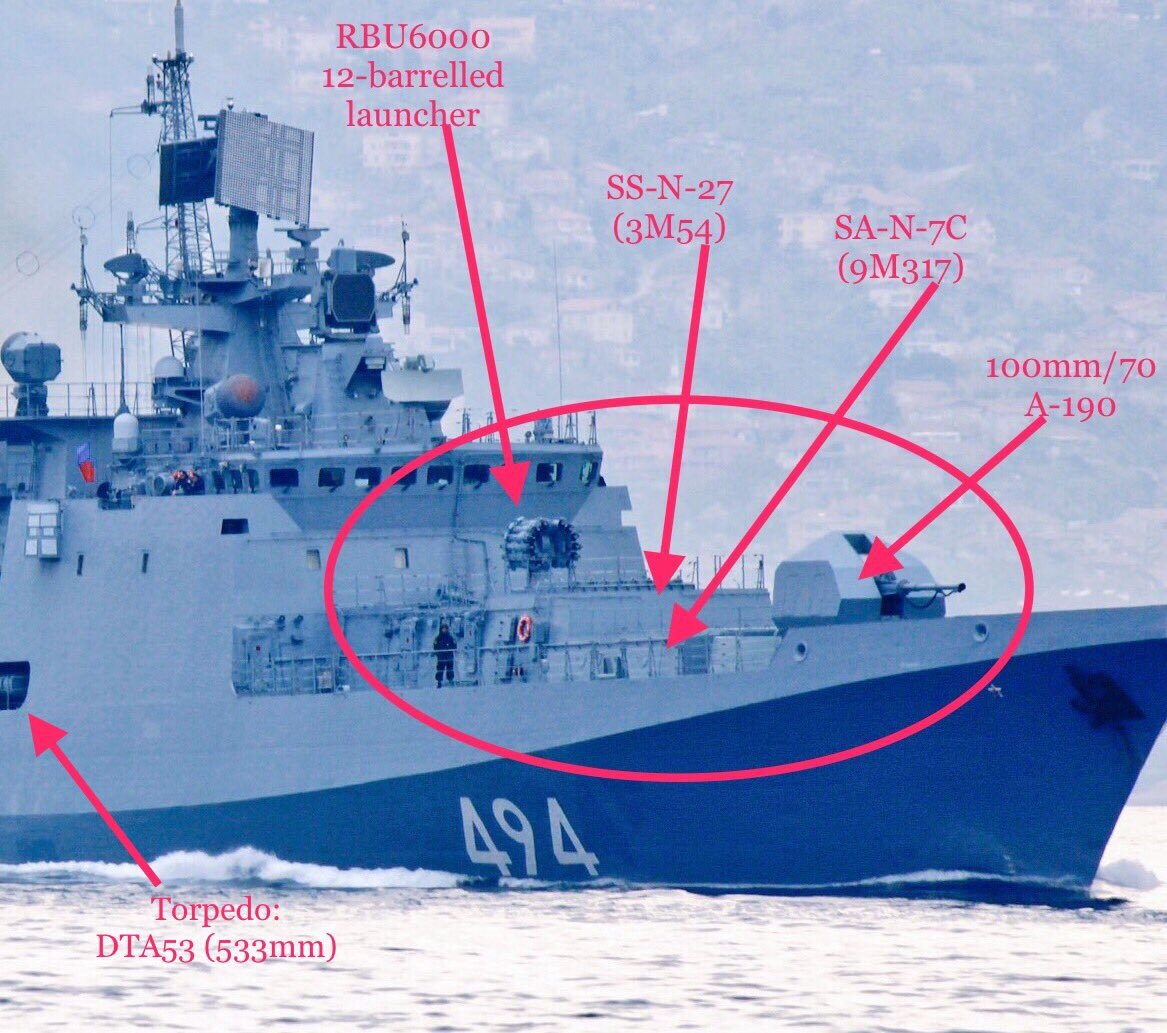
The difference between "a damaged ship" and "a ship that no longer shoots" lies in how the launcher is built. The UKSK 3S14 is not a piece of deck furniture that can be swapped out alongside a quay. It is a module built into the hull. On Project 11356R frigates it sits in the bow section, between the 100 mm A-190 gun mount and the superstructure, sunk into the hull — exactly the length of a missile in its transport-launch canister.
The module's dimensions explain why this is not a job that can be done alongside a quay. According to the export brochure for the 3S-14E launcher, its height is 9,580 mm — nearly ten metres down into the hull — with a length of 3,760 mm, a width of 1,970 mm and a module mass of 14,000 kg for eight missile cells[11]. This is not something lifted out by a quayside crane.
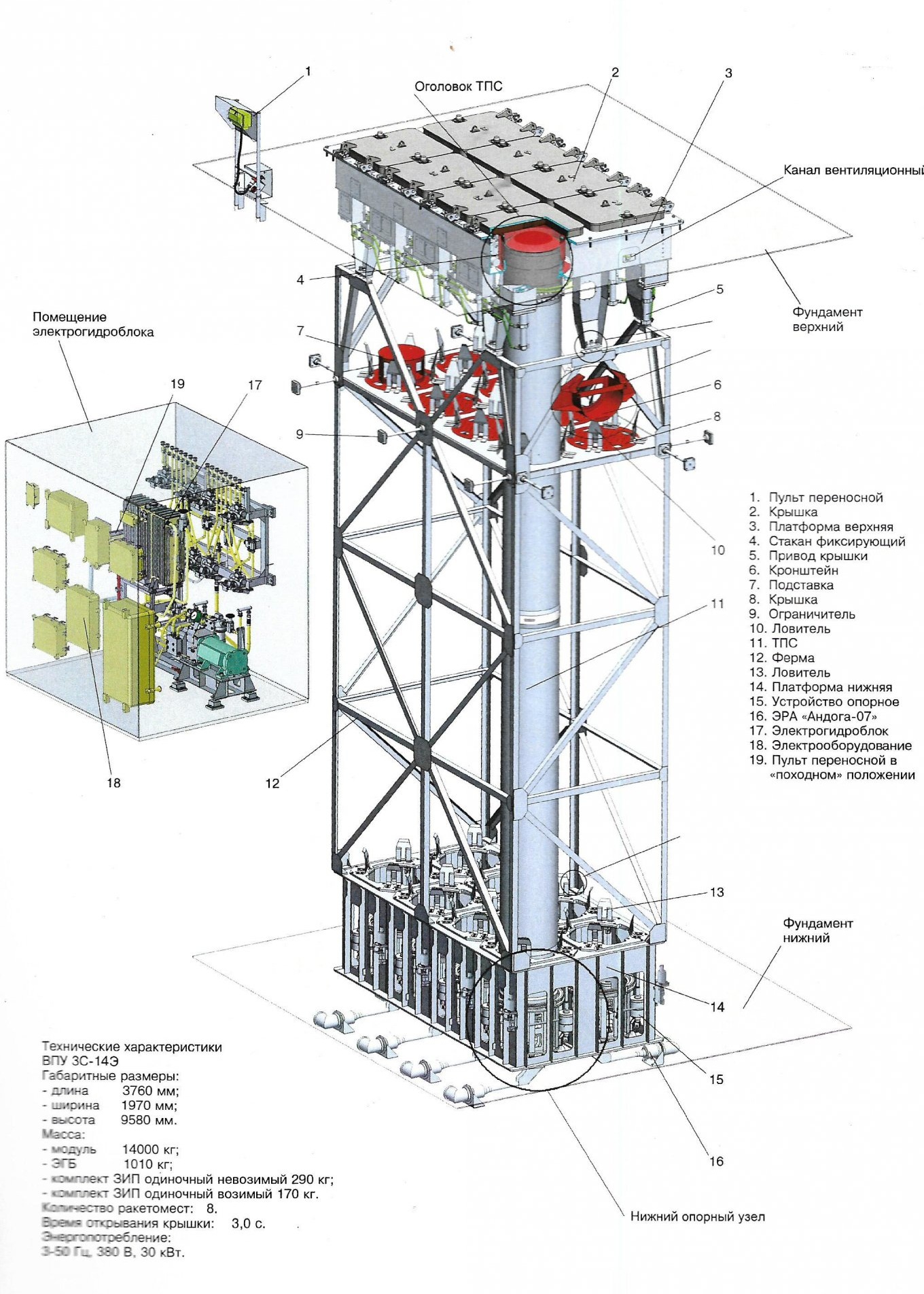
- 2cell hatch
- 3upper platform
- 5hatch drive
- 11transport-launch canister with the missile
- 12truss — the module's load-bearing frame
- 14lower platform
- 15support unit on the foundation inside the hull
- 17electro-hydraulic unit in a separate compartment
What it takes to give the ship its Calibers back
- Open up the deck above the module. Access to the 3S14 is from above and nowhere else; removing it means cutting through upper-deck structures.
- Extract and replace the module itself. That is a yard operation requiring cranes of the appropriate capacity, not work a crew can do.
- Restore everything tied into the launcher. Pre-launch preparation equipment, power supply, gas venting — all of it runs through the same zone.
The Black Sea Fleet's ship-repair base has historically been tied to Sevastopol — Sevmorzavod and the 13th Ship Repair Yard. That is precisely where the ships were pulled out of in 2023, and Sevmorzavod has itself been a target repeatedly since. Novorossiysk was built as a basing point, not a repair hub: facilities for dock work of this class there are severely limited. That is what the assessment "out of action for a long time" actually means — not that the ship is sinking, but that there is effectively nowhere to fix it.
WiderWho else is in the frame
The frigates took the headlines, but the consolidated imagery analysis published by Exilenova+ shows damage across the harbour far beyond those two positions. Besides Essen and Makarov, marks of damage were recorded on five more units, each with its own role in keeping the base running[8].
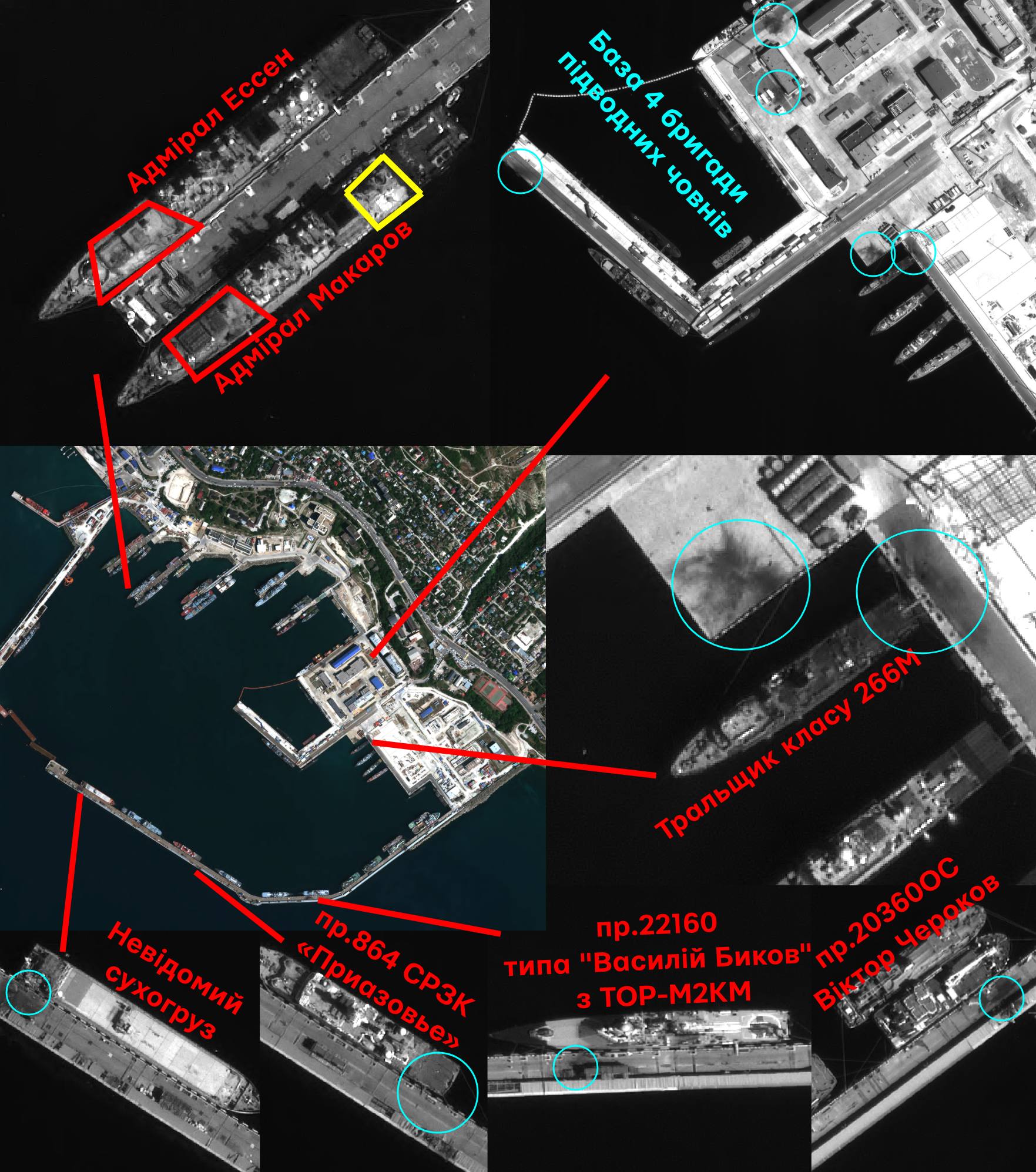
Besides the frigates · per the Exilenova+ layout
- pr. 266MSeagoing minesweeper. Keeps the exit from the bay and the fairways clear of mines.
- pr. 864Medium intelligence ship Priazovye — signals and electronic intelligence for the Black Sea Fleet.
- pr. 22160Patrol ship of the Vasily Bykov type with a containerised Tor-M2KM air-defence system on deck.
- pr. 20360OSViktor Cherokov — a naval armament transport, that is, the vessel that carries the munitions.
- unidentifiedA dry cargo ship by the outer mole; the type cannot be established from the imagery.
The layout separately marks the basing point of the 4th Submarine Brigade — the formation that operates the Project 636.3 Varshavyankas, the Black Sea's principal submerged Caliber carriers. No damage to the boats themselves is visible in the imagery, but the mere presence of that location in the layout shows the strike envelope covers the base as a whole rather than individual piers.
The response is visible from orbit. Over the summer of 2026 counter-drone cages appeared over the sails of the submarines at Novorossiysk, the boats themselves settled into the water on slackened moorings, and a boom closed the entrance to the inner harbour against drone boats.
20.08Geolocation: a Caliber leaves from inside the city harbour
A day after the damage imagery went round the internet, amateur night footage came out of Novorossiysk: a cruise missile launch filmed from a residential block[12].
The roofline of a distinctive apartment block in the frame, along with a lower reference point, was located on satellite imagery; intersecting the sightlines fixes the camera position at 44.7072, 37.7798, on the eastern shore of Tsemes Bay. The naval harbour lies opposite, across the water. That is where the bearing to the flare leads — not to the mouth of the bay, and not out to sea.
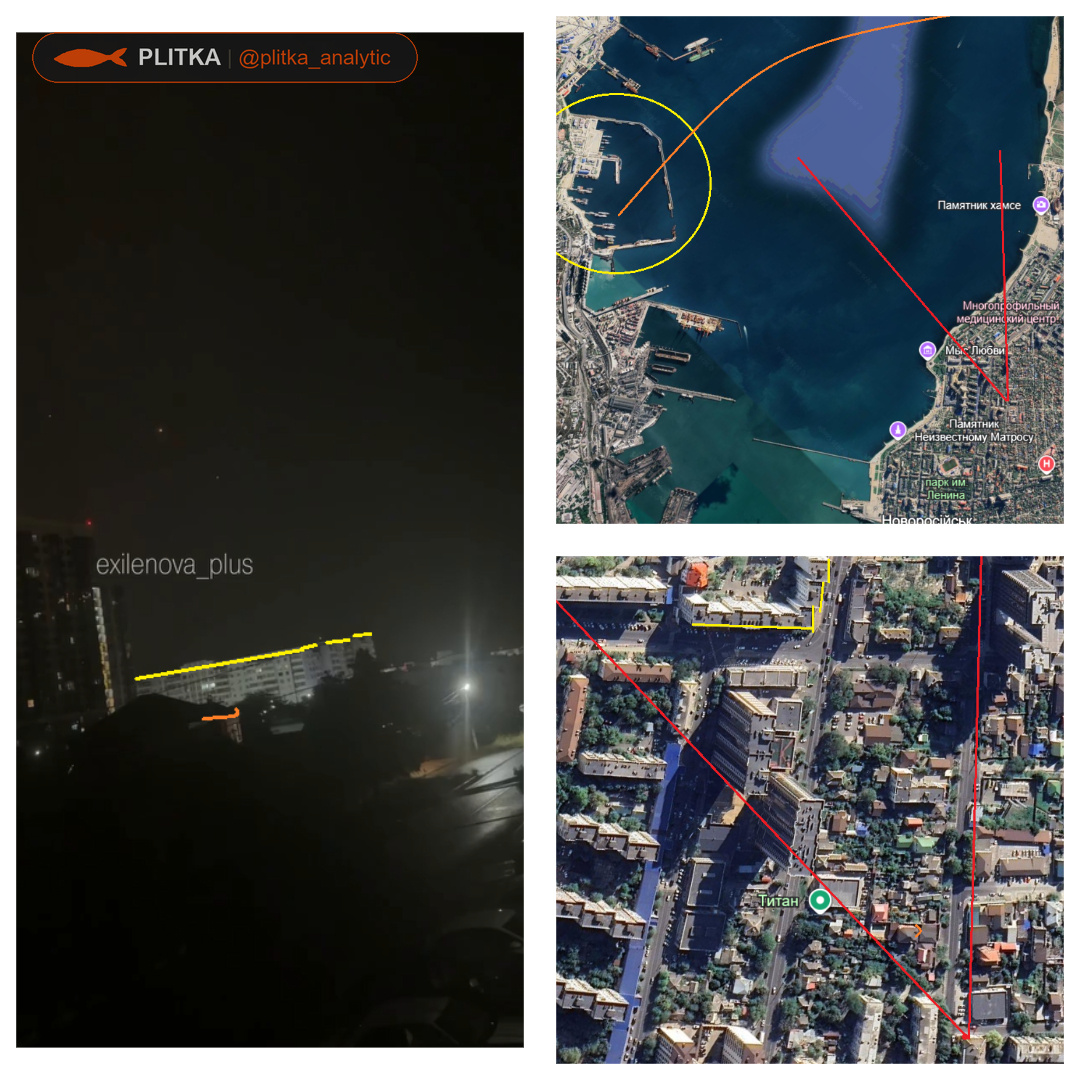
And the point of launch is the finding. The Russian missile-carrier group is firing from piers inside the city harbour, under cover of residential blocks, rather than moving out to firing positions at sea. The reason is plain: leaving the bay means meeting uncrewed surface vessels and anti-ship missiles. So is the price — the launch zone now coincides with the zone where those ships are being hit, and the housing of Novorossiysk sits immediately alongside both.
Bottom lineThree consequences for the Black Sea Fleet
A flagship without a strike function. Admiral Makarov became the Black Sea Fleet's de facto flagship after the cruiser Moskva went down in April 2022. A breached 3S14 launcher and a destroyed satellite communications station strip it of both roles at once: it neither launches Calibers nor coordinates the formation. Only a yard repair can restore that.
The relocation did not work. The move from Sevastopol was meant to put the ships beyond reach. The combined strikes of 2026 reach them alongside their piers at over 300 kilometres from the front line — and reach them systematically, four times in half a year. There is no further rear area to fall back to: the Black Sea is closed.
The carriers have become floating batteries. Ships built to operate at sea now fire from alongside, because putting to sea is more dangerous for them than staying put. That works for as long as the harbour works. The Black Sea Fleet's strike capability has been tied to a single point on the map — and that point is already within reach.
What remains open
- Russia has published no repair timelines for Makarov and Essen; the assessment of "extended dry-dock repair" rests on the character of the damage, not on official figures.
- How many Calibers are left in Black Sea Fleet stocks without reliable carriers is a matter of estimate rather than count; open sources give only an order of magnitude[13].
- Whether the fleet shifts to submarine launches as its primary method will become clear over the coming months.
Sources
- Planet Labs / MT Anderson. Satellite imagery of Novorossiysk · relocation of the Black Sea Fleet's surface missile carriers · 01–03.10.2023.
- Defence Express. Assessment of the combined strike on Novorossiysk · 03.2026.
- CyberBoroshno. OSINT analyses of strikes on the Novorossiysk naval base from satellite imagery · 03–04.2026.
- General Staff of the Armed Forces of Ukraine. Statement on damage to Admiral Essen and Admiral Makarov · 06.03.2026.
- 1st Separate Centre of the Unmanned Systems Forces / Robert "Madyar" Brovdi. Material from the Novorossiysk raid · 23.05.2026.
- HUR (Defence Intelligence of Ukraine). Announcement of the joint operation in Novorossiysk · 12.08.2026.
- The Maritime Executive — Ukraine Confirms Hits on Four Russian Warships · 08.2026.
- Exilenova+ (reprinted by Militarnyi) — Two Frigates, Minesweeper, Recon and Patrol Ships Damaged · 08.2026.
- Defence Blog — Satellite images confirm damage to two Russian missile frigates: Vantor imagery · 08.2026.
- Naval News — Ukraine Strike Damages 2 Russian Frigates at Novorossiysk · 08.2026. Kyiv Post — Satellite Images Reveal Damage to 2 Russian Frigates · 08.2026.
- "Izdeliye 3S-14E. Vertical launching system" — the manufacturer's export brochure: a cutaway with a numbered key and a table of technical characteristics. Figures as claimed by the manufacturer.
- Exilenova+. Amateur night-time footage of a cruise missile launch over the residential districts of Novorossiysk · 20.08.2026. Geolocation of the camera position — PLITKA Analytics.
- Militarnyi — Russia May Have Lost Two Kalibr Missile Carriers · 08.2026. NV — satellite images suggest serious damage to Caliber carriers · 08.2026. RBC-Ukraine — Russia's navy may be down two Kalibr launch ships · 08.2026. Charter'97 / Exilenova — Black Sea Fleet Is Trapped In Novorossiysk Bay · 08.2026.
Based on open sources. Weapon fits and characteristics drawn from Russian and reference publications have not been independently verified and are presented as claimed. Damage assessments from satellite imagery are interpretations of visible indicators and do not substitute for official figures, which neither side has released.