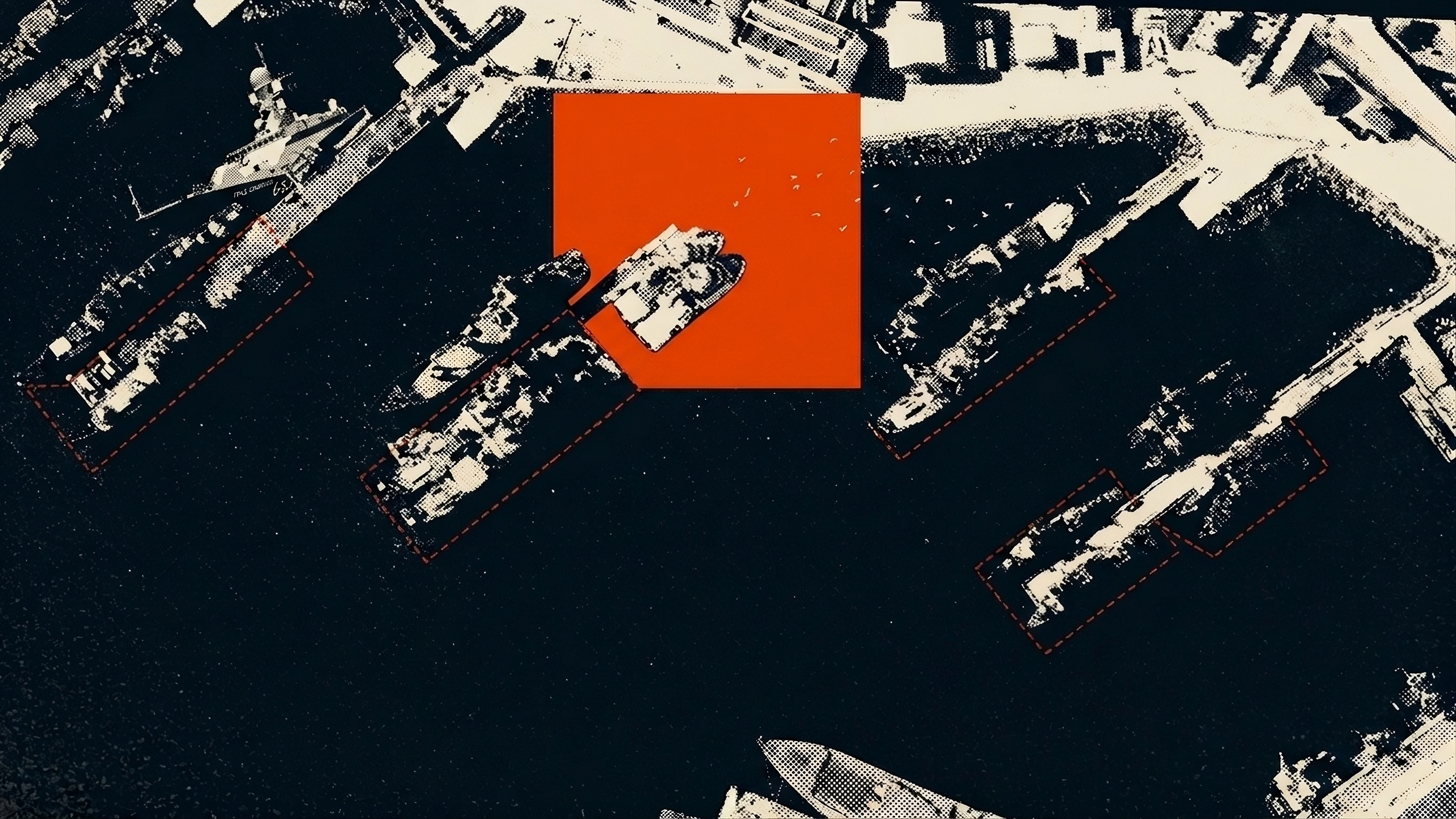
From a tactical standpoint, these are a relatively affordable cruise missile delivery platform that can operate not only at sea but in inland waters: the Buyan-M's dimensions were specifically designed to pass through the locks and bridges of the Volga-Baltic, Volga-Don, and White Sea-Baltic canals. This allows rapid redeployment of ships between theatres via Russia's inland river arteries — from the Caspian to the Black Sea, from the Baltic to the Caspian, from the White Sea to the Baltic. It was precisely this feature that determined the specific fate of the series during the full-scale war against Ukraine.
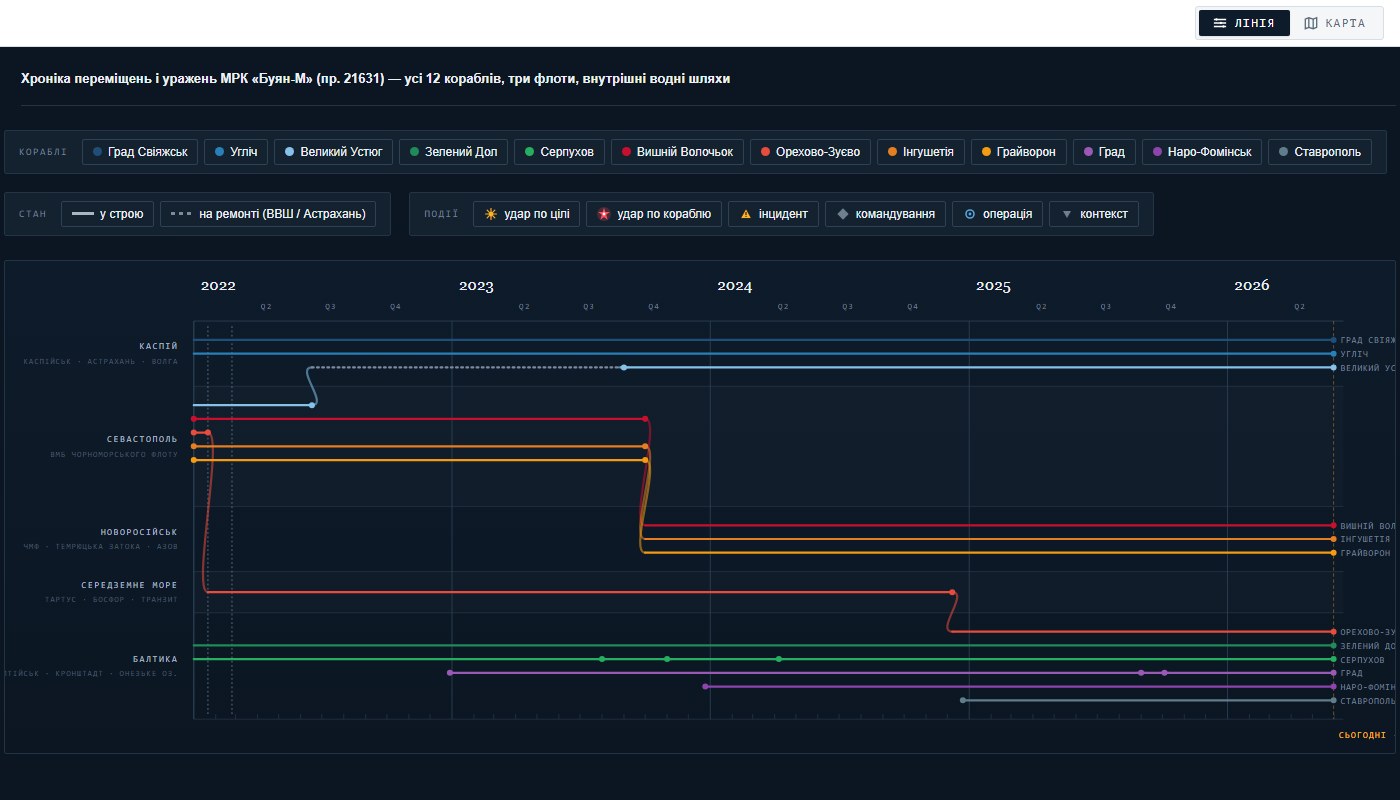
Over twelve years, the Buyan-Ms were distributed across several theatres of war — and it was geography, not combat losses, that became the main storyline of the series in this war.
Series 21631 · Distribution by Theatre, May 2026
| Ship | Hull# | In Service | Theatre | Status / Note |
|---|---|---|---|---|
| Grad Sviyazhsk | 652 | 2014 | Caspian | Active |
| Uglich | 653 | 2014 | Caspian | Active |
| Veliky Ustyug | 651 | 2014 | Caspian | Active · struck 2022 outside Caspian (Black Sea/Azov) |
| Zeleny Dol | 562 | 2015 → BF 2016 | Baltic | Active |
| Serpukhov | 563 | 2015 → BF 2016 | Baltic | Sabotage "Rybalka" · 07.04.2024 |
| Vyshniy Volochek | 609 | 2018 | BSF · Novorossiysk | Damaged 07.08.2025 (collision with tanker) |
| Orekhovo-Zuyevo | 626 | 2018 | BSF (formal) → Kronstadt | No confirmed combat launches against Ukraine |
| Ingushetiya | 600 | 2019 | BSF · Novorossiysk | Active |
| Grayvoron | 622 | 2021 | BSF · Novorossiysk | Active · likely struck 28.08.2025 |
| Grad | 575 | 2022 | Baltic | Struck by SOF 04.10.2025 (Lake Onega) |
| Naro-Fominsk | 577 | 2023 | Baltic | Active |
| Stavropol | 555 | 2026 (planned) | Baltic | Factory trials |
This article is the second in the series on the Russian fleet in the war against Ukraine, devoted specifically to the Buyan-Ms. The material is organised on a geographical basis — Black Sea (§ 02), Caspian (§ 03), Baltic (§ 04) — and within each section the chronicle runs from February 2022 to May 2026, reconstructing key episodes from open sources.
§ 02 · Black SeaThe Black Sea Group: Four Ships That Passed Through Sevastopol, Tartus, and Temryuk
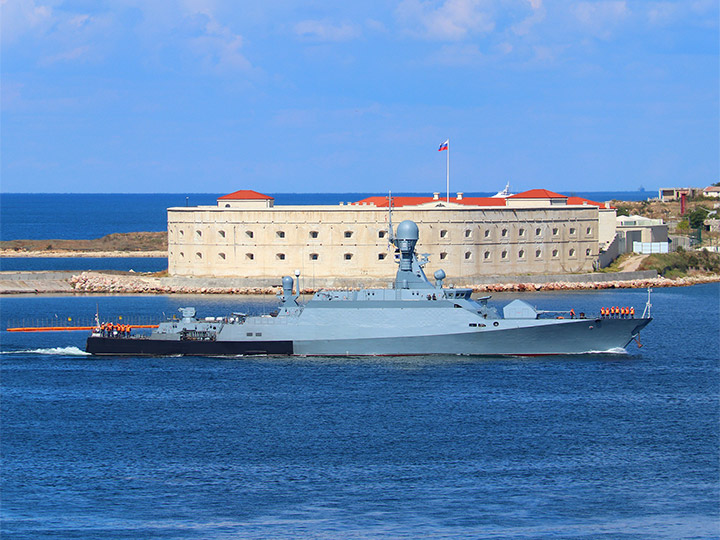
On the day of the full-scale invasion, four Project 21631 ships were formally assigned to the Black Sea Fleet — Vyshniy Volochek, Orekhovo-Zuyevo, Ingushetiya, and Grayvoron, commissioned between 2018 and 2021. All four were part of the 41st Missile Boat Brigade of the Crimean Naval Base, homeported at Sevastopol's South Bay. These were new vessels: the fleet's youngest ships, with UKSK 3S14 vertical launchers for eight Caliber-NK or Oniks missiles, a 2.5-metre draught, and official status as river-sea ships capable of transiting the Volga-Don Canal locks.
Due to Western sanctions, German diesel engines were replaced during construction with Chinese ones. However, cooling system defects discovered during trials caused delivery delays. By early 2022, all problems were resolved and the first ships had been officially handed over to the Black Sea Fleet.
Even this foursome was not complete on the day of the invasion. One of the nominally Black Sea ships — Orekhovo-Zuyevo — transited the Bosphorus to the Mediterranean four weeks before the invasion, where it became stranded after Turkey's decision to close the straits. So on 24 February 2022, the Black Sea actually had three combat-ready Buyan-Ms of the Black Sea Fleet: Vyshniy Volochek, Ingushetiya, Grayvoron.
However, during 2022 the MRK Veliky Ustyug, formally assigned to the Caspian Flotilla, was recorded operating in the Black Sea. When exactly Veliky Ustyug transited via the Volga-Don Canal is not precisely known, nor is its location in February 2022. But it was on the Black Sea-Azov theatre that the series suffered its first strike.
The Phantom Ship: Orekhovo-Zuyevo After the Bosphorus
The seventh ship of the series, Orekhovo-Zuyevo, left Sevastopol and passed through the Bosphorus southward on 21 January 2022 — 37 days before the straits closed and 34 days before the full-scale invasion. Mission: reinforcing the Russian Navy's permanent Mediterranean operational squadron.
From 28 February 2022, after Turkey invoked Article 19 of the Montreux Convention, Orekhovo-Zuyevo was among 13 Russian warships and 5 auxiliary vessels left in the Mediterranean with no way back to their home base. BlackSeaNews recorded hull number 626 in the Russian grouping at Tartus and Latakia in monthly summaries for May, September, October, and November 2022.[1]
The ship's subsequent trajectory, unlike its Black Sea siblings, was shaped not by war but by Mediterranean geography. Through 2022–2024, Orekhovo-Zuyevo performed routine Mediterranean squadron tasks: patrols, rotations in Tartus, calls at Latakia. Not a single confirmed combat Caliber launch from this ship against Ukrainian targets exists for the entire period — the Mediterranean geography and a missile's path over Turkish territory made such strikes politically impossible and practically unmanageable.
On 8 December 2024, Assad's regime fell in Syria. The Russian squadron was forced to leave Tartus — Planet Labs imagery from 3 December already showed the harbour empty. Together with the frigate Admiral Grigorovich and auxiliary vessels, Orekhovo-Zuyevo transferred to the Baltic. As of May 2026 the ship is based at Kronstadt as part of the Baltic Fleet's 36th Missile Boat Brigade — though its official fleet assignment has not changed: Orekhovo-Zuyevo formally remains a Black Sea Fleet ship.
The First Launches of the War
The first confirmed Caliber launches from a Buyan-M MRK against Ukrainian targets were recorded on 28 March 2022: Russia's MoD reported that one of the ships (visually identified as Project 21631) fired eight cruise missiles from the Black Sea, which, per the Russian account, destroyed "a Ukrainian ammunition depot in Orikhiv." Launch footage was published by Russia's Ministry of Defence — this became one of the first public video confirmations of an MRK carrier's launch in this war.[2]
The specific ship in that launch was not officially named. In Sevastopol as of 28 March were three units: Vyshniy Volochek, Ingushetiya, Grayvoron. Whether Veliky Ustyug could perform combat tasks at that point remains unknown. Over the following three weeks the scale of launches from the Black Sea grew: British military intelligence and Ukrainian Navy spokesperson Dmytro Pletenchuk repeatedly documented Black Sea Fleet Buyan-M MRKs as active participants in missile bombardment.
The First Strike on a Buyan
On 17 June 2022, a photograph appeared of Veliky Ustyug being towed by two vessels along the Volga. Its tactical number and name had been painted over, the main radar removed — standard preparation for transiting river locks. Hull number 651 was identified from remnants of markings on the superstructure. Route: back to the Caspian, to the repair base in Astrakhan.
The claim of "7 March 2022" circulating in later publications originates from a BlackSeaNews assumption made after the June photos appeared (phrasing: "probably struck as early as 7 March… by MLRS"), unsupported by any document or independent source. Only the fact that by mid-June 2022 the ship already required Volga towing to a repair facility is definitively known.
Analysis by Defence Blog from 17 June 2022, based on photos from the Russian military forum airbase.ru, identifies the damage character as artillery — from a BM-21 Grad MLRS, most likely shore fire near Odesa Oblast or from the left bank of the Kinburn Spit. However, the precise date and circumstances of the strike are not recorded in open sources.[3]
By 28 July 2022, Veliky Ustyug was already participating in the Main Naval Parade in St. Petersburg — less than five months after the strike. Commander Maxim Nikiforov declared at the ceremony that "the MRK's name will never be disgraced." Russian official sources mentioned neither the strike nor the repair. The ship reappears in Russian Caspian Flotilla reports in late 2023 — without details on the scope of restoration. As of May 2026, Veliky Ustyug is active in the Caspian.
Explosion in the Roadstead: Naval Baby or Exercises?
The 13 October 2023 episode is publicly discussed but not confirmed by either side under our verification criteria. We include it as unverified.
On the morning of 13 October 2023, around 10:30, a powerful explosion was heard in central Sevastopol — residents' car alarms triggered. The Crimean Wind Telegram channel was first to publish photos of smoke near one of the ships on the outer roadstead.[4]
Sources inside the SBU stated to UNN and Channel 24 that this was a joint operation with Ukraine's Navy using Naval Baby sea drones with "experimental armament." According to the same version, on 11 October the same weapon struck the patrol ship Pavlo Derzhavin (Project 22160) — and on 13 October the same scenario was repeated against a Buyan-M, the specific ship unnamed.
Russian channels and independent analysts subsequently advanced an alternative version: the explosion occurred near the ship, not on it, and may have been related to an underwater detonation during training manoeuvres. No source provided satellite or video material confirming damage to the ship; Ukraine's Navy also did not publicly comment on this episode.
The Novorossiysk Period, from October 2023
In autumn 2023, following Storm Shadow strikes on Sevastopol — on the large landing ship Minsk and the diesel submarine Rostov-on-Don on 13 September, on the Black Sea Fleet headquarters on 22 September — a mass relocation of BSF surface forces to Novorossiysk began. Planet satellite imagery from 1–3 October 2023, published by OSINT analyst MT Anderson, recorded the arrival at Novorossiysk of two frigates — Admiral Essen and Admiral Makarov. Project 21631 MRKs began transferring to Novorossiysk at roughly the same time — the largest change of basing for the Black Sea Fleet during the full-scale war.
The transfer of BSF Buyan-Ms to Novorossiysk changed the operational logic. If Sevastopol was a base on the peninsula with direct access to the north-west Black Sea, Novorossiysk is a deep-water port on the Russian coast with limited approaches and powerful shore air defences. From there, a direct Caliber launch northward toward Ukraine is geographically disadvantageous: the missile must fly over the Black Sea, bypassing Crimea. For strikes on northern and central Ukraine, the ships began operating from Temryuk Bay in the Sea of Azov — a zone covered by the Kerch Bridge's air defences.
A small section of the Sea of Azov between Temryuk and the Kerch Peninsula. Powerful air defence systems (S-300/400, Pantsir-M) are deployed on both sides of the Crimean Bridge — the most protected zone of launch positions against Ukraine. Distance to Kyiv ≈ 850 km; closer to Zaporizhzhia and Dnipro.
It was in Temryuk Bay in 2025 that both of the most documented incidents involving the Black Sea Buyan-Ms occurred.
Vyshniy Volochek and the Tanker Nazan
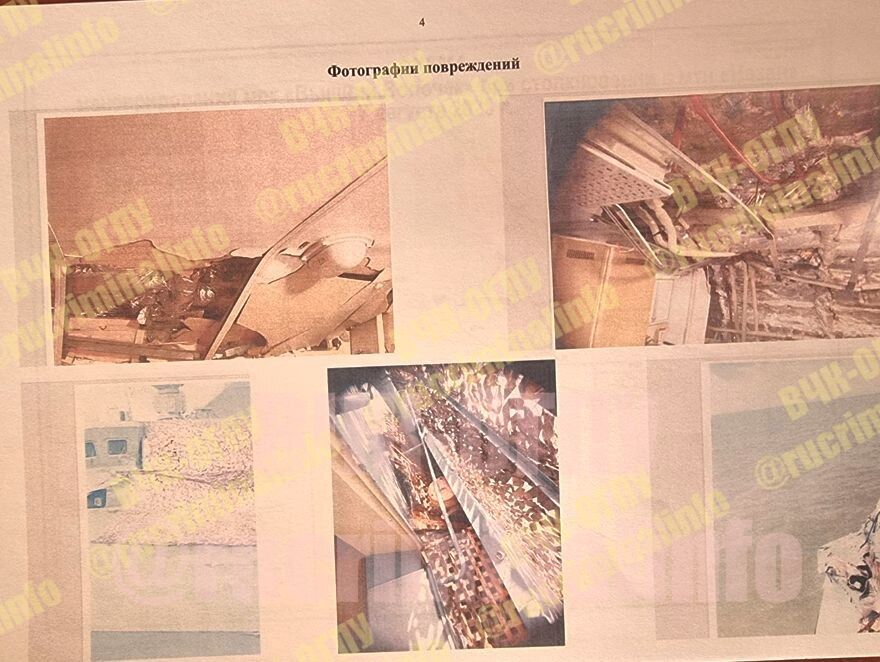
On 7 August 2025, Vyshniy Volochek went on combat duty in Temryuk Bay. In the fire area the ship came under attack from Ukrainian strike drones — according to Russian military documents published in open sources, the crew executed an evasion manoeuvre. During the manoeuvre the ship collided with the civilian oil tanker Nazan, which was nearby in the bay.[5]
Russian military documents of the 41st Missile Boat Brigade, published in open sources, record the collision as an accident — without public attribution to Ukrainian strike means, but with a direct mention of "actions by enemy unmanned aerial vehicles." The scale of damage to Vyshniy Volochek after the collision was not publicly assessed. During August–September 2025 the ship does not appear in public BSF reports; other BSF Buyan-Ms continued going on duty.
Operation Prymar: Drone into the Radar
Three weeks after Vyshniy Volochek's collision — with footage published 28 August 2025 — another Black Sea Fleet Buyan-M was struck in the same Temryuk Bay. This was a joint operation of the Active Operations Department of Ukraine's Military Intelligence Directorate (HUR MO) and HUR's special unit Prymar (Phantoms). The tactic was combined: an aerial strike drone hit the ship's radar, then a second strike drone attacked the hull. HUR published aerial drone footage showing the moment of impact on the radar equipment.[6]
According to HUR, the ship had gone to the bay to carry out a launch mission — a massed Russian cruise missile attack on Kyiv that same night. The launch did not take place. The Buyan-M turned around and left the combat duty zone. Ukraine's Navy did not publicly name the specific ship — at that time Vyshniy Volochek (if recovered), Ingushetiya, or Grayvoron could have been in Temryuk Bay.
General Staff: One Buyan-M Hit
On the night of 11–12 August 2026, Ukraine's Defence Forces carried out a combined strike on the Novorossiysk naval base. According to operational data from Ukraine's General Staff, four ships sustained damage of varying severity: two Project 11356R frigates, the patrol ship Vasily Bykov, and a Project 21631 Buyan-M small missile ship.[11] The General Staff did not say which of the three Novorossiysk Buyan-Ms was hit, and open sources do not name the ship either. The strike on the frigates is covered in “Russian Navy Frigates”.
Eight Calibers from Novorossiysk
On the night of 19–20 August, Russia launched a combined attack on Kyiv and the surrounding region: Oniks, Zircon, Iskander-M and S-400 missiles flying ballistic trajectories, 36 cruise and air-launched missiles, 168 drones — and eight Calibers. According to Ukraine's Air Force, all eight Calibers were shot down.[12] Euromaidan Press reports that they were fired by a Buyan-M at Novorossiysk — exactly one magazine — and that the ship was undamaged, i.e. not the one hit on 12 August.[13] Citing an OSINT account on X, the outlet also claims one Caliber struck the Antonov plant; this has not been officially confirmed.
A Hit, per OSINT
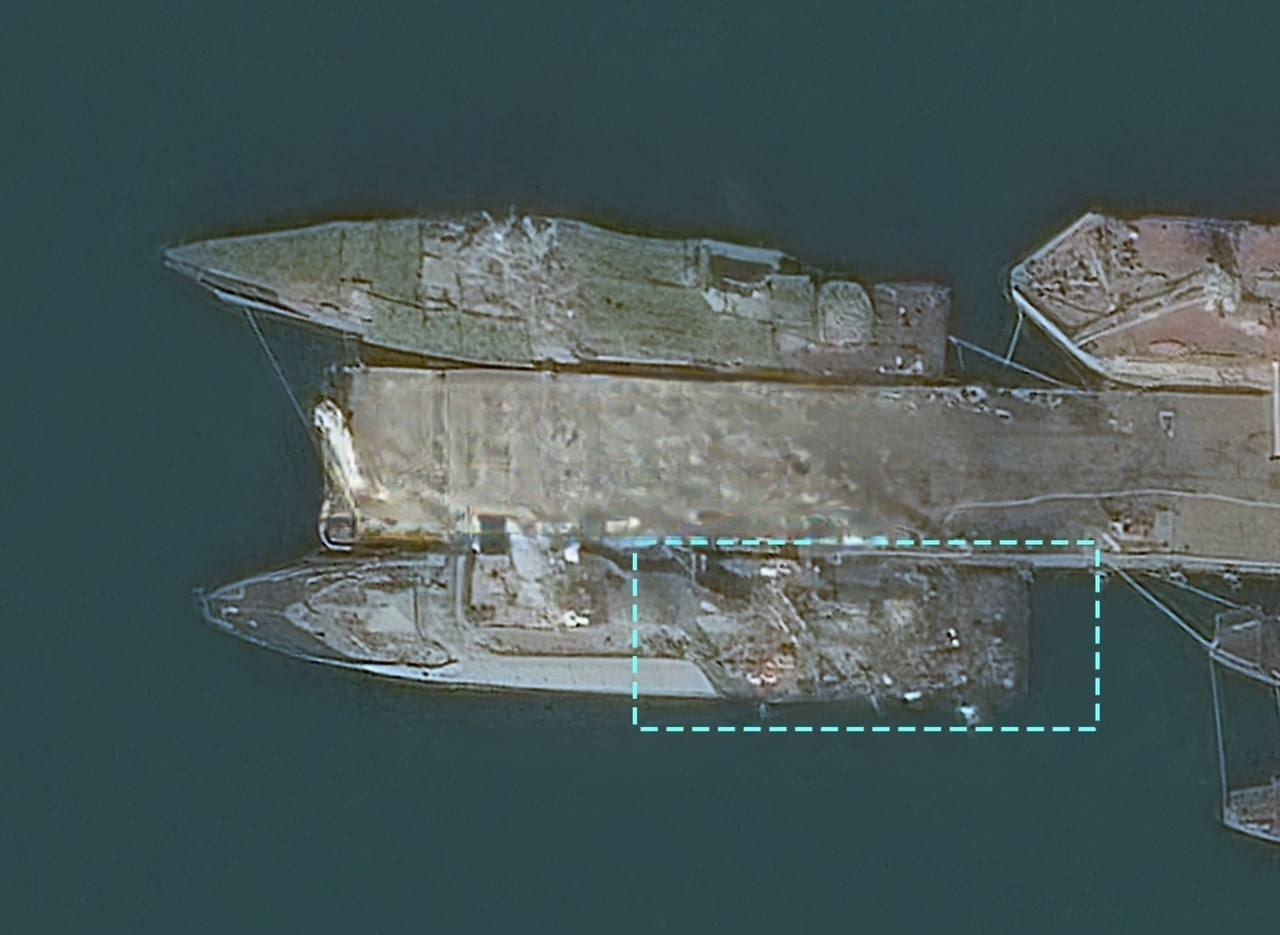
After the strike on Novorossiysk on the night of 8–9 September, the OSINT project Exilenova+ published satellite imagery of the damaged ships, including a Buyan-M.[14] CyberBoroshno described it as “the Buyan-M that recently fired Calibers at Kyiv.”[15] No one gives its name or hull number. According to Defense Express, the ship's stern is “completely wrecked”: it houses the diesel machinery, so the ship is unlikely to move under its own power, and it could only be repaired at a specialised shipyard.[17]
The hit on a Buyan-M on 9 September has not been officially confirmed. The General Staff's list of ships hit that night names the minesweeper Zheleznyakov, the frigate Admiral Essen and the large landing ship Pyotr Morgunov.[16] Reports of the Buyan-M's “destruction” attributed to the General Staff are not borne out by the primary source.
Black Sea Group Commanders
Vyshniy Volochek
Ingushetiya
Grayvoron
Orekhovo-Zuyevo
Black Sea Group Summary
As of September 2026 the Black Sea Fleet effectively has three Buyan-Ms at Novorossiysk — Vyshniy Volochek, Ingushetiya, Grayvoron. Veliky Ustyug, transferred from the Caspian in 2022, returned to the Caspian after repairs and remains there. Orekhovo-Zuyevo — on the Baltic with no change of assignment.
Three Novorossiysk Buyan-Ms · Status
- Vyshniy Volochek — damaged 7 August 2025 due to collision with a tanker while executing an evasion manoeuvre from Ukrainian UAVs. Scope of damage not publicly assessed.
- Unidentified BSF Buyan-M — struck 28 August 2025 in Temryuk Bay by joint HUR Prymar operation. Specific ship not publicly named; likely one of the three Novorossiysk ships.
- Unidentified BSF Buyan-M — hit at Novorossiysk on 12 August 2026, per the General Staff.
- Unidentified BSF Buyan-M — hit on 9 September 2026, per OSINT assessment: stern wrecked. Not officially confirmed.
Whether the 2026 hits concern the same ship or two different ones, and which of the three remains operational, has not been established.
§ 03 · CaspianThe Closed-Sea Flotilla: The 2015 Trio and the Phantom That Went to the Black Sea
If the Black Sea foursome represents the newest 2018–2021 hardware, the Caspian Buyan-M group is, conversely, the oldest part of the series. Three ships — Grad Sviyazhsk, Uglich, and Veliky Ustyug — joined the Caspian Flotilla back in 2013–2014 and already in autumn 2015 became the face of the entire project: on 7 October 2015, this trio together with the Project 11661K missile frigate Dagestan fired Caliber missiles from the Caspian at ISIS positions in Syria — through Iranian and Iraqi airspace. This was the first combat Caliber-NK launch from a ship carrier ever, and the first public demonstration of why Russia needed an entire class of small missile ships on a landlocked sea.
The logic is the same as on the Azov: the ship need not leave its own basin. The Caliber-NK's range (estimated at 1,500–2,500 km against ground targets) covers most of Ukraine from the Caspian — from Kyiv to Dnipro and Zaporizhzhia.
Formally it is landlocked in a lake with no access to the world ocean; in practice — a stationary launch battery in Russia's deep rear, a thousand and a half kilometres from the nearest front line.Ukrainian analysts on the Caspian Flotilla, pre-2022
In 2018–2020 the flotilla was gradually relocated from Astrakhan (in the Volga delta) to Kaspiisk in Dagestan — closer to the open sea and farther from river limitations. Russia's MoD announced this in April 2018; the actual move began in December 2018; Kaspiisk received main base status in 2020. Kaspiisk would become a target of Ukraine's response in 2024.
Caspian as Launch Battery, 2022–2024
British military intelligence directly documented the flotilla's role: the Caspian Flotilla was most likely used for massed missile strikes against Ukraine in 2022, continuing with less frequent strikes in 2023–2024. Beyond missile launches, the unit also made a ground contribution — the Flotilla's 177th Separate Marine Infantry Regiment fought in Kherson and Zaporizhzhia oblasts.
The War Reaches the Caspian: Strikes Series 2024–2025
For over two years the Caspian remained an absolute rear for the Russian fleet — the most distant point from the front that Ukrainian weapons physically could not reach. This changed at the end of 2024, and since then the flotilla has been struck regularly.
Strikes on Kaspiisk · 2024–2026
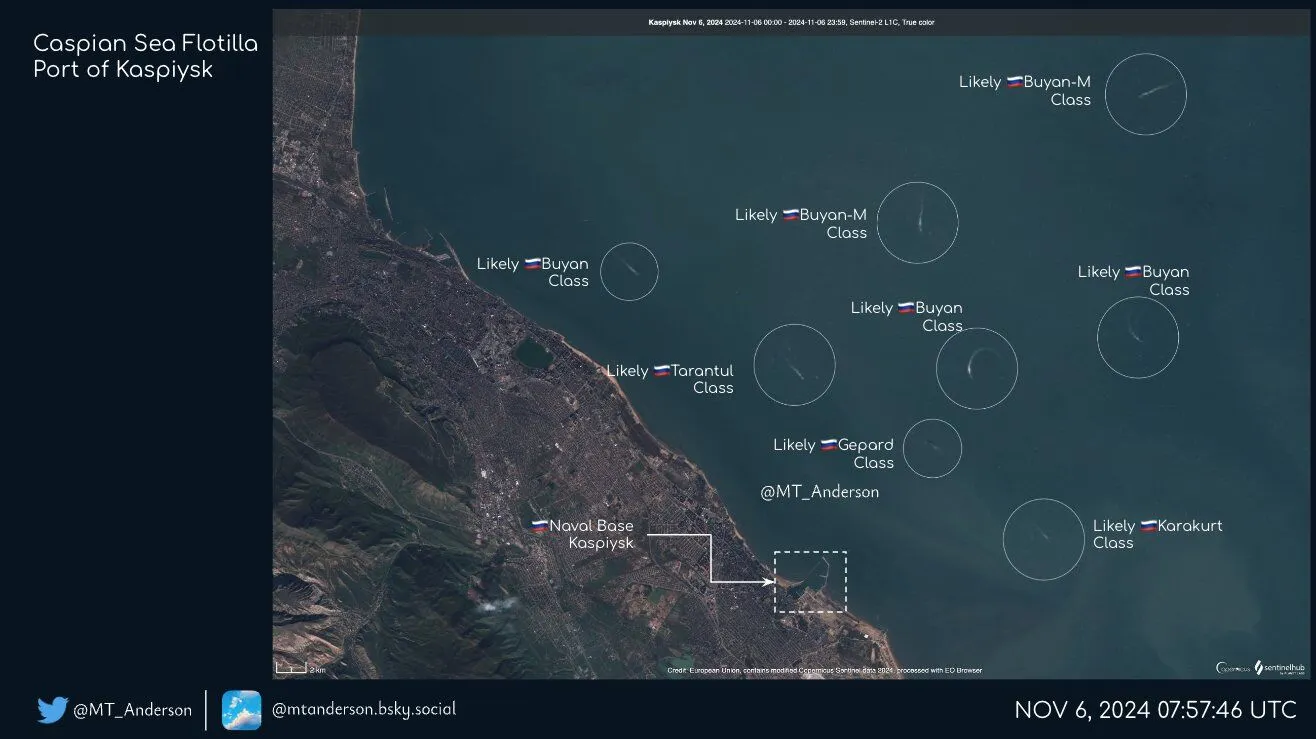
- 06.11.2024First kamikaze drone strike by HUR MO on the flotilla base; distance from the border ≈ 1,500 km. British MoD: "at least two, probably Gepard-class frigates" damaged (Tatarstan and Dagestan, Project 11661K). ISW and The War Zone noted via satellite two Project 21631 Buyan-Ms in port and suggested "several Project 21631 corvettes could also have been damaged" — at the level of supposition.
- 30.11.2024Repeat attack. Dagestan's head called the strike "ineffective"; Makhachkala airport operations were suspended. No confirmed ship damage.
- 01.12.2025Attack on the naval base. Per Dagestan's head, drones were shot down over Kaspiisk; civilian infrastructure was damaged. No confirmed ship damage.
- 11–19.12.2025Focus shifted from ships to oil production and transport: Filanovsky Platform (11.12), vessels Compositor Rakhmaninov and Askar-Sarydzha (12.12), Korchagina Platform (12 and 15.12), patrol ship Project 22460 Okhotnik (19.12). All targets over 900 km from the border.
- 15.05.2026Per Exilenova+ monitoring channel — prolonged explosions in Kaspiisk, likely a warship or ships struck, over 30 servicemen reportedly wounded. No official confirmation of ship damage.
- 17.05.2026Ukraine's Unmanned Systems Forces officially confirmed striking border patrol vessel Project 10410 Svetlyak (≈ 375 t, FSB Border Service) — not a Buyan-M.
The peculiarity of the Caspian series of 2024–2025 strikes is that not once did they yield a confirmed strike on a specific Project 21631 Buyan-M. The main documented targets in November 2024 were Gepard frigates; Project 21631 MRKs appear only as "possibly damaged." British intelligence also noted that the ships damaged at Kaspiisk were unlikely to have been used for direct strikes on Ukraine — meaning the effect of these operations was primarily demonstrative[10].
Caspian Buyan-M Commanders · Reference Directory
Veliky Ustyug
Grad Sviyazhsk · Lead Ship of the Series
Uglich
Caspian Summary
As of May 2026, the Caspian Buyan-M group remains in the flotilla: Grad Sviyazhsk and Uglich are active in the Caspian; Veliky Ustyug returned to Caspian reports in late 2023 after its Black Sea repair and is also listed as active; Stavropol is completing the series. No confirmed destruction of a Caspian Buyan during the war — unlike the Black Sea group, the flotilla has not lost MRKs, and the only documented strike on a flotilla ship (Veliky Ustyug, 2022) occurred outside the Caspian, on the Black Sea-Azov theatre.
§ 04 · BalticThe Rear Group: Four Ships, One Sabotage, and Geography That Prevents Shooting
The Baltic Buyan-M group is the most distant from the war theatre against Ukraine, and that is precisely why its role is fundamentally different from the Black Sea or Caspian groups. Not a single Baltic Buyan-M has carried out a confirmed combat Caliber launch against Ukrainian targets throughout the entire full-scale war. Not because of technical limitations — the Caliber-NK's range of 1,500–2,500 km would theoretically allow coverage of most of Ukraine from the Baltic — but most likely because of the geographic risks of flying a missile over a large swath of Russia's European territory.
The Baltic group exists as two parallel storylines: routine service with training Caliber launches at test ranges — and two documented operations by Ukrainian special services that put two ships in the group out of action.
How the Baltic Foursome Was Formed
As of May 2026, four Project 21631 ships are effectively based on the Baltic Fleet: Zeleny Dol, Serpukhov, Grad, Naro-Fominsk. A fifth — Stavropol — is undergoing factory trials and is planned for delivery to the Baltic Fleet by end of 2026. Orekhovo-Zuyevo is additionally effectively based at Kronstadt, though its formal fleet assignment remains Black Sea (see § 02).
Stage 1, 2015–2016. The fourth and fifth ships of the series — Zeleny Dol (yard no. 634) and Serpukhov (yard no. 635) — joined the Black Sea Fleet on 12 December 2015. From 4 to 28 October 2016, both made a joint transfer from Sevastopol to Baltiysk with calls at Valletta (Malta) and Ceuta (Spain) — around Europe, not via inland waterways — and joined the Baltic Naval Base's 36th Missile Boat Brigade.
Stage 2, 2020. Zeleny Dol made an inter-fleet transit to the Northern Fleet, where it carried out a Caliber launch at the Colder Range (Arkhangelsk Oblast), and returned to Baltiysk in September via inland waterways through the White Sea-Baltic Canal — covering over four thousand nautical miles.
Stage 3, 2022–2023. Grad (yard no. 640) was accepted into the Baltic Fleet on 29 December 2022; Naro-Fominsk (yard no. 641) on 25 December 2023; Stavropol (yard no. 642) began factory sea trials on 23 December 2024.
Operation Rybalka: Fire on Serpukhov
The first documented episode of a Ukrainian operation against a Baltic Buyan-M — a fire on MRK Serpukhov on 7 April 2024 at the Baltiysk Naval Base in Kaliningrad Oblast. Details became known in July 2024, when HUR MO and the Freedom of Russia Legion held a joint press conference in Kyiv. The operation had the code name Rybalka and was prepared from 2023.
The executor — a Russian serviceman with the callsign "Gogha," a Baltic Fleet sailor who in 2023 contacted Ukraine's intelligence programme "I Want to Live" and began cooperating with the Freedom of Russia Legion. In the night of 7 April 2024 "Gogha" set fire inside the ship; per HUR's statement, the communications and automation systems of MRK Serpukhov were completely destroyed while the hull remained afloat. After the sabotage, the executor defected to Ukraine, taking secret documents from the ship's onboard and receiving status as a Legion volunteer.
The fact that the ship was burning means it remains afloat, but the modern technological equipment has been put out of action, and its repair will take a long time.
The Russian official side never publicly acknowledged the fire. First reports appeared in Ukrainian sources citing intelligence services — RBK-Ukraine, Suspilne — on 8 April 2024. Local Russian channels limited themselves to recording an emergency situation on one of the Baltiysk ships without naming the vessel or cause.
SOF Strikes Grad in Transit to the Caspian
The second Ukrainian operation against a Baltic Buyan-M occurred a year and a half after Rybalka — and in a fundamentally different geography: not at a base, but during an inter-fleet transfer. On 4 October 2025 at 04:31, a Special Operations Forces unit of the Armed Forces of Ukraine struck MRK Grad (hull number 575, Project 21631) on Lake Onega (Republic of Karelia, Russia). Per SOF's official statement, the strike hit the right section of the power plant compartment; the General Staff of the Armed Forces of Ukraine confirmed it in a separate briefing.[9]
The key detail: the ship was in transit from the Baltic to the Caspian Sea via the Volga-Baltic waterway (Neva — Lake Ladoga — Svir — Lake Onega — White Sea-Baltic Canal — Volga). That is, Russia was trying to transfer one of the Baltic Buyan-Ms to reinforce the Caspian Flotilla — most likely in response to Ukrainian strikes on Kaspiisk in 2024. Transit via inland waterways was traditionally considered relatively safe.
Grad was the youngest ship of the Baltic foursome: commissioned into the Baltic Fleet only on 29 December 2022. According to SOF, "one of Russia's newest and most modern ships."
Despite the damage, the ship may remain afloat but will not be able to launch missiles.Ukrainian analyst, commentary on Channel 24
Baltic Buyan-M Commanders · Reference
Serpukhov
Zeleny Dol
Grad
Naro-Fominsk
Stavropol
SummaryTwelve Ships, Three Theatres, and Geography as the Main Weapon
The Buyan-M series entered the war against Ukraine as the Russian Navy's main near-sea Caliber carrier — across three theatres, via internal waterways, across 4,000-kilometre transit routes. The war revealed the fleet's key structural vulnerability: a dependence on geography that weapons cannot replace. Black Sea ships either launch from Sevastopol (and got struck there) or transit to Novorossiysk, then Temryuk Bay — where they too got hit. Caspian ships fired from deep rear — but even the rear proved reachable. Baltic ships cannot fire at Ukraine at all due to geographical constraints, and two were put out of action by Ukrainian intelligence.
As of May 2026: of twelve ships in the series, three are effectively in Novorossiysk (BSF group, one damaged), four in the Caspian (one from the BSF group returning to the Caspian after repair), and four in the Baltic (Zeleny Dol, Naro-Fominsk, plus the damaged Serpukhov and Grad). In August–September 2026, strikes reached the Buyan-Ms at their Novorossiysk piers; which ships were hit has not been established. The geography that made the Buyan-M series so flexible — the ability to move between any theatre via Russia's inland waterways — proved to be simultaneously the system's main structural vulnerability: the ships cannot hide anywhere that is truly safe from Ukrainian strikes.
Sources
- BlackSeaNews monthly summaries, 2022; hull number 626 in the Russian Mediterranean grouping.
- Russian Ministry of Defence statement on Caliber launches from a Project 21631 MRK, 28 March 2022.
- Defence Blog, 17 June 2022, identification of Veliky Ustyug damage character based on airbase.ru photos.
- Crimean Wind Telegram channel, 13 October 2023; SBU source statements to UNN and Channel 24.
- Russian military documents of the 41st Missile Boat Brigade, published in open sources; collision of Vyshniy Volochek with tanker Nazan, 07.08.2025.
- HUR MO Ukraine footage of drone strike on BSF Buyan-M radar in Temryuk Bay, 28.08.2025.
- State Bureau of Investigations of Ukraine, notice of suspicion against Denys Sukhar under Art. 111 Part 1 of the Criminal Code (high treason), 27 June 2022.
- Channel One (Russia) report, January 2021, on Grayvoron commissioning ceremony; commander interview.
- SOF Command of the Armed Forces of Ukraine official statement, 04.10.2025; General Staff of the Armed Forces of Ukraine briefing, 04.10.2025.
- UK MoD Defence Intelligence — assessments of the strikes on Kaspiisk of 06.11.2024: damage, results and the operational significance of the attack; Planet Labs satellite imagery.
- General Staff of the Armed Forces of Ukraine. “Four enemy warships hit in Novorossiysk” · 12.08.2026.
- Ukrainian Air Force — overnight report for 19–20 August: eight Calibers, all shot down · Telegram · 20.08.2026. As reported by LIGA.net.
- Euromaidan Press. “Ukraine finally hit three Russian Kalibr ships on 12 August. On the 19th, an untouched one hit Kyiv” · 22.08.2026.
- Exilenova+. Satellite imagery of ships in Novorossiysk after the 9 September strike · Telegram · 10.09.2026. OSINT project.
- CyberBoroshno. Identification of a Buyan-M in Novorossiysk imagery · Telegram · 10.09.2026. OSINT project.
- General Staff of the Armed Forces of Ukraine. “Makhachkala sea port hit. Hits on three ships in Novorossiysk confirmed” · Telegram · 10.09.2026.
- Defense Express. “Can Russia repair the Buyan-M, Admiral Essen and Admiral Makarov hit by Neptunes — and, above all, where?” · 10.09.2026. In Ukrainian.